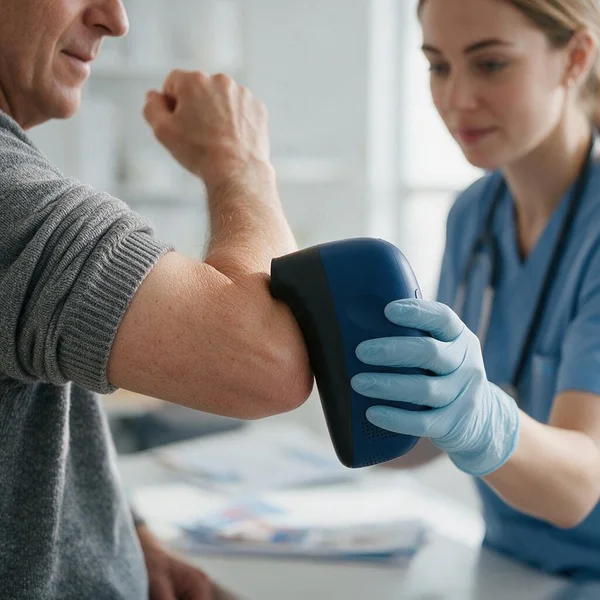
Chronic lateral epicondylalgia stalls in recovery because the extensor carpi radialis brevis (ECRB) tendon insertion lacks robust vascular perfusion, trapping micro-trauma in a hypoxic, nutrient-starved loop. Targeted 960nm photobiomodulation bypasses superficial skin layers to deliver concentrated photon irradiance directly into this dense avascular zone, restarting cellular repair and clearing inflammatory debris. Unlike oral anti-inflammatory drugs that carry significant gastrointestinal risks and liver metabolism burdens, targeted light therapy works purely through physical, non-invasive bio-stimulation. Pairing this optical approach with structured physiotherapy exercises tennis elbow recovery protocols offers an effective, non-pharmacological pathway to restore joint function.
The Daily Toll of Chronic Elbow Strain
When lateral epicondylalgia turns chronic, ordinary hand movements trigger sharp, debilitating pain that disrupts daily life.
The Morning Coffee Mug Slip: You reach out to lift a standard ceramic coffee mug, and a sudden, electric twinge fires across the outside bump of your elbow, forcing your grip to give out involuntarily.
The Door Handle Hesitation: Twisting a stiff brass doorknob or turning a car ignition key creates a shearing, grinding sensation along the upper forearm.
The Interrupted Workday: Holding a computer mouse, typing a detailed report, or tightening a plumbing fitting sets off a persistent, gnawing ache that radiates toward the wrist by mid-afternoon.
The Restless Night: Finding a comfortable sleeping position becomes a nightly struggle because resting your arm against the mattress exerts dull, throbbing pressure right on the irritated tendon insertion.
Most people cycling through traditional remedies for tennis elbow hit predictable barriers:
NSAIDs and Analgesic Pills: Over-the-counter painkillers temporarily mask pain receptors in the brain, but continuous use risks stomach lining irritation, ulcers, and kidney strain while doing nothing to reconstruct degenerated tendon fibers.
Steroid Injections: Cortisone shots frequently deliver rapid short-term numbness, yet extensive clinical data reveals they weaken tendon collagen over time, drastically increasing future relapse rates.
Surface Hot Packs and Liniments: Topical menthol gels and electric heating pads generate superficial cutaneous redness within the top 2 millimeters of skin, but their thermal energy never penetrates the deep, dense fibrous layers beneath.
Root Pathology: The Metabolic Stalemate of Tendon Degeneration
Discovering how to help tennis elbow permanently means recognizing that chronic tendon pain is rarely an acute inflammatory condition. It is a degenerative angiofibroblastic tendinosis locked in metabolic stagnation.
Repetitive Wrist Extension
           │
           ▼
Micro-Tears at Extensor Carpi Radialis Brevis (ECRB)
           │
           ▼
Local Capillary Collapse and Severe Tendon Hypoxia
           │
           ▼
Arrested Mitochondrial Respiration and ATP Depletion
           │
           ▼
Accumulation of Lactic Acid, Bradykinin, and Substance P
           │
           ▼
Chronic Pain Loop and Weakened Collagen Synthesis
The common extensor tendon origin is an anatomical “watershed zone” with sparse blood supply. Repetitive micro-tears cause localized swelling within a rigid connective sheath, crushing delicate capillary loops.
Without constant oxygen delivery, local tenocytes enter an energy crisis. Cells cannot generate the adenosine triphosphate (ATP) necessary to clear lactic acid, bradykinin, and Substance P, leaving sensitive nerve endings bathed in an acidic soup. Starved fibroblasts fail to produce organized Type I collagen, leaving behind fragile, scarred Type III tissue that tears again under minor mechanical load.
The 960nm Breakthrough: Rebuilding Deep Fibrous Tissue
To break this vicious cycle, therapeutic energy must reach the hypovascular tendon origin rather than stopping at the skin’s surface.
Penetration Physics: 960nm vs. Conventional Red Wavelengths
Standard consumer red light panels (630nm–660nm) and traditional near-infrared units (810nm–850nm) face distinct physical limitations. Shorter wavelengths scatter extensively in epidermal melanin, while 810nm is heavily absorbed by dermal microvascular hemoglobin.
The targeted 960nm wavelength falls within a specialized optical transmission window. It features low tissue scattering combined with balanced, controlled water absorption. This physical profile enables collimated photons to pass through skin, subcutaneous fat, and the thick fascial envelope, delivering therapeutic energy 30mm to 50mm deep directly into the ECRB tendon insertion.
The Mitochondrial Cascade: From Photons to Functional Repair
Upon reaching hypoxic tenocytes, 960nm photons trigger a well-documented physiological healing response:
Activation of Cytochrome c Oxidase: Photons are absorbed by Unit IV of the mitochondrial respiratory chain, photodissociating inhibitory nitric oxide (NO) from catalytic binding pockets.
Restoration of Cellular ATP: Relieved of nitrosative blockage, the electron transport chain resumes normal output, generating the ATP required for protein synthesis and cellular cleansing.
Microvascular Dilation: Released nitric oxide diffuses into local vascular walls, opening collapsed capillary beds and flushing trapped metabolic waste out of the tendon matrix.
Organized Collagen Synthesis: Energized tenocytes stop producing disordered scar tissue and begin laying down strong, linear Type I collagen fibrils along natural mechanical stress lines.
Modality Comparison: Evaluating Proven Approaches
Evaluation Parameter
Oral NSAIDs / Analgesics
Superficial Heat & 650nm Red Light
Targeted 960nm Deep Photobiomodulation
Tissue Penetration Depth
Systemic circulation (non-targeted)
1 mm to 3 mm (surface dermal layers)
30 mm to 50 mm (penetrates joint capsule & tendon origin)
Non-invasive, zero systemic toxicity, zero habituation
Home Usability
High (oral tablet ingestion)
High (passive warm compresses)
High (compact, handheld targeted administration)
Annual Cumulative Cost
$200 – $500 (ongoing prescriptions)
$40 – $120 (replacement pads & ointments)
Single hardware investment, shared long-term utility
Detailed Clinical Case Record
The following verified case tracks the application of targeted deep-tissue photobiomodulation in a patient suffering from recurrent, work-limiting lateral epicondylalgia.
Parameter
Documented Clinical Details
Patient Profile
Male, 51 years old, Master Electrician & Weekend DIY Carpenter
Primary Diagnosis
Stage 3 Lateral Epicondylalgia (ECRB Insertion), Right Dominant Arm
Baseline Symptoms
Severe grip deficit, localized point tenderness, pain score VAS 8/10 when using wire strippers
Twice-weekly 10-minute preventive sessions; zero relapses documented at 12-month checkup
An Honest Patient Perspective
“Carrying my heavy electrical tool bag from the truck to the job site felt like someone was driving a sharp nail right through the outside edge of my elbow. I’d already blown through bottles of ibuprofen that upset my stomach, and the forearm strap was just a temporary bandage. When I started using the 960nm device, the difference in sensation was obvious right away. It’s not a cold laser, and it’s not a burning pad either—it gives off this soothing, deep, soaking warmth that feels like it penetrates straight down into the joint capsule. By the fourth week, I could use heavy pliers and lift a full gallon paint can without a second thought. It gave me my livelihood back.”
Clinical Reality: Sensations, Eligibility, and Safety Boundaries
Understanding what to expect ensures proper compliance and steady, realistic recovery:
Sensory Experience: Patients experience a comfortable, deep-soaking warmth. It is a non-cold, photo-thermal therapeutic process with no tingling, electric shocks, or needle-like skin sensations.
Appropriate Candidates: Ideal for individuals managing chronic, recurrent elbow pain, golfer’s elbow, tendon insertion strains, and repetitive strain injuries from desk work or manual trades.
Contraindications: Do not apply over active malignant tumors, suspected cancerous lesions, directly across the thyroid gland, over the pregnant abdomen, or over implanted electronic medical devices such as pacemakers. Avoid application over active hemorrhages or acute open wounds.
Progressive Recovery Timeline and Economic Analysis
[Weeks 1 - 2: Microvascular Induction]
- Nitric oxide release opens compressed micro-capillaries
- Forearm tightness and morning stiffness decrease by 30% to 40%
- Baseline resting ache diminishes from severe to manageable
                         │
                         ▼
[Weeks 3 - 4: Active Cellular Remodeling]
- ATP synthesis accelerates tenocyte collagen output
- Organized Type I collagen replaces fragile Type III scar tissue
- Functional grip strength returns during common daily tasks
                         │
                         ▼
[Long-Term: Structural Maintenance]
- Weekly or bi-weekly 10-minute touch-up sessions
- Flushes out metabolic waste from repetitive physical tasks
- Prevents chronic relapse loops during heavy workloads
The Financial Equation: Clinic Visits vs. At-Home Care
Outpatient physiotherapy clinics typically bill between $90 and $180 per visit. Over a standard 10-to-12-week rehabilitation course (consisting of 20 to 30 clinical sessions), copays and out-of-pocket costs regularly exceed $1,800 to $3,600—before factoring in travel time, parking fees, and time off work.
A certified at-home 960nm system provides significant long-term savings. The one-time hardware investment delivers unlimited, on-demand sessions in the comfort of your home, while offering shared value for family members managing joint stiffness, tendonitis, or everyday muscular aches.
Combining Light with Daily Home Care
To secure lasting tendon resilience, combine targeted light therapy with functional physical therapy exercises. Begin by cleansing the skin over the lateral elbow. Hold the emitter directly against the most tender tendon insertion point for 10 to 12 minutes to boost microcirculation and prime cellular ATP.
Once the area feels warm and flexible, transition into your mechanical loading routine:
Eccentric Wrist Drops: Rest your forearm on a flat table with your wrist extended over the edge, palm down. Using a light 1- to 2-pound weight, lift the weight with your uninjured hand, then lower it slowly using only the affected wrist over a 4-second count. Complete 3 sets of 10 repetitions.
Forearm Pronation/Supination: Hold a lightweight hammer near the head. Slowly rotate the handle from side to side in a controlled arc to strengthen rotational stabilizers without overloading the extensor origin.
Finger Extension Resistance: Wrap a thick rubber band around the outside of your closed fingers. Slowly spread your fingers outward against the elastic resistance, hold for 2 seconds, and return smoothly.
To review clinical beam spot sizes, output energy density, and home protocol guidelines, explore the verified physiotherapy exercises tennis elbow equipment specifications.
Frequently Asked Questions
Can I perform my rehabilitation exercises immediately after using the 960nm device?
Yes, this sequence is ideal. The 960nm photobiomodulation session stimulates local microcirculation, boosts ATP production, and reduces resting joint stiffness. Performing controlled eccentric exercises right after light therapy allows you to complete your rehabilitation drills with greater range of motion and guides newly synthesized collagen fibers along natural tension vectors.
Why choose 960nm photobiomodulation over common cold laser therapy?
Cold laser systems often operate at lower power levels and shorter wavelengths, which struggle to reach deep, dense connective tissues without extensive application times. The 960nm system is a non-cold, deep-penetrating infrared modality that generates a gentle, endogenous warmth. This mild thermal effect works synergistically with photon delivery to dilate deep microvessels and relieve tight fascial structures.
How quickly will I notice my grip strength returning?
While resting muscular tightness and local point tenderness often ease within the first 7 to 14 days, measurable gains in grip strength generally appear between weeks 3 and 5. Reconstructing damaged collagen fibers and building cross-linked structural strength requires consistent biological remodeling over several weeks.
Chronic lateral epicondylalgia persists because the common extensor tendon origin is an avascular watershed zone, trapping micro-tears in metabolic starvation. Targeted 960nm photobiomodulation directs therapeutic photon density deep into dense te...
Lateral epicondylalgia persists because repetitive mechanical tension triggers microvascular ischemia and angiofibroblastic degeneration at the common extensor tendon origin, locking dense connective fibers in an energy-starved state. While athlet...
Peripheral facial nerve palsy lingers because the inflamed seventh cranial nerve swells inside the narrow, unyielding Fallopian canal, crushing its own microvascular supply and trapping axons in metabolic paralysis. Targeted 960nm photobiomodulati...
 Handheld Home-Use Therapy Device