 家庭用携帯型治療機器











960nmのターゲット型PBMを用いたアレルギー性鼻炎の治療
33持続的な鼻づまり、目のかゆみ、そして朝に絶え間なく続く鼻水は、粘膜組織の腫れと微小血管の血流の停滞によって、鼻腔内に物理的なボトルネックが生じているために続いています。毎日の抗ヒスタミン薬やステロイド点鼻薬は…….
詳細を見る商品を検索投稿を検索
Persistent joint stiffness and cartilage tenderness often stem from a deep, stagnant microcirculatory bottleneck inside dense synovial capsules. Targeted 960nm photobiomodulation penetrates straight through periarticular connective tissue to kickstart cellular respiration, clear localized hypoxia, and assist standard 関節リウマチの治療 plans without systemic organ burden. Because it operates through photon-driven energy transfer rather than liver metabolism, it bypasses gastrointestinal degradation and drug-interaction hazards completely.
Waking up shouldn’t feel like negotiating with concrete. For people navigating chronic inflammatory flare-ups, the earliest hours of the day are often the hardest. Fingers refuse to wrap around a coffee mug, stepping out of bed sends sharp warnings through rigid ankles, and even buttoning a shirt demands painful mental calculus.
Over time, that physical grind takes an emotional toll:
Standard approaches leave plenty of gaps. NSAIDs mask nociceptive signals temporarily, yet continuous use strains stomach linings and kidney markers. Topical sprays wear off in hours. Conventional electric heating pads feel soothing on skin, but their long-wavelength infrared energy dissipates within the first 1 to 2 millimeters of dermal tissue—failing to reach congested joint capsules where real swelling persists.
When looking at systemic conditions like psoriatic arthritis treatment and erosive arthritis, chronic inflammation isn’t simply a feeling of heat—it is a localized bioenergetic breakdown.
Immune Complex Buildup
       │
       ▼
Capillary Hypoperfusion & Endothelial Swelling
       │
       ▼
Severe Tissue Hypoxia (Low O2)
       │
       ▼
Mitochondrial ATP Depletion & Lactic/Proton Accumulation
       │
       ▼
Sensitized Synovial Nerve Fibers & Sustained Stiffness
In inflamed synovial joints, microvascular beds become compressed by stagnant fluid. This swelling chokes off oxygen supply. Deprived of oxygen, local cells fail to produce adequate adenosine triphosphate (ATP).
Instead of flushing waste, the tissue pools lactic acid, inflammatory prostaglandins, and cellular debris. Surface-level warmers cannot shift this dense, hypoxic fluid pocket. Without restoring microcapillary transport, joint structures stay trapped in chronic, self-reinforcing stiffness.
Not all light therapy delivers the same physical impact. While popular 630nm or 660nm red wavelengths work well for superficial skin tone and superficial collagen, their photon energy is rapidly absorbed and scattered by melanin and superficial hemoglobin. Even popular 850nm wavelengths face distinct scattering limitations across dense fibrous tissue.
Wavelength Penetration Comparison:

Skin Surface  ═══════════════════════════════════════
0 - 2 mm:     [660nm Red Light] ── Absorbed by melanin & superficial blood
2 - 5 mm:     [850nm Near-Infrared] ── Diminishes through subcutaneous fat
5 - 15+ mm:   [960nm Targeted Band] ── Low-scatter window reaches deep synovial capsule
              ═══════════════════════════════════════
The 960nm near-infrared band sits in an optical transmission window characterized by lower scattering across dense, collagen-rich tissues. This lets light penetrate directly into joint cavities, dense tendons, and periosteum.
Once photons arrive at the target cells, they set off an evidence-backed physiological cascade:
The table below contrasts targeted photobiomodulation against conventional daily joint management options:
| 次元 | Oral NSAIDs & Counter-Irritant Sprays | Traditional Heating Pads / 660nm Red Light | 960nmを標的とした光生体調節 |
| 組織への浸透深度 | Systemic distribution via bloodstream (non-targeted) | Superficial dermis only (1–3 mm max) | Deep connective structures (10–20+ mm direct reach) |
| 細胞のメカニズム | Blocks COX-1/COX-2 enzymes; blunts pain signaling | Temporary superficial thermal vasodilation | Stimulates mitochondrial ATP; clears local hypoxia |
| 副作用/依存リスク | Elevated risk of gastric ulcers, liver strain, rebound | Mild skin irritation or superficial burn risk | None; non-ionizing, non-thermal photic response |
| ホームのユーザビリティ | High (simple swallow or spray) | High, but limits mobility during use | High; cordless, handheld point-to-point application |
| 1年間の費用 | $400 – $1,200+ ongoing recurring expense | $40 – $150 (limited functional value) | One-time device cost with zero consumable fees |
Tracking patient outcomes using objective, standardized functional scores shows how targeted phototherapy works alongside standard rheumatoid arthritis treatments.
PATIENT & PROTOCOL PROFILE
----------------------------------------------------------------------
Patient ID:        RA-8820-F               Age / Sex:    54-Year-Old Female
Primary Diagnosis: Rheumatoid Arthritis     Stage:        Moderate-to-Severe
Target Sites:      Bilateral PIP & MCP     Baseline:     VAS 7.4 / Morning
                   Finger Joints                         Stiffness: 75 Mins
Protocol:          960nm Handheld PBM      Duration:     8 Weeks Continuous
----------------------------------------------------------------------
| Parameter / Milestone | ベースライン(0日目) | Week 2 Checkpoint | Week 4 Checkpoint | Week 8 Evaluation |
| VAS Pain Score (0–10 Scale) | 7.4 / 10 | 5.8 / 10 | 3.6 / 10 | 2.1 / 10 |
| Morning Joint Rigidity | 75 minutes | 45 minutes | 20 minutes | Under 10 minutes |
| Grip Strength (Dynamometer) | 11.2 kg (Dominant) | 13.8 kg | 18.1 kg | 22.4 kg |
| Daily Session Duration | 10 mins / joint group | 10 mins / joint group | 8 mins / joint group | 5 mins maintenance |
| Concurrent Medication Load | Daily NSAID + DMARD | Daily NSAID + DMARD | NSAID reduced 50% | DMARD only (Physician Approved) |
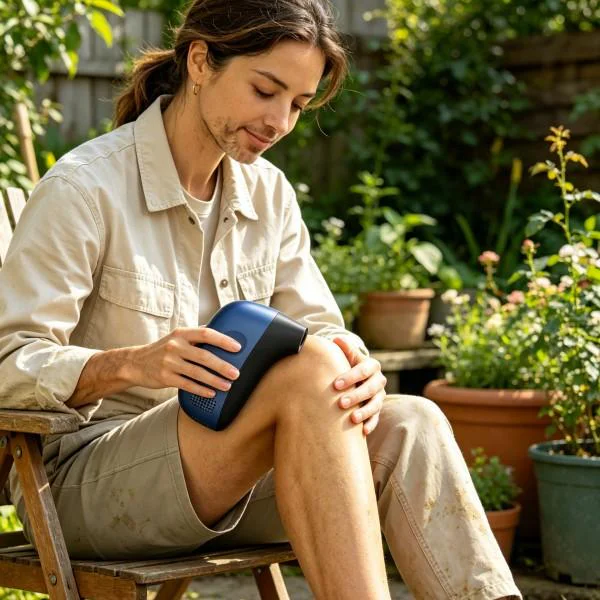
“By week three, the change was obvious when I started my mornings. For years, turning the key in the front door or unscrewing my travel mug sent sharp pains down my thumbs. It felt like holding a warm, gentle sunbeam directly against my knuckles—no buzzing, no stinging, just a steady, soothing warmth deep inside. By the end of the second month, I could spend Sunday mornings potting plants in the garden without dreading how my hands would feel the next day.”
Understanding realistic usage parameters builds a sustainable daily routine.
Unlike high-intensity surgical lasers or electric muscle stimulators, a targeted 960nm device emits a steady, gentle deep-tissue warmth. It does not shock, vibrate, or scald. Most people experience a subtle loosening sensation across stiff tendons within 10 to 15 minutes of direct application.
While non-invasive and non-ionizing, photobiomodulation is not a universal fit:
Tissue recovery requires consistent biological time. Approaching care with clear milestones keeps recovery on track:
Relying entirely on out-of-pocket clinical physical therapy or specialized laser clinics adds up fast, often running between $75 and $150 per visit, alongside commuting time and waiting rooms. Equipping your home with dedicated hardware pays for itself in weeks, giving your whole household on-demand access to care whenever joints flare up.
Review the complete technical parameters, optical density specs, and direct joint application guides to select the right setup for your daily routine.
Can I use 960nm photobiomodulation alongside my prescribed DMARDs or biologics?
Yes. 960nm light acts locally on tissue mechanics rather than through systemic metabolic pathways. It does not alter circulating drug concentrations in your bloodstream. However, always let your rheumatologist know whenever you add any complementary modality to your existing routine.
How is 960nm different from the red-light panels sold for home skincare?
Cosmetic panels emit primarily 630nm to 660nm light. That energy is largely soaked up by the top layers of your skin to support surface collagen. To pass through thick skin, subcutaneous fat, and the fibrous capsule around a knee or knuckle, you need the low-scattering penetration of the 960nm infrared band.
How often should I use the device on a stiff joint?
For chronic joint stiffness, a consistent routine works best: aim for 10 to 15 minutes per target joint group once or twice a day during the first 3 to 4 weeks. Once comfort and range of motion stabilize, you can dial back to 3 to 4 maintenance sessions per week.
持続的な鼻づまり、目のかゆみ、そして朝に絶え間なく続く鼻水は、粘膜組織の腫れと微小血管の血流の停滞によって、鼻腔内に物理的なボトルネックが生じているために続いています。毎日の抗ヒスタミン薬やステロイド点鼻薬は…….
詳細を見るテニス肘が治りにくいのは、総伸筋腱の血流が悪く、活発に治癒する組織ではなく、変性した瘢痕組織へと変化してしまうためです。外側上顆に微小な断裂が蓄積すると、通常の安静療法では代謝に必要な...
詳細を見る960nmの光生体調節療法は、高密度の鼻軟骨を通して近赤外線のエネルギーを低酸素状態の呼吸器粘膜に直接届けることで、慢性的な上気道うっ血を改善します。一時的に腫れを収めるだけの従来の治療法とは異なり…….
詳細を見る慢性的な鼻づまり、顔面の圧迫感、そして繰り返す気道の炎症は、局所的な治療では届かない、粘膜の深部における血管のうっ血やリンパ液の循環不良に起因しています。一般的な抗ヒスタミン薬やコルチコステロイド点鼻薬は…….
詳細を見る