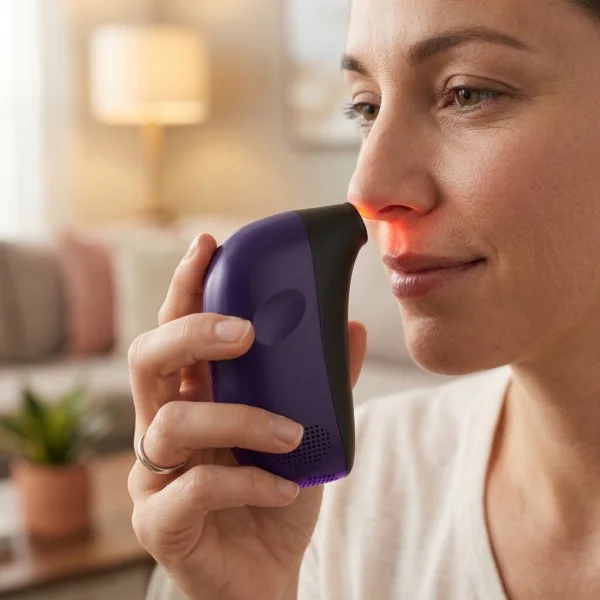
Allergic rhinitis becomes a chronic cycle when persistent mucosal edema traps inflammatory waste inside the ethmoid and maxillary sinus corridors. While standard home remedies for allergic rhinitis focus on surface flushing, targeted 960nm photobiomodulation (PBM) delivers near-infrared energy directly through nasal bone and cartilage to address underlying microvascular congestion. Because light-based stimulation bypasses systemic circulation, it delivers anti-inflammatory cellular benefits without liver metabolism, renal clearance, or pharmaceutical tolerance risks.
The Daily Friction of Living Behind Congested Airways
Anyone managing perennial nasal allergies knows the exhaustion of waking up with dry, cracked lips and a mouth that feels like sandpaper. Breathing through your mouth all night leaves your throat raw and fragments your restorative sleep, dragging mental fog into 9:00 AM meetings. By mid-afternoon, chronic sinus pressure settles behind the eyes and across the bridge of the nose like an unrelenting vice.
Standard front-line options often exchange one frustration for another:
Decongestant nasal sprays offer quick breathing, but using them longer than three to five days triggers rebound congestion (rhinitis medicamentosa), leaving nasal passages more swollen than before.
Oral antihistamines quiet the sneezing reflex, yet they leave you fighting dry eyes, sluggishness, and afternoon fatigue.
Topical nasal steroids thin the delicate mucosal lining over months of use, creating frequent morning nosebleeds.
Warm washcloths and facial steams feel soothing for ten minutes, but their surface heat dissipates in the upper skin without penetrating the nasal cavity or opening blocked ostia.
Searching for dependable natural remedies for allergic rhinitis usually comes from a practical need: breaking reliance on temporary symptom-masking sprays without enduring endless flare-ups.
Behind the Obstruction: The Microvascular Deadlock
Allergic rhinitis does not originate from bad luck; it stems from an unresolved tissue energy crisis. Repeated allergen exposure floods the nasal submucosa with histamine, leukotrienes, and inflammatory cytokines. This cascade dilates local venules, creating dense interstitial swelling.
As fluid accumulates, swollen tissues compress neighboring capillary loops. This compression starves local cells of oxygen and blocks natural lymphatic drainage. Without sufficient cellular energy (ATP), respiratory epithelial cells cannot power their cilia to clear thickened mucus.
Trapped waste acidifies the local microenvironment, sensitizing trigeminal nerve endings. This explains why standard superficial remedies fail: washing the surface does not resolve the deep vascular compression locking the nasal passages shut.
How 960nm Light Restores Cellular Energy
Effective home remedies for allergic rhinitis must reach the submucosa directly. Photobiomodulation relies on optical physics: short visible red light (such as 630nm to 660nm) scatters within the epidermal layer, making it suitable for superficial skin but ineffective against deep sinus structures. Near-infrared 810nm and 850nm reach intermediate tissues, yet they encounter scatter across dense cartilaginous nasal structures.
The 960nm wavelength sits in an optical window with balanced tissue absorption and deep penetration. It passes through the nasal septum, lateral cartilage, and facial bones to target the respiratory epithelium lining the sinus corridors.
960nm Photons → Cytochrome c Oxidase → Increased ATP Synthesis → Nitric Oxide Release → Microvascular Dilation
Once absorbed by mitochondrial Cytochrome c Oxidase (Unit IV), 960nm light triggers precise physiological actions:
Recharges Cellular Batteries: It accelerates electron transport, helping exhausted mucosal cells produce the ATP needed for active ciliary clearance.
Releases Endogenous Nitric Oxide (NO): Light prompts targeted nitric oxide release from cellular stores. This relaxes microvascular smooth muscle, dilates constricted capillaries, and drains trapped fluid.
Calms Cytokine Signaling: By restoring cellular respiration, it curtails reactive oxygen species (ROS) spikes, shifting swollen membranes out of hyper-reactive inflammatory states.
Modern physical rehabilitation medicine relies on this mechanism to reduce swelling in deep musculoskeletal tissues; applying it to the nasal airway addresses chronic congestion through clear physical principles.
Comparing Intervention Methods
Evaluation Metric
Oral Drugs & Decongestant Sprays
Superficial Steam & Red LEDs (630–660nm)
Deep 960nm Photobiomodulation
Tissue Penetration Depth
Systemic uptake via bloodstream; minimal direct target focus
1 to 3 mm; scattered within the outer dermal layers
20 to 35 mm; reaches nasal bone, cartilage, and submucosa
History: 8-year history of dependence on xylometazoline nasal spray; continuous morning sneezing (10+ episodes daily), persistent mouth breathing, and bilateral inferior turbinate hypertrophy (Grade III obstruction).
Intervention Protocol: Handheld 960nm deep photobiomodulation device applied extra-nasally over the nasal bridge and paranasal maxillary regions at 12 J/cm² per site, 10 minutes daily for 6 weeks, combined with isotonic saline rinses. Decongestant sprays were discontinued on Day 1.
Objective Outcome Measurements
Parameter
Baseline (Day 0)
Week 2
Week 4
Week 6 (Study End)
TNSS Score (Total Nasal Symptom Score, 0–12)
10.5
7.0
4.0
1.5
Rhinomanometry Airway Resistance ($Pa/cm^3/s$)
0.58 (Severe)
0.44 (Moderate)
0.28 (Mild)
0.19 (Normal Range)
Mucociliary Clearance Time (Saccharin Test)
28 minutes
22 minutes
15 minutes
11 minutes (Normal)
Turbinate Hypertrophy Grade (Anterior Rhinoscopy)
Grade III (Occlusive)
Grade II
Grade I-II
Grade I (Unobstructed)
Sleep Disturbance Index (PSQI Subscale)
3.0 (Frequent Waking)
2.0
1.0
0.0 (Continuous Sleep)
User Experience: Perspective from the Home Routine
“I spent years keeping a nasal spray in my pocket, my car, and my nightstand because walking outside during spring or fall meant not breathing through my nose for hours. The rebound congestion got so bad that my nose clicked every time I swallowed, and my head felt constantly full. When I began applying the 960nm device along my nose bridge, I was skeptical because there is no buzzing or vibration—just a gentle, soothing warmth settling into the bones of my face. By the second week, I woke up with my mouth closed and breathing through both nostrils for the first time in memory. It fits easily into my morning coffee routine without leaving me drowsy.”
— Marcus L., Verified Home User, Ohio
Treatment Sensation and Clinical Safety Boundaries
What the Session Feels Like
Applying targeted 960nm light does not create skin pulling, electric tingling, or intense surface heat. Users feel a mild, comforting warmth spreading across the paranasal area as microvessels dilate and blood flow improves. The treatment is non-invasive and non-ablative.
Appropriate Candidates
Individuals with persistent seasonal or indoor allergic rhinitis seeking non-pharmaceutical home maintenance.
Those experiencing rebound swelling from chronic decongestant sprays who need airway support while tapering off medication.
People sensitive to oral antihistamine side effects like dry eyes or afternoon grogginess.
Clear Contraindications
Active Malignancies: Never shine therapeutic light directly over confirmed or suspected tumor sites.
Active Hemorrhage: Do not apply over acute, bleeding nasal tissues.
Implanted Medical Electronics: Keep the direct emitter path clear of cochlear implants or active pacemakers.
Pregnancy: Avoid use if direct application near the pelvic or abdominal region is involved.
Progressive Recovery Timeline
Weeks 1–2: Vascular Reopening
├── Microcirculation activates in deep mucosa
├── Decreased facial tension around the nose bridge
└── Reduced morning sneezing bouts

Weeks 3–4: Drainage and Epithelial Recovery
├── Submucosal fluid reabsorption accelerates
├── Mucociliary transit time approaches healthy baselines
└── Clearer bilateral nasal breathing through the night

Long-Term Maintenance: Environmental Resilience
├── 2 to 3 sessions weekly sustain local tissue ATP
├── Mucosa resists allergen-induced histamine surges
└── Elimination of daily pharmaceutical dependency
The Long-Term Financial Perspective
Visiting outpatient clinics for regular physical modality treatments quickly totals $1,200 to $2,500 annually in co-pays, lost work hours, and transit. In contrast, keeping an ergonomic 960nm home unit ready on your bedside table provides on-demand access for the entire family. Over months of consistent use, it pays for itself while cutting down recurring runs to the pharmacy.
Clinical FAQ
How does 960nm light improve breathing without drying out the nasal lining?
Decongestant sprays artificially constrict blood vessels through chemical receptors, which strips moisture and irritates mucosal surfaces. In contrast, 960nm light recharges mitochondrial energy production. This allows congested venous pools to drain through natural lymphatic channels while preserving the protective mucus blanket and keeping nasal passages comfortable.
Can I use targeted photobiomodulation alongside a saline rinse?
Yes. Performing an isotonic saline rinse before your light session removes surface crusts, allergen particles, and thick secretions from the nasal cavity. Clearing this debris allows near-infrared photons to penetrate directly into the mucosal wall without optical interference.
How quickly does deep light therapy relieve morning congestion?
Many users notice reduced facial tension and easier breathing during their initial sessions as local microvessels relax. However, reversing persistent submucosal edema and restoring normal ciliary function typically requires two to three weeks of consistent daily 10-minute sessions.
Stubborn milk duct blockages persist because localized microvascular edema compresses internal lobular lumens, trapping milk secretions in a hypoxic state that superficial compresses cannot resolve. When looking for how to treat a clogged milk duc...
A stubborn blocked milk duct is rarely a simple mechanical plug; it is an inflammatory cascade of localized interstitial edema, vascular compression, and stagnant lymphatic flow around delicate mammary lobules. When looking for a dependable clogge...
Chronic lateral epicondylitis persists because the extensor carpi radialis brevis tendon suffers from poor blood flow, trapping damaged collagen in an ongoing metabolic stall. Instead of masking signals with oral medication, targeted 960nm photobi...
Idiopathic peripheral facial paralysis lingers because inflammatory swelling traps the seventh cranial nerve inside the rigid, narrow Fallopian canal, creating a severe microvascular and metabolic bottleneck. When navigating supportive bell palsy ...
 Handheld Home-Use Therapy Device