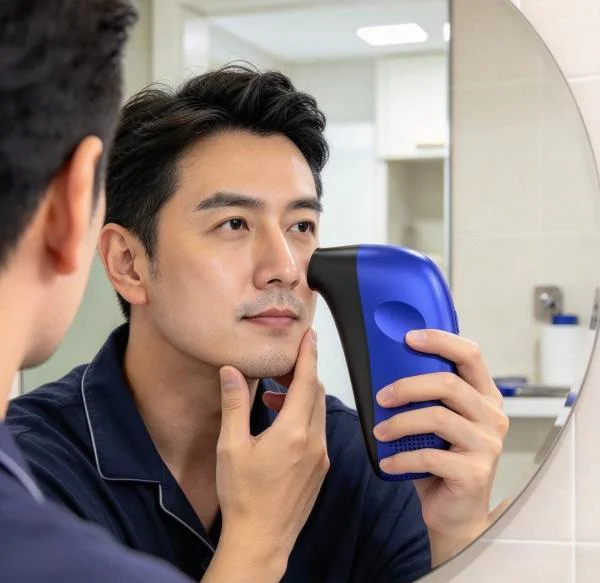
Facial nerve palsy persists because mechanical entrapment within the rigid fallopian canal chokes microvascular perfusion to cranial nerve VII, triggering perineural ischemia and conduction blocks that systemic oral steroids cannot always resolve. Patients researching how to treat facial nerve palsy discover that true recovery requires clearing deep inflammatory edema and restoring cellular bioenergetics rather than simply waiting for spontaneous axonal sprouting. Targeted 960nm photobiomodulation (PBM) delivers near-infrared photons through the temporal bone and stylomastoid foramen directly into ischemic neural tissue, reactivating mitochondrial ATP synthesis and clearing interstitial fluid. This non-invasive modality supports axonal regeneration without metabolic liver load, immunosuppression, or gastrointestinal ulceration.
The Daily Toll of Flaccid Paralysis and Impaired Enunciation
Living with unilateral facial nerve paresis turns everyday communication and nourishment into stressful, draining ordeals. Drinking coffee or tea demands continuous vigilance because liquid spills past the denervated corner of your lower lip if you tilt your head even slightly. The affected eye refuses to blink or close completely, leaving the sensitive corneal surface dry, burning, and prone to wind-induced abrasions that require ointment and nocturnal eye patches. At work, articulating crisp dental and labial sounds like p, b, and m becomes a strenuous effort, while smiling at colleagues produces an asymmetrical grimace that triggers self-consciousness. Behind the jawline, a dull, aching soreness lingers over the mastoid tip as a constant physical reminder of deep perineural compression.
Standard frontline strategies for facial nerve palsy often hit therapeutic ceilings:
High-dose oral corticosteroids suppress acute systemic inflammation, yet tapering them after ten days often leaves deep perineural fluid trapped within the bony canal.
Prescription oral antivirals target suspected viral reactivation, but provide zero biophysical stimulus to rebuild injured axonal sheaths or restore local capillary blood flow.
Aggressive electrical neuromuscular stimulation carries the documented clinical risk of misdirected axonal reinnervation, accelerating synkinesis and abnormal facial spasms.
Conductive warm compresses soothe surface skin receptors, but superficial thermal energy drops off within two millimeters of the epidermis, entirely failing to reach the stylomastoid trunk deep behind the jaw.
The Root Pathological Gridlock: Microvascular Ischemia in the Fallopian Canal
The primary obstacle in facial nerve palsy is an anatomical and bioenergetic bottleneck inside the petrous temporal bone. The facial nerve travels through the narrowest osseous tunnel in the human body. When viral reactivation or localized trauma sparks capillary hyperpermeability, the nerve sheath swells against unyielding bony walls.
This swelling rapidly exceeds the intraluminal pressure of the vaso nervorum, the microscopic capillary network nourishing the nerve. As microcirculation stalls, local oxygenation ($pO_2$) plummets. Deprived of oxygen, Schwann cells and axonal mitochondria exhaust their adenosine triphosphate (ATP) reserves. Fast axonal transport of neurotrophins stops, leaving muscle motor units denervated and facial muscles flaccid. Surface washes and oral tablets cannot relieve this closed-compartment ischemic strangulation.
960nm Photobiology: Bypassing the Petrous Bone and Dense Parotid Fascia
Delivering therapeutic photon density to the facial nerve trunk requires overcoming intense biological tissue barriers. Visible red light (630–660nm) absorbs heavily into epidermal melanin and microvascular hemoglobin, losing therapeutic energy in superficial skin. Shorter near-infrared light (810–850nm) scatters intensely across the dense collagenous parotid fascia and mastoid bone.
Targeted 960nm near-infrared radiation operates in an optimal optical window, achieving high photon transmission through dense fascial layers, tendon structures, and deep pelvic or cranial tissues:
Tissue Depth
 Dermal Surface   │ 650nm (Red Light)    ──► Quenched by epidermal melanin (<2mm)
                  │
 Parotid Fascia   │ 850nm (Short NIR)    ──► Scattered by dense fibrous capsule (3–5mm)
                  │
 Stylomastoid Core│ 960nm (Targeted Deep)──► Transmits through bone/fascia to nerve trunk (15–25mm)
                  ▼
The Biological Action Chain
Cytochrome c Oxidase Excitation: 960nm photons hit mitochondrial Complex IV, dislodging inhibitory nitric oxide and restoring the inner-membrane proton gradient.
ATP Synthesis Surge: Adenosine triphosphate production jumps, providing cellular ion pumps with the energy needed to reestablish osmotic balance and halt interstitial fluid leakage.
Endothelial Nitric Oxide Release: Photonic liberation of nitric oxide prompts regional microvascular vasodilation, opening collapsed capillaries and washing out acidic pain metabolites.
Lymphatic Decompression: Restored vascular outflow lowers interstitial hydrostatic pressure, allowing swollen nerve fibers to decompress within the canal and restoring axonal conduction.
Baseline Presentation: Sunnybrook Facial Grading System score of 35/100, retroauricular soreness behind the right mastoid (VAS 6.5/10), 3mm lagophthalmos preventing complete nocturnal eye closure, flat nasolabial fold, and noticeable speech slur. Standard 10-day oral steroid and antiviral courses finished at week 2 without motor progress across weeks 3 through 6.
Treatment Protocol: Application of a calibrated 960nm handheld photobiomodulation device over the right stylomastoid foramen, preauricular parotid border, and distal zygomatic/buccal branches, 10 minutes per session, once daily for 8 consecutive weeks alongside structured mirror re-education.
Longitudinal Progress Log
Treatment Phase
Application Frequency
Objective Metrics
Functional Observations & Symptoms
Baseline
Daily intake
House-Brackmann: Grade IV; Sunnybrook: 35
3mm lagophthalmos, severe mouth droop, continuous mastoid ache
Week 2
7 sessions/wk
House-Brackmann: Grade III; Sunnybrook: 55
Mastoid tenderness cleared; resting eyelid gap narrowed to 1mm
Week 4
7 sessions/wk
House-Brackmann: Grade II; Sunnybrook: 79
Complete voluntary eyelid closure; restored clarity in labial speech
Week 8
4 sessions/wk
House-Brackmann: Grade I; Sunnybrook: 95
Complete resting and dynamic symmetry; broad natural smile; zero synkinesis
“Six weeks after being diagnosed, my right eye still burned from staying half-open, and I was dribbling water down my chin during job-site meetings. Taking the steroids did nothing after the initial week, and the clinic told me I had to wait months and hope for the best. When I used the 960nm unit behind my ear, there was no sharp tingling or uncomfortable heat—just a deep, soothing warmth that stayed deep in the bone for hours. By the second week, that grinding ache behind my ear vanished, my eyelid closed on its own, and by the eighth week, my smile looked completely natural with zero abnormal twitches.”
Application Experience, Boundaries, and Medical Precautions
A session with a calibrated 960nm device produces a gentle, deeply comforting thermal sensation across the mastoid and parotid areas. Because this wavelength operates outside ionizing radiation and high-heat ablation spectra, there is zero electric shock, tissue burning, or surface stinging.
Safe Application Boundaries
Target Users: Individuals seeking non-pharmacological support for acute or post-acute Bell’s palsy, chronic facial nerve palsy recovery, persistent retroauricular soreness, and facial microcirculatory stagnation.
Strict Contraindications: Do not apply the light over active malignant lesions on the facial skin or neck, directly over eyes without dedicated protective eyewear, over areas with implanted electronic hardware (such as cochlear pacing units), or across acute hemorrhages.
Managing facial nerve recovery through recurring specialist neurology appointments, repeated outpatient physical therapy visits, and private speech therapy easily reaches $2,000 to $4,500 over several months, not counting lost working hours and emotional stress. Equipping your home with a certified 960nm handheld system provides targeted optical therapy with zero recurring refill expenses, delivering reliable daily support whenever facial stiffness or fatigue appears.
Consistent daily use provides calibrated optical power density and broad spatial coverage, clearing congested tissue beds and supporting long-term neuromuscular function across recovery milestones.
Frequently Asked Questions
Can 960nm light replace early corticosteroid prescriptions?
No. Standard medical protocol dictates that acute facial nerve palsy warrants immediate medical evaluation and systemic steroids within 72 hours of onset. Targeted 960nm photobiomodulation acts as a powerful non-invasive adjuvant that accelerates microvascular reperfusion and helps prevent long-term post-acute paralysis.
How does 960nm light differ from an ordinary heating pad?
Heating pads warm only the superficial skin layers, with thermal energy dissipating within 2 millimeters of superficial tissue. A targeted 960nm device emits near-infrared photons that travel 15 to 25 millimeters through dense tissue, directly stimulating cellular mitochondria.
Can using light therapy cause abnormal facial synkinesis?
Unlike aggressive electric stimulation which can hyper-excite misdirected motor nerves and cause involuntary muscle linking, 960nm photobiomodulation provides pure cellular bioenergetics to the native nerve trunk, supporting coordinated, natural axonal reinnervation.
Peripheral facial nerve palsy lingers because the inflamed seventh cranial nerve swells inside the narrow, unyielding Fallopian canal, crushing its own microvascular supply and trapping axons in metabolic paralysis. Targeted 960nm photobiomodulati...
Chronic allergic rhinitis persists when persistent submucosal swelling blocks natural ostiomeatal drainage routes, trapping inflammatory proteins within the nasal passages. While conventional home remedies for allergic rhinitis offer temporary sur...
 Handheld Home-Use Therapy Device