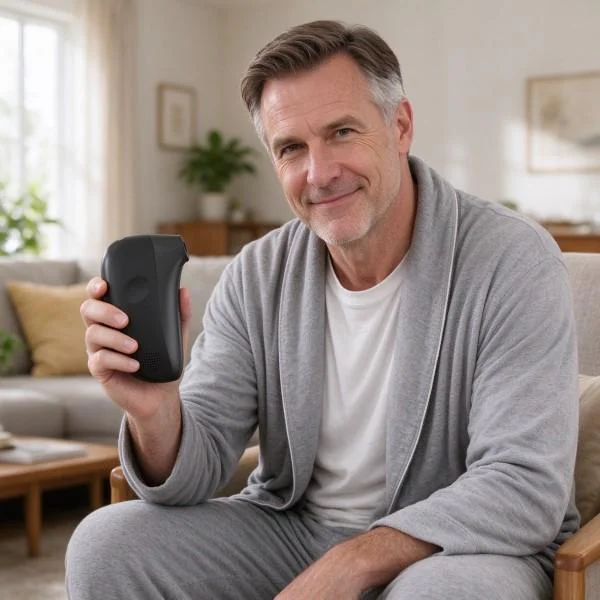
Chronic pelvic tension and benign urinary obstruction persist because a rigid anatomical capsule traps microvascular congestion, starving deep glandular tissue of oxygen and locking smooth muscle in spasm. While men search for a natural cure for enlarged prostate issues or wonder what is the treatment for prostatitis, typical supplements and pills fail to address this localized circulatory stagnation. Targeted 960nm photobiomodulation (PBM) delivers deep near-infrared photons through the perineal floor directly into congested parenchymal tissue, reigniting mitochondrial cellular respiration and clearing interstitial fluid. This physical therapy restores tissue metabolism without systemic hepatic breakdown, pharmaceutical sexual side effects, or drug tolerance.
The Daily Toll of Pelvic Aches and Broken Sleep
Pelvic congestion turns routine daily activities into quiet physical torment. You dread long car drives and sitting in office chairs because a relentless ache settles deep between your thighs, feeling like sitting on a hard golf ball. Nights are worse: waking up four to five times to urinate leaves you chronically sleep-deprived, only to produce a weak, hesitant dribble while standing over the bowl in the dark. The constant fear of bathroom proximity disrupts travel, cuts meetings short, and breeds a lingering frustration that drains your daily confidence.
Standard options evaluated when considering what is the best treatment for enlarged prostate or pelvic inflammation carry sharp real-world trade-offs:
Alpha-blockers relax bladder neck smooth muscle for modest flow gains, but frequently trigger orthostatic dizziness, nasal congestion, and retrograde ejaculation.
5-alpha reductase inhibitors gradually shrink stromal volume over six to twelve months, yet often cause long-term libido loss and erectile dysfunction that many men find unacceptable.
Non-steroidal anti-inflammatory drugs (NSAIDs) dampen acute soreness, but prolonged daily use risks severe gastric ulcers, kidney strain, and cardiovascular complications.
Sitz baths and surface heating pads provide brief surface comfort, but moist thermal conduction dissipates within the first two millimeters of skin, never penetrating the dense perineal musculature shielding the gland.
The Root Pathological Gridlock: Microcirculatory Collapse
Chronic non-bacterial pelvic inflammation and stromal hypervascular stagnation stem from a closed architectural trap. The prostate is encased within a dense, fibrous collagenous capsule. When local inflammatory signals or benign glandular proliferation trigger capillary hyperpermeability, excess plasma leaks into interstitial spaces faster than low-pressure venous loops and lymphatics can evacuate it.
This swelling builds substantial hydrostatic pressure against low-pressure venous plexuses. As localized blood flow drops, tissue oxygen tension ($pO_2$) plummets. Deprived of oxygen, prostatic smooth muscle and stromal cells suffer adenosine triphosphate (ATP) depletion, locking pelvic floor muscle fibers into chronic contraction. Surface heat and oral pills wash past or float atop this stagnant biological dead zone, leaving the deep hypoxic core untouched.
960nm Photobiology: Piercing the Dense Perineal Barrier
Reaching deep pelvic structures requires overcoming intense tissue attenuation. Standard visible red light (630–660nm) absorbs rapidly within epidermal melanin and dermal hemoglobin, dissipating in the upper cutaneous layers. Shorter near-infrared wavelengths (810–850nm) suffer heavy optical scattering across the dense, fibrous perineal connective tissue and deep pelvic floor musculature.
Targeted 960nm near-infrared radiation operates within an optimal optical window, achieving balanced tissue penetration through dense fascial layers, tendon structures, and deep pelvic tissues:
Tissue Layer
 Perineal Skin    │ 650nm (Red Light)    ──► Quenched by epidermal melanin (<2mm)
                  │
 Pelvic Fascia    │ 850nm (Short NIR)    ──► Scattered by dense fibrous collagen (3–5mm)
                  │
 Prostatic Stroma │ 960nm (Targeted Deep)──► Transmits through fascia to deep tissue (15–25mm)
                  ▼
The Intracellular Healing Cascade
Cytochrome c Oxidase Excitation: 960nm photons hit mitochondrial Complex IV, displacing inhibitory nitric oxide and restoring the inner-membrane proton gradient.
ATP Synthesis Surge: Adenosine triphosphate production jumps, giving cellular ion pumps the energy needed to restore osmotic equilibrium and halt ongoing interstitial fluid leakage.
Endothelial Nitric Oxide Release: Photonic liberation of nitric oxide prompts regional microvascular dilation, expanding collapsed capillaries and washing out acidic pain metabolites.
Lymphatic Decompression: Restored vascular outflow lowers interstitial hydrostatic pressure, allowing hyperplastic, boggy tissues to retract and relieving pressure on the urethral channel.
Modality Comparison: Managing Prostatic and Pelvic Symptoms
Evaluation Parameter
Daily Alpha-Blockers & 5-ARIs
Superficial Sitz Baths & Red Light Pads
Targeted 960nm Photobiomodulation
Tissue Penetration Depth
Systemic chemical circulation
1–3 mm (stops at perineal skin and superficial fat)
15–25 mm (transmits through dense pelvic floor fascia)
Cellular Mechanism
Receptor blockade; enzymatic hormone inhibition
Superficial thermal dilation
Cytochrome c Oxidase excitation, ATP restoration, microvascular flush
Side Effect & Tolerance Risk
High; sexual dysfunction, dizziness, medication dependency
Negligible; temporary cutaneous skin flushing
None; non-ionizing, non-thermal, zero hormonal disruption
Home Usability
High, but requires lifelong pharmacy refills
Moderate; messy water preparation or bulky sitz basins
Exceptional; ergonomic handheld session completed in minutes
Annual Financial Impact
$500–$1,200 on ongoing prescriptions and clinic visits
$40–$100 on basins, salts, and heating pads
Single equipment acquisition; zero recurring consumable fees
Baseline Presentation: International Prostate Symptom Score (IPSS) of 21/35 (severe category), National Institutes of Health Chronic Prostatitis Symptom Index (NIH-CPSI) score of 28/43, nocturia 4 to 5 times per night, severe perineal aching while seated. Past treatments included tamsulosin (discontinued due to severe orthostatic dizziness) and finasteride (discontinued due to pronounced loss of libido).
Treatment Protocol: Application of a calibrated 960nm handheld photobiomodulation device across perineal and suprapubic acoustic windows, 10 minutes per session, once daily for 8 consecutive weeks.
Longitudinal Progress Log
Treatment Phase
Application Frequency
Objective Metrics
Functional Status & Clinical Presentation
Baseline
Intake assessment
IPSS: 21; NIH-CPSI: 28; Nocturia: 4–5x
Severe sitting discomfort, fragmented sleep, weak interrupted stream
Week 2
7 sessions/wk
IPSS: 16; NIH-CPSI: 20; Nocturia: 3x
Perineal fullness eased; less straining required to initiate urination
Week 4
7 sessions/wk
IPSS: 10; NIH-CPSI: 12; Nocturia: 2x
Significant drop in pelvic tightness; continuous urine stream; sounder sleep
Week 8
4 sessions/wk
IPSS: 6; NIH-CPSI: 5; Nocturia: 0–1x
Normal urinary stream; painless prolonged sitting; daytime stamina restored
“Sitting through two-hour management meetings was pure agony, like perching on a hot brick. The prescription pills left me dizzy and killed my sex life, so I stopped taking them and just suffered through the night-waking. When I began using the 960nm device, there was no pinching or stinging—just a soothing, deep thermal warmth soaking through the pelvic base. By week four, the heavy fullness between my legs was gone, I was sleeping through until 5:00 AM without waking, and my stream was strong again. It gave me my daily life back.”
Application Sensation, Operational Boundaries, and Precautions
A session with a calibrated 960nm device produces a gentle, deeply comforting thermal sensation across the perineum. Because this wavelength operates outside ionizing radiation and extreme thermal cutting parameters, there is no electric shock, skin stinging, or tissue burning.
Clinical Boundaries
Target Users: Adult men seeking an effective at-home approach for chronic non-bacterial pelvic tension, benign urinary hesitancy, and discomfort from prolonged sitting without pharmaceutical dependence.
Strict Contraindications: Do not shine the device over known active prostate adenocarcinoma or pelvic malignancies, over areas with implanted electronic hardware (such as sacral nerve stimulators), across acute open hemorrhages, or during active, febrile bacterial urinary tract infections requiring systemic intravenous antibiotics.
Phased Recovery Timeline and Cost Economics
Phased Functional Milestones
Phase 1 (Weeks 1–2): Microcirculatory Awakening
  └─ Capillary recruitment begins; noticeable drop in perineal pressure, post-void dribbling, and sitting aches.

Phase 2 (Weeks 3–4): Structural Decompression
  └─ Interstitial fluid drains; pelvic floor smooth muscle relaxes, reducing nocturia to 1–2 times nightly.

Phase 3 (Week 5+): Long-Term Stability
  └─ Transition to two to three maintenance sessions weekly to sustain cellular drainage and prevent flare-ups.
The Cost Reality
Managing chronic pelvic and prostate discomfort through recurring urology visits, repeated ultrasound scans, and lifelong drug prescriptions routinely costs between $1,800 and $3,600 every year, without factoring in lost work productivity. Equipping your home with a certified 960nm handheld system provides clinical-grade optical therapy with zero ongoing prescription expenses, delivering reliable support whenever pelvic tension reappears.
Can 960nm light replace prescription medications completely?
Photobiomodulation is an adjunctive physical therapy that restores microvascular blood flow and eases interstitial swelling. Many men managing non-bacterial pelvic floor issues or mild-to-moderate enlargement safely step down from medications under their physician’s guidance once tissue circulation normalizes.
How does 960nm light differ from an ordinary heating pad?
Heating pads warm only the superficial skin layers, with heat conducting barely 2 millimeters into dermal fat. A targeted 960nm device emits focused near-infrared photons that travel 15 to 25 millimeters through dense perineal fascia and muscle, directly stimulating cellular mitochondria.
How soon will I notice improvements in nighttime urination?
Most users note a reduction in pelvic heaviness and easier bladder emptying within the first 10 to 14 days of daily sessions, with major reductions in nighttime awakenings typically consolidating over 4 to 8 weeks.
Chronic nasal congestion, dull facial pressure, and non-stop airway irritation persist because swollen venous networks and trapped lymphatic fluid lock the nasal turbinates into a physical metabolic stalemate. Conventional antihistamines and corti...
Erectile decline lingers because deep cavernosal arteries and pelvic smooth muscle beds become trapped in an ongoing state of microvascular hypoxia, where endothelial cells lose the ability to produce baseline nitric oxide and clear stagnant venou...
Chronic urinary hesitancy and pelvic congestion persist because microvascular loops inside the prostate capsule collapse under localized swelling, leaving stromal tissue starved of oxygen and trapped in constant spasm. Men looking for an effective...
Chronic urinary hesitancy and lower pelvic fullness persist because microvascular loops inside the dense prostatic capsule collapse under interstitial fluid pressure, starving smooth muscle cells of oxygen and locking them in spasm. Men evaluating...
 Handheld Home-Use Therapy Device