Chronic rhinitis persists when persistent submucosal edema, microcirculatory stasis, and impaired lymphatic drainage trap nasal tissues in a cycle of metabolic starvation and swelling. While pharmaceutical sprays temporarily alter vascular tone, targeted 960nm photobiomodulation (PBM) delivers near-infrared photon energy directly past the nasal bone and cartilage to reactivate cellular energy production and stimulate natural fluid clearance. Because this physical approach relies on mitochondrial activation rather than chemical receptor modulation, it provides an adjunctive path to nasal airway patency without systemic side effects, hepatic burden, or rebound rebound congestion.
When Every Breath Feels Like Work: The Reality of Constant Nasal Blockage
Waking up gasping for air with a mouth dry as sandpaper is an exhausting way to start every single morning. For those navigating long-term nasal inflammation, the physical disruption goes far beyond carrying a pocketful of tissues. It is that relentless, heavy pressure behind your cheekbones and between your eyes that makes screen work painful by 2:00 PM. It is the muffled voice during important business calls, the loss of smell that flattens every meal, and the chronic fatigue stemming from fractured, low-oxygen sleep.
Most people trapped in this routine cycle through standard medicine cabinets in search of reliable comfort:
Topical decongestant sprays (Oxymetazoline): They offer quick, dramatic opening for 72 hours, but continuing past three to five days frequently triggers severe rebound swelling (rhinitis medicamentosa), leaving nasal turbinates more engorged than before.
Oral antihistamines: Helpful for classic systemic allergies, yet largely ineffective if your symptoms stem from non-allergic triggers, and they often cause daytime brain fog, lethargy, or extreme dryness.
Corticosteroid sprays: Useful for broad immune suppression, but slow to provide relief, and continuous use often results in crusting, mucosal thinning, and nosebleeds.
Standard warm washcloths or facial steamers: The soothing vapor hydrates superficial membranes, but surface heat dissipates within millimeters, failing to alter the fluid trapped behind rigid cartilage walls.
Finding the best relief from allergic rhinitis or vasomotor flare-ups requires shifting away from superficial cover-ups toward the vascular environment governing nasal mucosal volume.
The Root Problem: Submucosal Hypoxia and Microvascular Gridlock
Nasal turbinates are complex vascular cushions designed to warm, humidify, and filter incoming air through dynamic blood volume shifts. In chronic inflammatory states, this autonomic regulation breaks down:
As fluid pools in the interstitial spaces of the inferior turbinates, physical expansion crushes delicate capillaries. Oxygen delivery drops, cellular waste builds up, and the local tissues fall into a metabolic standstill. Surface rinses clear superficial secretions, but they cannot evacuate the congested fluid packed deep within the venous sinusoids.
Deep-Tissue Photobiomodulation: The 960nm Biological Advantage
Photobiomodulation works by using specific light wavelengths to influence cellular biology without surgical ablation or tissue destruction. The critical factor governing clinical success in the paranasal area is optical penetration depth.
Most red light devices (630–660nm) are absorbed heavily by epidermal melanin and hemoglobin in the skin’s top 2 to 3 millimeters, making them unable to bypass the nasal bridge. Even standard 850nm light loses significant power in dense connective tissues.
In contrast, 960nm sits squarely in an optimal optical transmission window with low scattering, permitting photons to pass through dense cartilage, the nasal septum, and deep mucosal layers.
The Cellular Healing Cascade
Once 960nm photons penetrate the submucosal layers, they trigger three distinct biological actions:
Cytochrome c Oxidase Photo-Activation: The photon energy excites Unit IV of the mitochondrial respiratory chain, accelerating electron transfer and jump-starting Adenosine Triphosphate (ATP) production in starved cells.
Nitric Oxide (NO) Photodissociation: PBM prompts the localized release of nitric oxide from inhibitory protein bindings. This gas immediately diffuses into smooth muscle cells lining regional micro-vessels, opening constricted pathways to restore vascular balance.
Lymphatic Clearance and De-Swelling: As cellular pumps gain energy and blood flow normalizes, trapped interstitial fluid drains via regional deep cervical lymphatics, visibly shrinking swollen turbinate cushions.
Evaluating Chronic Nasal Interventions
Evaluation Dimension
Topical Sprays & Oral Meds
Surface Warm Compresses / 650nm Light
Targeted 960nm PBM Therapy
Effective Penetration Depth
Chemical surface absorption only; zero tissue depth
Superficial (1–3 mm max); blocked by facial bones
Deep-reaching (15–25 mm); penetrates nasal cartilage & bone
Primary Physiological Mechanism
Chemical receptor binding; temporary vessel constriction
Prior Regimen: Daily Fluticasone propionate spray (2 years, complicated by recurring nosebleeds) and pseudoephedrine tablets as needed.
Standardized PBM Application Parameters
Light Center Wavelength: 960nm (non-cold, deep-reaching photo-thermal profile).
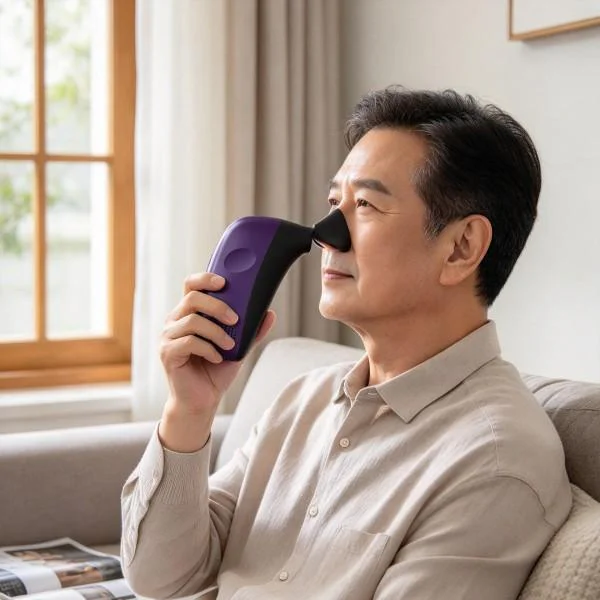
Beam Delivery: Bilateral trans-alar and paranasal application (focused directly on the lateral margins of the inferior turbinates).
Session Dosage & Frequency: 12 minutes per session, once daily in the evening, 6 days per week.
Progressive Objective Recovery Metrics
Total Nasal Symptom Score (TNSS: 0-12 Scale)
Day 0   [■■■■■■■■■■] 10.5 (Severe obstruction, mouth breathing)
Day 14  [■■■■■■■   ]  7.0 (Decreased morning congestion, nasal breathing at rest)
Day 30  [■■■■      ]  4.0 (Consistent airway patency, discontinued oral meds)
Day 60  [■■        ]  2.0 (Stable mucosal tissue, clear nighttime breathing)
Day 1 to 14 (Microvascular Rebound Phase): Peak Nasal Inspiratory Flow (PNIF) increased from 45 L/min to 75 L/min. Patient reported waking with fewer throat secretions and an initial reduction in facial fullness after each 12-minute session.
Day 15 to 30 (Structural Decongestion Phase): Mucosal appearance changed from dusky purple and edematous to healthy pink. Rebound swelling from topical medications resolved entirely. PNIF reached 105 L/min.
Day 31 to 60 (Tissue Stabilization & Maintenance): Daytime mouth-breathing ceased. Fluticasone was completely discontinued under clinical guidance without adverse reactions. The patient transitioned to an ongoing three-times-weekly maintenance schedule.
User Experiences in Daily Practice
“My congestion had turned every winter into a nightmare of mouth breathing and disturbed sleep. Topical sprays worked for a few days, but the rebound swelling made things twice as bad, and salt rinses only cleared surface mucus. Adding a 960nm deep-tissue unit to my evening routine was completely straightforward. It does not feel like a cold laser; you just feel a soft, calming warmth spreading through your cheekbones and the bridge of your nose. Around the end of the second week, I realized I was sleeping through the entire night with my mouth closed and waking up with a clear head.”
Practical Expectations, Sensation, and Clinical Safety Limits
PBM offers a direct physical approach to tissue recovery, but matching expectations to tissue biology is essential for getting the best outcomes.
What the Application Feels Like
Targeted 960nm technology operates as a soothing photo-thermal modality rather than a harsh cold laser. Within three to five minutes of direct skin contact near the paranasal area, users feel a deep, comforting warmth spreading across the midface. There are no stinging, sharp electrical sensations, or mucosal irritations. Most people find the sessions relaxing to run right before bed.
Who Benefits Most
Individuals seeking non allergic rhinitis home remedies where typical antihistamine medications yield poor results.
Patients with chronic seasonal or environmental rhinitis looking for an effective allergic rhinitis natural treatment to minimize dependence on drying nasal sprays.
Individuals troubled by swollen, boggy nasal turbinates who cannot tolerate the rebound effects of common decongestants.
Contraindications and Safety Boundaries
PBM is non-ionizing, but it must be applied with sound judgment:
Never direct the emitter into the open eye: Keep eyes closed or use protective eyewear when operating near the orbital rim.
Active Local Malignancies: Do not apply over known or suspected cancerous lesions in the facial region.
Implanted Electronics: Avoid direct contact over active facial neurostimulators.
Acute Hemorrhage: Do not use during active nosebleeds (epistaxis), as gentle thermal vasodilation can slow clot formation.
Progressive Recovery Timeline and Cost Analysis
Repairing chronic microvascular swelling takes systematic consistency rather than overnight fixes:
Weeks 1–2 (Microvascular Mobilization): Interstitial micro-vessels dilate and stagnant fluid begins moving. Frontal head tension eases and daytime nasal airflow shows steady, measurable gains.
Weeks 3–4 (Structural Turbinate Remodeling): Mitochondrial ATP supports natural cellular recovery. Turbinate swelling subsides, morning crusting drops sharply, and restful nasal breathing returns at night.
Month 2 and Beyond (Airway Maintenance): Sessions can be stepped down to 2 to 3 times per week to help guard against environmental flare-ups and maintain open, comfortable airways.
Investing in a high-grade 960nm home unit pays for itself quickly when compared to ongoing clinic appointments, outpatient radiofrequency treatments, and recurring prescriptions. Having your own device means comfortable, unhurried care at home, without the hassle of commute times or waiting room lines, making it easy for the whole household to share.
Common Questions About Home PBM
Can I pair deep-tissue PBM with my regular hypertonic saline nasal wash?
Yes. In fact, performing a saline flush five minutes prior to your light session removes surface crusts and mucus blankets. Clearing the path allows near-infrared light to travel smoothly through the submucosal structures of the nasal passage.
How does 960nm differ from the inexpensive red-light clips that sit inside the nostrils?
Nasal clip devices generally run at 650nm (red light). While 650nm helps heal superficial scratches on mucosal surfaces, red light scatters quickly and cannot penetrate deeply into swollen turbinates. Deep 960nm energy penetrates safely through external skin and cartilage layers, treating the full volume of congested venous tissues without needing to touch sensitive inner-nose linings.
How quickly will I notice an improvement in my nasal breathing?
Most users experience a pleasant sensation of warmth and a mild release of paranasal pressure during or right after their first session. Measurable structural changes in chronic turbinate swelling, however, typically appear between days 10 and 14 of consistent daily use as cellular energy rebounds and stagnant lymphatic fluids clear.
Finding an enduring tennis elbow fix requires addressing the poor blood supply where extensor tendons anchor into bone. Lateral epicondylalgia persists because micro-tears in the extensor carpi radialis brevis (ECRB) anchor trap the tendon in loca...
Peripheral facial nerve palsy persists because the swollen seventh cranial nerve remains physically compressed within the narrow Fallopian canal of the temporal bone, choking its microvascular supply and trapping motor axons in an ischemic state. ...
Chronic sinus congestion persists because stagnant tissue fluid, hypoxic mucosal walls, and blocked ostial channels lock facial cavities into an inflammatory metabolic stalemate that surface sprays cannot resolve. When looking for non-pharmaceutic...
Adhesive capsulitis lingers because fibrotic contracture and chronic ischemia fuse the glenohumeral joint capsule, choking off local microcirculation beneath thick layers of deltoid muscle and dense connective tissue. Searching for how to cure fro...
 Handheld Home-Use Therapy Device