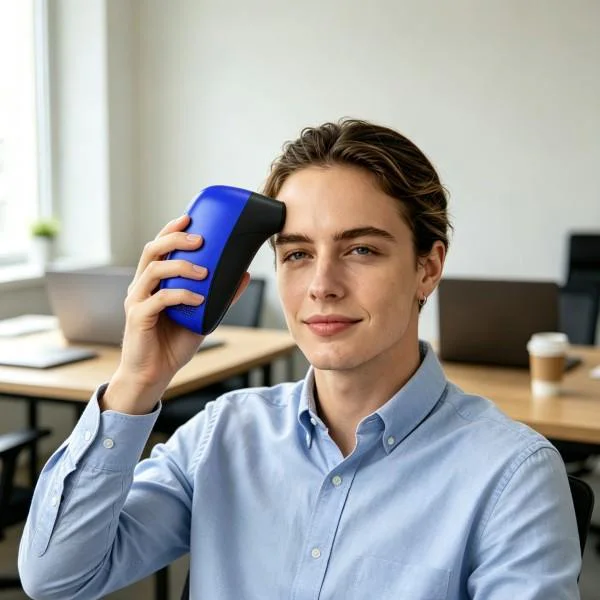
Peripheral facial nerve palsy persists because the swollen seventh cranial nerve remains physically compressed within the narrow Fallopian canal of the temporal bone, choking its microvascular supply and trapping motor axons in an ischemic state. Targeted 960nm photobiomodulation penetrates through dense temporal bone and deep facial fascia to deliver concentrated photon irradiance directly into the nerve trunk, restoring cellular ATP production and relieving neurovascular fluid entrapment. Unlike high-dose oral steroids or antivirals that carry systemic metabolic burdens, emotional swings, and gastrointestinal irritation, this targeted physical modality reboots cellular respiration non-invasively, offering a grounded clinical strategy for individuals navigating how to treat facial nerve palsy at home.
When Expression Freezes: The Daily Physical and Emotional Strain
Waking up with sudden hemifacial paralysis alters everyday life in ways that go far beyond physical symptoms, hitting personal confidence and routine interactions hard.
The Exposed, Stinging Eye: Your eyelid fails to complete its involuntary blink, leaving the delicate cornea exposed to dry indoor air, burning constantly with grit-like irritation, and requiring thick ointments, daytime protective glasses, and nightly moisture taping.
The Messy Coffee Sip: Sitting down for breakfast becomes an exercise in frustration as your lips cannot seal around a mug or straw, letting liquid dribble down your chin and onto your clothes.
The Strained Smile: Smiling at your children or greeting clients in a video call results in an asymmetric, frozen grimace that can cause acute self-consciousness, professional anxiety, and withdrawal from social engagements.
The Deep Ear and Jaw Ache: A dull, pressurized ache throbs constantly right beneath the mastoid process behind your ear, turning simple jaw movements, yawning, or chewing tough food into painful tasks.
Navigating early-stage care often reveals the clear limits of traditional standard regimens:
Oral Corticosteroids (Prednisone): Indispensable during the initial 72-hour emergency window to blunt severe acute swelling, extended steroid courses frequently cause severe insomnia, fluid retention, anxiety, and digestive distress without physically restoring stalled axonal transport.
Prescription Antivirals: Prescribed to suppress suspected dormant viral reactivation within the sensory ganglion, they cannot decompress an axon that is mechanically pinched by surrounding unyielding bone.
Superficial Warm Washcloths: While applying moist heat across the cheek can temporarily soften tight surface muscles, its thermal energy dissipates entirely within the top 2 millimeters of dermal tissue, failing to reach the nerve trunk sealed inside dense temporal bone.
Root Pathology: Bony Canal Entrapment and Microvascular Ischemia
Restoring functional nerve conduction requires understanding the tight anatomical space through which Cranial Nerve VII travels.
Viral Reactivation or Idiopathic Neurogenic Swelling
                         │
                         ▼
Entrapment Inside the Rigid Fallopian Canal (Temporal Bone)
                         │
                         ▼
Microvascular Vasa Nervorum Collapse & Local Axonal Hypoxia
                         │
                         ▼
Mitochondrial CCO Inhibition & Axonal ATP Depletion
                         │
                         ▼
Retrograde Degeneration, Fluid Cuffing, and Myelin Breakdown
                         │
                         ▼
Persistent Motor Signal Interruption (Hemifacial Weakness)
The human facial nerve must pass through the Fallopian canal, an anatomical bony tunnel less than 1 millimeter wide at its narrowest segment. When baseline inflammation sets in, the nerve trunk expands against non-yielding osseous walls.
This confinement causes the vasa nervorum—the microscopic capillary network feeding the nerve—to collapse under the pressure. Deprived of oxygen, Schwann cells and axonal pathways rapidly deplete their adenosine triphosphate (ATP) reserves. Cellular ion pumps fail, preventing the clearance of interstitial edema and toxic byproducts like lactic acid and free radicals. This stagnant microenvironment accelerates axonal degeneration and blocks saltatory nerve impulse conduction. Surface heat cannot resolve this entrapment because it cannot decompress the rigid bony channel beneath.
The 960nm Bio-Optical Advantage: Penetrating the Temporal Bone
Reversing deep neural ischemia requires an optical window capable of penetrating dense cortical bone without heating superficial skin.
Optical Transmission: Why 960nm Reaches Deep Nerve Trunks
Superficial red light wavelengths (630nm–660nm) are scattered by melanin and dermal capillaries, while standard near-infrared (810nm–850nm) is absorbed by superficial vascular beds.
The targeted 960nm wavelength falls into an optimal bio-optical window. It balances low tissue scattering with moderate, physiologically beneficial water absorption. This physics profile allows collimated photons to traverse the parotid gland, dense fascia, and the mastoid portion of the temporal bone, penetrating 30mm to 50mm deep to reach the stylomastoid foramen and intra-temporal facial nerve sheath.
The Intracellular Cascade: From Photons to Neurovascular Decompression
When 960nm photons reach the hypoxic nerve fibers, they initiate an evidence-based biological repair cascade:
Photodissociation of Nitric Oxide at Cytochrome c Oxidase: Unit IV of the mitochondrial respiratory chain absorbs near-infrared light, releasing inhibitory nitric oxide (NO) from catalytic binding sites.
Restoration of Mitochondrial ATP: Unblocked electron transport drives a surge in ATP synthesis, fueling axonal transport mechanisms and Schwann cell myelin reconstruction.
Endogenous Vasodilation of the Vasa Nervorum: Liberated nitric oxide acts on adjacent microvascular smooth muscle, reopening crushed capillary loops and restoring micro-perfusion.
Edema Decompression and Re-innervation: Enhanced microcirculation clears trapped interstitial fluid out of the narrow Fallopian canal, relieving mechanical pressure on the nerve and accelerating motor unit recruitment.
Objective Multi-Dimensional Modality Comparison
Evaluation Metric
Oral Corticosteroids / Antivirals
Superficial Moist Heat / 650nm Red Light
Targeted 960nm Deep Photobiomodulation
Tissue Penetration Depth
Systemic circulatory distribution
1 mm to 3 mm (outer skin and superficial dermis)
30 mm to 50 mm (penetrates bone, canal, and parotid)
Non-invasive, zero systemic toxicity, zero habituation
Home Usability
High (daily oral pill ingestion)
High (washcloths, heating pads)
High (compact, targeted handheld applicator)
Cost Over 1 Year
$180 – $500 (medication tapers, follow-ups)
$30 – $80 (pads, replacement heat wraps)
Single hardware investment, shared long-term home use
Verified Clinical Case Record
The following clinical data records the structured care of a patient with severe idiopathic peripheral facial palsy who had plateaued on standard steroid medications.
Clinical Parameter
Documented Patient Case Profile
Patient Profile
Female, 37 years old, Senior Corporate PR Manager & Mother of Two
Clinical Diagnosis
Grade IV Peripheral Facial Nerve Palsy (House-Brackmann Scale), Left Side
Complete voluntary eyelid seal restored (no daytime taping needed); drinking without leaking liquids
Week 8 Outcome
House-Brackmann Grade I (Complete Recovery); normal articulation during press events; natural smile returned
Long-Term Protocol
Twice-weekly 8-minute maintenance sessions; zero synkinesis or facial contractures recorded at 6 months
Patient Perspective: A Real-World Experience
“Waking up on a Monday morning with half my face frozen was terrifying. As a public relations manager, my face and voice are my career, and suddenly I couldn’t blink my left eye, speak clearly, or drink my morning coffee without it leaking down my sweater. After finishing my course of steroids, my cheek still felt like an unresponsive, frozen weight. When I started using the 960nm device, the difference in sensation was obvious right away. It isn’t an icy cold laser, and it’s definitely not a scorching heat lamp. It produces this steady, deep, soothing warmth that feels like it penetrates straight through the bone behind your earlobe. Within two weeks, the deep ache behind my ear was gone, and by week four, I could blink my eye shut and smile in photos again without hiding my face. It gave me my expression and my confidence back.”
Realistic Expectations: Sensations, Candidacy, and Safety Boundaries
Understanding practical boundaries ensures safe and effective home application:
Sensory Experience: Patients experience a comfortable, deep-reaching therapeutic warmth. It is a non-cold, photo-thermal therapeutic modality without electric shocks, stinging, or muscle twitches.
Clear Contraindications: Do not apply over known active head or neck malignancies, active parotid tumors, directly over the anterior thyroid, or over implanted active electronic devices. Avoid application during the acute blistering phase of facial herpes zoster without antiviral coverage.
Progressive Recovery Timeline and Practical Economics
Restoring axonal conduction follows a structured biological process:
[Weeks 1 - 2: Microvascular Induction]
- Nitric oxide release opens compressed vasa nervorum
- Deep mastoid ache and periauricular pressure drop by 35% to 50%
- Initial resting facial tone begins to balance
                         │
                         ▼
[Weeks 3 - 4: Axonal Regeneration & Myelin Repair]
- Restored ATP synthesis powers axonal transport and Schwann cells
- Voluntary eyelid closure seals, preventing corneal dry spots
- Oral competence returns, stopping liquid spills while drinking
                         │
                         ▼
[Long-Term: Neuromuscular Stabilization]
- Weekly or bi-weekly 8-minute maintenance sessions
- Supports healthy re-innervation without abnormal synkinesis
- Maintains microvascular perfusion during periods of fatigue or stress
Financial Analysis: Specialist Clinic Visits vs. Personal Home Care
Outpatient physical therapy, specialized neuromuscular re-education, and private neurology sessions routinely cost $1,600 to $3,800 over a standard 8-to-12-week rehabilitation plan. Adding the costs of transportation, time off work, and eye care supplies makes clinical routines difficult to maintain.
A dedicated at-home 960nm device changes this balance. The one-time hardware investment provides on-demand, non-invasive sessions from home, giving your entire family an easy-to-use option for nerve rehabilitation, joint stiffness, and muscle recovery.
Safe Home Care Integration
To achieve lasting facial recovery, combine light therapy with gentle facial re-education exercises. Ensure the skin around the ear and jaw is clean and dry. Position the emitter head in gentle, direct contact with the mastoid area just behind the earlobe, along the stylomastoid foramen, and over the affected cheek for 8 to 10 minutes per session.
Once the deep warmth relaxes the tissue and stimulates blood flow, perform slow, mindful facial movements in front of a mirror: gentle blinking, raising the corner of the mouth, and soft whistling shapes without forceful straining.
Consult manufacturer technical specifications to verify calibrated continuous/pulsed optical emission, tissue surface contact guidelines, and certified safety compliance parameters before establishing a daily home care regimen.
Frequently Asked Questions
Can 960nm photobiomodulation trigger facial synkinesis?
No. Synkinesis typically occurs when regenerating axons branch off abnormally under chronic ischemic stress and uncontrolled electrical muscle stimulation. By delivering pure photon energy to increase microvascular blood flow and restore cellular ATP without forced electrical contractions, 960nm light promotes clean, organized axonal sprouting and minimizes aberrant nerve pathways.
Why does the 960nm device feel warm during application?
Unlike low-power red LEDs, the 960nm wavelength has a minor, physiologically beneficial water absorption coefficient. As collimated photons travel deep into dense facial bone and parotid tissue, a small fraction of photon energy converts into a mild, soothing endogenous warmth that aids local vascular dilation without overheating superficial skin layers.
How soon will I notice my eyelid closing properly?
While reduction of periauricular pressure and facial heaviness often occurs within the first 7 to 10 days of consistent daily sessions, nerve regrowth proceeds at roughly 1 millimeter per day. Meaningful motor improvement, such as natural eyelid closure and mouth corner movement, typically develops steadily between weeks 3 and 6 of regular application.
Chronic airway congestion lingers because microvascular pooling traps stagnant interstitial fluid behind rigid facial bones, generating localized hypoxia that topical sprays and homeopathic pellets never resolve. When looking into red light therap...
Lateral epicondylalgia persists as a chronic condition when repetitive mechanical tension produces microscopic structural tears at the common extensor origin, trapping the poorly vascularized tendon in an ischemic, degenerative cycle. While many p...
Adhesive capsulitis lingers because fibrotic contracture and chronic ischemia fuse the glenohumeral joint capsule, choking off local microcirculation beneath thick layers of deltoid muscle and dense connective tissue. Searching for how to cure fro...
 Handheld Home-Use Therapy Device