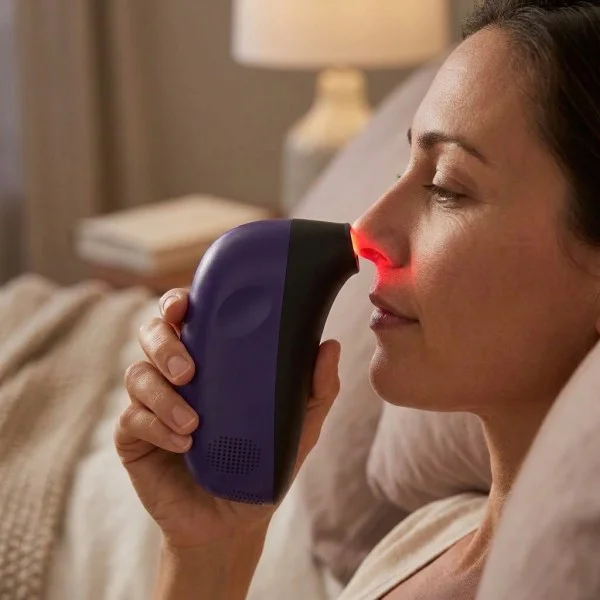
Chronic rhinitis persists when unresolved interstitial swelling paralyzes local mucosal clearance and locks the paranasal passages in a state of stagnant hypoxia. While typical searchers seek an overnight natural cure for rhinitis, lasting stabilization requires targeted 960nm photobiomodulation to bypass dense facial bone structures and dilate compressed capillary beds directly. Because non-ionizing light works via direct cellular photoreception rather than systemic biochemical uptake, this non-invasive approach provides anti-inflammatory and decongestive support without drug tolerance, rebound congestion, or metabolic burden on the liver and kidneys.
The Daily Exhaustion of Blocked Airways
Anyone dealing with persistent nasal inflammation knows the heavy fatigue that sets in before the day even starts. You wake up with your tongue glued to the roof of your mouth, throat raw from eight hours of forced mouth breathing, and a head that feels stuffed with cotton. Throughout the workday, sinus pressure presses against the bridge of your nose and radiates toward the temples, turning simple tasks like reading spreadsheets or holding client meetings into an uphill battle against brain fog.
Standard first-line treatments for rhinitis often trade one set of daily frustrations for another:
Decongestant nasal sprays offer quick breathing room within ten minutes, but relying on them past four days triggers rebound swelling (rhinitis medicamentosa), leaving nasal passages far tighter than before.
Oral antihistamines reduce erratic sneezing fits, yet they tend to dry out vocal cords, leave eyes feeling gritty, and drag down afternoon alertness.
Intranasal steroid sprays require weeks of diligent daily application to alter mucosal immune responses, frequently producing crusting, mucosal thinning, and morning nosebleeds.
Steam inhalations and hot compresses provide transient comfort to the skin surface, but the thermal energy dissipates entirely in the epidermal fat without altering the congested venous pools beneath nasal cartilage.
Searching for a viable rhinitis home remedy usually begins when you realize symptom-masking drugs no longer provide clean, unlabored breathing.
The Root Pathology: Submucosal Metabolic Deadlock
Persistent rhinitis is fundamentally a microvascular clearance crisis trapped inside rigid anatomical walls. Continuous environmental triggers cause prolonged submucosal mast cell activation, filling local tissue with histamine, substance P, and inflammatory prostaglandins.
As fluid floods the interstitial matrix, local tissue pressure rises rapidly. This swelling crushes fragile venules and terminal lymphatic channels against the unyielding turbinate bone.
Deprived of steady blood flow, epithelial cells run out of oxygen and fail to synthesize the adenosine triphosphate (ATP) required to drive active ciliary transport. Cilia go dormant. Mucus thickens, inflammatory waste pools in the ostiomeatal channels, and localized tissue acidosis sensitizes the trigeminal sensory nerve branches. This explains why standard superficial treatments fail: clearing surface secretions does not resolve the deep vascular compression locking the nasal passages shut.
960nm Light Physics: Deep Target Penetration
Superficial red wavelengths between 630nm and 660nm scatter rapidly within the epidermis and dermis, making them suitable for surface abrasions but ineffective for congested sinus cavities. While 810nm and 850nm wavelengths penetrate deeper, they still encounter optical scatter when passing through dense facial structures.
The 960nm wavelength falls within a specialized optical transmission window. It demonstrates balanced water absorption and minimal melanin scattering, allowing photon energy to travel 20 to 35 millimeters through facial skin, the nasal septum, and lateral nasal cartilage to reach the submucosal capillary networks.
960nm Near-Infrared Photons → Cytochrome c Oxidase Activation → ATP Acceleration → Nitric Oxide Dissociation → Vasodilation & Drainage
When 960nm light reaches the target respiratory epithelium, it activates mitochondrial Cytochrome c Oxidase (Complex IV):
Recharges Cellular Power (ATP): Photons accelerate the electron transport chain, restoring the energy supply that dormant ciliated epithelial cells require to clear stagnant mucus.
Releases Endogenous Nitric Oxide (NO): Light prompts the targeted release of bound nitric oxide from mitochondrial complexes. This relaxes vascular smooth muscle, reopens compressed capillary beds, and drains stagnant venous pools.
Calms Cytokine Cascades: Rebalancing cellular respiration stops the surge of reactive oxygen species (ROS), downregulating nuclear factor kappa B (NF-κB) and allowing chronically swollen membranes to return to their baseline thickness.
Physical rehabilitation centers routinely rely on these proven photobiomodulation dynamics to clear deep musculoskeletal swelling; applying the same physics to the nasal passages addresses chronic airway obstruction at the structural source.
Comparing Common Airway Interventions
Evaluation Dimension
Pharmaceutical Sprays & Pills
Warm Compresses & Standard Red LEDs (630–660nm)
Deep 960nm Photobiomodulation
Tissue Penetration Depth
Absorbed systemically; minimal localized focus on trapped sinus beds
1 to 3 mm; scattered within the outer epidermal and dermal layers
20 to 35 mm; passes through nasal cartilage and deep facial bone
Cellular Mechanism
Chemical receptor antagonism (alpha-adrenergic or H1 receptor blockade)
Mild surface dermal warming; no direct mitochondrial enzyme stimulation
Cytochrome c Oxidase activation, ATP generation, NO-mediated microvascular dilation
Side Effect & Dependency Risk
High rebound risk (rhinitis medicamentosa), mucosal atrophy, drowsiness
Minimal; minor localized skin redness from excessive surface heat
Non-ionizing, non-thermal light; zero chemical tolerance or mucosal thinning
Requires boiling water or wired heating masks; brief comfort
Compact handheld sessions, 10–15 minutes daily from the couch
Annual Cumulative Cost
$260 – $620 per year in recurring prescriptions and OTC packs
Low upfront cost, but delivers minimal deep airway clearance
Single durable equipment investment shared across the entire household
Clinical Case Record
Documented under standard physical rehabilitation follow-up protocols. Individual patient identifiers omitted.
Patient Background: Female, 46 years old.
Diagnosis: Non-allergic vasomotor rhinitis complicated by chronic bilateral inferior turbinate hypertrophy (Grade III obstruction).
Clinical History: 7-year history of daily post-nasal drip, dry mouth, poor sleep quality, and severe dependence on OTC oxymetazoline spray (using 4 to 5 doses daily). Previous oral antihistamines and fluticasone sprays caused nasal dryness and recurrent septal bleeding without clearing the airway.
Intervention Protocol: Handheld 960nm deep photobiomodulation applied externally across the nasal dorsum and bilaterally over the paranasal maxillary regions at 12 J/cm² per site, 10 minutes daily for 8 weeks, supported by morning isotonic saline flushes. Medicated decongestant sprays were discontinued on Day 1.
Objective Clinical Parameters
Measured Parameter
Baseline (Day 0)
Week 2
Week 4
Week 8 (Evaluation Endpoint)
TNSS Score (Total Nasal Symptom Score, 0–12)
11.0
7.5
3.5
1.0
Nasal Airway Resistance ($Pa/cm^3/s$)
0.64 (Severe Obstruction)
0.48 (Moderate)
0.29 (Mild)
0.17 (Normal Baseline)
Mucociliary Transit Time (Saccharin Test)
32 minutes
24 minutes
16 minutes
11.5 minutes (Healthy Range)
Turbinate Hypertrophy Grade (Anterior Rhinoscopy)
Grade III (Contacting Septum)
Grade II
Grade I-II
Grade I (Normal Airway)
Epworth Sleepiness Scale (ESS, 0–24)
16 (Severe Daytime Sluggishness)
12
6
3 (Normal Daytime Alertness)
User Perspective: Real Feedback from Daily Life
“I used to keep a bottle of medicated spray in my purse, another in the car, and a third right beside my bed. If I forgot it, within two hours my nostrils would swell so shut that I couldn’t even force a gasp of air through my nose. My ears felt constantly full and my head pounded behind my eyebrows. Going cold turkey on the sprays felt terrifying, but starting the 960nm sessions made it manageable. There is no stinging, no buzzing, and no harsh heat—just a slow, soothing warmth spreading across the bridge of my nose and cheeks. By the end of the second week, I slept through the entire night with my mouth closed for the first time in years. Being able to breathe without chemical sprays has completely changed my daily energy.”
— Elena R., 46, Verified Home User, Texas
Treatment Sensations and Safety Boundaries
What the Session Feels Like
A 960nm treatment does not produce shocks, vibrations, or sharp heat. As near-infrared energy penetrates into deep facial tissues and microcapillaries open, users experience a gentle, spreading warmth across the nose and cheekbones. It delivers a calming sensation that helps loosen sinus tightness without surface irritation.
Suitable Candidates
Individuals managing chronic allergic or vasomotor rhinitis who want to reduce medication dependence.
People recovering from severe rebound nasal congestion after stopping over-the-counter nasal sprays.
Those who experience dry mouth, fatigue, or mucosal irritation from antihistamines and steroid sprays.
Clear Contraindications
Active Malignant Lesions: Do not apply light directly over confirmed or suspected cancerous tissues.
Acute Localized Bleeding: Avoid application over nasal areas experiencing active nosebleeds.
Electronic Medical Implants: Do not point the emitter directly over cardiac pacemakers or cochlear implants.
Pregnancy: Avoid applying the emitter directly over the pelvic or lumbar regions.
Progressive Recovery Timeline
Weeks 1–2: Vascular Opening Phase
├── Microcapillaries dilate to reabsorb pooled fluid
├── Eases pressure behind the eyes and across the nose bridge
└── Reduces nighttime waking caused by dry mouth

Weeks 3–4: Epithelial Restoration Phase
├── Accelerates submucosal drainage through lymphatic paths
├── Restores normal ciliary rhythm and clearance times
└── Eliminates the urge to reach for medicated nasal sprays

Long-Term Maintenance: Airway Resilience
├── 2 to 3 sessions weekly preserve cellular ATP reserves
├── Mucosal tissues stay calm against ambient allergens
└── Keeps daily breathing clear and effortless year-round
The Long-Term Household Value
Repeated ENT consultations, prescription refills, and specialty nasal mists easily exceed $1,400 to $2,800 over two years. Having a durable 960nm handheld device at home provides reliable, non-chemical airway care for the entire household. It turns daily sinus management into a simple, predictable routine right from your favorite chair.
For comprehensive technical specifications, optical energy density parameters, and step-by-step home administration protocols, consult the clinical guidelines at the sinusitis and rhinitis home management resource.
Frequently Asked Questions
Can 960nm light therapy cause rebound congestion like nasal sprays?
No. Rebound congestion occurs when synthetic chemicals repeatedly force blood vessels to constrict, causing extreme rebound swelling once the medication wears off. In contrast, 960nm light operates photochemically by stimulating cellular mitochondria and releasing natural nitric oxide, encouraging natural microvascular drainage without creating physiological dependency.
Is external facial application effective without placing the light inside the nostrils?
Yes. The 960nm wavelength easily passes through skin, lateral cartilage, and facial bones to penetrate 20 to 35 millimeters into tissue. Applying the device across the nasal bridge and cheeks treats the entire submucosal capillary bed and paranasal sinus network without irritating sensitive internal nasal membranes.
Can I combine deep photobiomodulation with a morning saline flush?
Yes, using them together is highly practical. Rinsing with an isotonic saline wash clears loose debris, crusts, and mucus from the nasal passage first. This clean surface allows near-infrared light to travel directly into the mucosal wall without optical interference.
Facial paralysis, mouth asymmetry, and severe eye lag persist when cranial nerve VII remains mechanically trapped in microvascular edema, cellular hypoxia, and bioenergetic breakdown within the rigid Fallopian canal. Targeted 960nm photobiomodulat...
Chronic auditory ringing persists because sensory hair cells and the stria vascularis suffer from deep microvascular ischemia, trapping cochlear structures in cellular hypoxia and energy depletion. Targeted 960nm photobiomodulation bypasses superf...
Nasal congestion persists when submucosal vascular beds lose their tone and trap stagnant fluid against the rigid cartilage of the nasal vault. People seeking a natural cure for rhinitis often run through saline flushes and elimination diets with ...
Targeted 960nm photobiomodulation addresses chronic upper airway congestion by delivering near-infrared energy through dense nasal cartilage directly into the hypoxic respiratory mucosa. Unlike conventional therapies that only temporarily shrink b...
 Handheld Home-Use Therapy Device