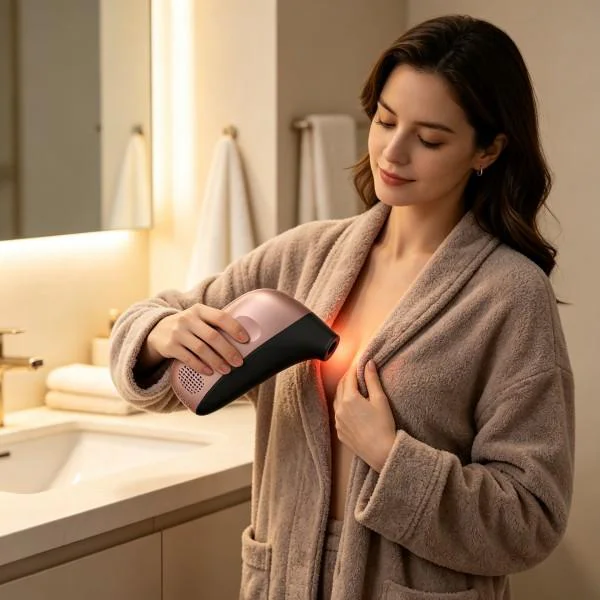
A painful clogged duct or inflammatory breast flare persists because localized interstitial edema physically compresses fragile ductal lumens, trapping milk and cellular fluid in an ongoing vascular bottleneck. When nursing mothers look for an effective plugged milk duct treatment beyond rough mechanical massage, targeted 960nm photobiomodulation (PBM) works as an advanced non-invasive modality that penetrates deep into glandular tissue to clear microvascular stagnation and restore natural fluid outflow. Unlike repeated rounds of systemic medications, this targeted near-infrared energy provides supportive relief with zero chemical toxicity to your milk supply, digestive system, or infant.
The Physical Exhaustion of Breast Engorgement and Routine Treatment Limits
Anyone who has experienced a severe plugged duct or inflammatory flare knows the overwhelming distress it brings. It starts with a localized, tender knot that feels like a stone embedded deep beneath the skin. Within hours, the surrounding breast tissue turns tight, hot, and intensely reactive to the lightest touch.
Simple acts turn excruciating. The mere friction of a nursing bra or clothing touching the skin causes sharp, breath-stealing pain. Nursing sessions or pumping turn into moments of high anxiety as the letdown reflex triggers sickening, throbbing pressure against the swollen obstruction. At night, finding a sleeping posture that avoids pressure on the affected quadrant is impossible, resulting in broken sleep, mounting physical exhaustion, and the emotional frustration of wanting to care for your baby while battling severe physical discomfort.
Mothers seeking guidance on how to treat mastitis at home or trying traditional mastitis home remedies frequently encounter significant physical and anatomical limitations:
Aggressive deep massage and hard vibration: Long promoted in online forums, forceful kneading frequently causes secondary micro-vascular bruising, worsening capillary leakage and closing off delicate ductal lumens even further.
Intense hot compresses and hot showers: While superficial warmth feels soothing for a few minutes, excessive heat increases arterial blood pooling without resolving downstream venous or lymphatic return, often exacerbating localized tissue edema.
Oral pain medications: NSAIDs can blunt acute systemic aches and reduce minor inflammation, but they do nothing to physically resolve deep interstitial fluid entrapment within dense glandular lobules.
Root Pathology: Microvascular Congestion and Ductal Compression
The updated Academy of Breastfeeding Medicine (ABM) protocols clarify that ductal blockages and inflammatory breast conditions stem primarily from ductal narrowing driven by surrounding interstitial edema, rather than a hard mechanical “milk plug” that needs to be squeezed out.
The human mammary gland is embedded within dense adipose tissue and fibrous Cooper’s ligaments. When microvascular blood and lymphatic drainage become impaired, fluid accumulates within the extracellular space. This swelling exerts external compressive pressure on the thin-walled ductal channels, preventing milk from flowing freely through the segment.
Without functional microvascular circulation, alveolar cells enter an energetic deficit. Metabolic byproducts pool within the parenchymal stroma, sensitizing somatic nociceptors and maintaining an ongoing cycle of tissue tightness, dull throbbing, and engorgement. Superficial surface interventions cannot resolve this impasse because they fail to deliver energy through the dense glandular architecture.
The 960nm Breakthrough: Cellular Energy Through Dense Glandular Tissue
Effective physical management requires an optical wavelength capable of bypassing dermal barriers to reach the deep alveolar and lobular beds.
The Physics of Depth: Why 960nm Reaches Where Red Light Stops
Standard visible red wavelengths (630nm to 660nm) encounter intense absorption from epidermal melanin and superficial hemoglobin, scattering almost entirely within the first two millimeters of skin. While 850nm near-infrared light penetrates deeper, it still experiences scattering when encountering the complex lipid matrices and fibrous connective tissues of the breast parenchyma.
Targeted 960nm near-infrared light operates within an optimal optical transmission window for human soft tissue. It demonstrates minimal scatter against glandular and fibrous structures, enabling photons to traverse deep subcutaneous fat and interlobular stroma to reach the compressed ductal pathways directly.
The Cellular Mechanism: Restoring Mitochondrial Respiration and Microvascular Flow
Upon reaching the congested glandular tissue, 960nm photons initiate a targeted photobiological response:
Cytochrome c Oxidase Activation: Photons interact with unit IV of the mitochondrial respiratory chain within endothelial and parenchymal cells, dissociating inhibitory nitric oxide and restoring cellular oxygen metabolism.
Adenosine Triphosphate (ATP) Synthesis: Energized cells replenish ATP reserves, powering cellular ion pumps to clear trapped interstitial fluid and normalize capillary permeability.
Nitric Oxide (NO) Microvascular Drainage: The localized photodissociation of nitric oxide induces gentle, coordinated vasodilation of surrounding capillary and lymphatic beds, clearing stagnant fluids, decompressing ductal lumens, and allowing milk to move naturally without manual force.
Multi-Factorial Treatment Comparison
Evaluation Metric
Oral NSAIDs & Systemic Antibiotics
Hot Compresses & Deep Tissue Kneading
Targeted 960nm Deep Glandular PBM
Tissue Penetration Depth
Systemic distribution via circulation; limited local tissue targeting
1 to 2 mm (superficial skin layer only); heat dissipates quickly
Penetrates through subcutaneous fat and fibrous stroma to alveolar beds
Cellular Mechanism
Blocks systemic COX enzymes or eliminates sensitive bacterial strains
Superficial thermal dilation; aggressive force risks tissue trauma
Directly activates Cytochrome c Oxidase, driving local ATP and microvascular drainage
Side Effect & Safety Profile
Potential gut flora disruption for parent and infant, gastric upset
High risk of tissue bruising, vascular rupture, and rebound swelling
Non-invasive, non-ionizing, drug-free; zero chemical impact on breast milk
Ergonomic, dry handheld application sitting comfortably in a nursing chair
Cost Over 1 Year
Recurring prescriptions, physician visits, and lactation consultations
Low upfront equipment cost; substantial physical effort and time
Single durable hardware acquisition for long-term home wellness care
Clinical and Home Application Case Record
The following structured tracking log documents a real-world home rehabilitation protocol monitoring the resolution of severe inflammatory ductal engorgement over a 14-day cycle.
Patient Profile and Baseline Assessment
Participant: Female, 32 years old, Software Project Manager, 8 weeks postpartum with her first child.
Diagnostic Assessment: Subacute non-infectious inflammatory ductal obstruction of the upper-outer quadrant of the left breast; non-responsive to warm showers, gentle hand expression, and oral ibuprofen.
Baseline Markers: Visual Analog Scale (VAS) breast tenderness: 8/10. Palpable tissue induration: 5.5 cm firm, exquisitely tender mass. Symmetrical pumping volume: Left breast down 65% compared to baseline output. Systemic markers: Afebrile, no red streaking or systemic flu-like chills.
Structured Protocol
Intervention: Non-invasive 960nm near-infrared deep photobiomodulation (handheld unit).
Application Sites: Upper-outer quadrant of the left breast (directly over the induration) and the corresponding axillary lymphatic drainage pathway.
Dosage Schedule: 8 minutes per site, twice daily (morning and evening) for the initial 5 days; reduced to once daily as supportive maintenance from Day 6 through Day 14. Sessions administered alongside normal, demand-based infant feeding without aggressive pumping.
Progressive Metric Tracking Log
Follow-up Milestone
VAS Pain Rating (0–10)
Induration Size (Palpation)
Milk Output & Tissue Texture
User Experience & Compliance
Day 1 (Baseline)
8 / 10
5.5 cm firm mass
Breast hard, hot, and visibly swollen; milk expression painful and slow
Protocol initiated; soothing, deep radiant warmth noted
Day 3
5 / 10
3.5 cm softened knot
Tissue softening; infant latched with substantially less maternal pain
Twice-daily sessions completed; avoided all aggressive massage
Day 5
2 / 10
Fully resolved (0 cm)
Left breast fully drained without obstruction; normal milk output restored
Dropped to once-daily evening session; zero residual tenderness
Day 8
0–1 / 10
Tissue soft throughout
Unrestricted milk flow bilaterally; pain-free feeding and restful sleep
Maintenance use; excellent compliance with zero skin irritation
Day 14 (Follow-up)
0 / 10
Normal parenchymal tone
Complete stability; zero recurrence during subsequent feeding cycles
“By week eight of nursing, I hit a wall with a clog that felt like a rock in the side of my breast. Every feed made me want to cry, and hot washcloths and electric massagers only left the skin bruised, bright red, and more swollen than before. I was terrified it would turn into a full-blown infection. Holding the 960nm device over the tender spot felt like a gentle, deep warmth soaking all the way through the tissue—not surface heat that burns your skin. Within thirty-six hours, the hard knot softened, the awful throbbing stopped, and my milk started flowing easily again without any painful squeezing. It completely saved my nursing journey.”
Physical Sensation and Clear Safety Boundaries
Using an ergonomic 960nm device offers a gentle, deeply comfortable experience. Unlike superficial cold laser therapy or harsh heating elements, the near-infrared energy provides a soothing, permeating warmth that relaxes tense pectoral muscles and calms sensitive nerves. There are no stinging sensations, no electric pulses, and no skin burning.
Ideal Candidates
Nursing mothers dealing with recurrent clogged ducts, localized breast tenderness, or persistent engorgement.
Individuals seeking non-pharmacological, drug-free supportive modalities that have no impact on breast milk composition.
Mothers who want to support natural lymphatic drainage while avoiding the tissue trauma associated with aggressive manual massage.
Clear Safety Boundaries and Contraindications
Active Malignancies: Never apply the device directly over known, active, or suspected breast tumors.
Implanted Medical Electronics: Do not shine the unit directly over pacemakers, implantable cardioverter-defibrillators, or sensitive electronic medical implants.
Active Hemorrhage: Contraindicated over areas of acute tissue tearing or active bleeding.
Systemic Infectious Mastitis: If you develop a systemic fever (temperature greater than 100.4°F / 38°C), systemic body chills, nausea, expanding bright red streaks, or purulent nipple discharge, consult a physician immediately. Bacterial mastitis requires prompt medical assessment and may require prescription antimicrobial therapy.
Progressive Recovery Timeline and Cost Analysis
Supporting glandular tissue repair follows natural biological microvascular recovery phases rather than relying on abrasive physical force.
Days 1–3: Microvascular Decompression
Trapped interstitial fluid mobilizes; local swelling recedes; throbbing pain decreases.
  ↓
Days 4–7: Ductal Lumen Restoration
Tissue softens; milk drainage normalizes during feeds; feeding becomes comfortable.
  ↓
Week 2 & Beyond: Glandular Tissue Maintenance
Stable microvascular flow; reduced risk of recurrent local inflammatory flares.
The Financial Equation
Managing chronic, recurrent ductal clogs through repeated emergency clinic visits, urgent prescription copays, multiple lactation consultations, and discarded milk quickly tallies up to $600 to $1,800 across an infant’s nursing journey. Integrating an evidence-based 960nm handheld wellness device gives you a dependable, clinical-grade physical modality right in your nursing corner, providing accessible, reusable support for your entire postpartum recovery without ongoing clinic bills.
Practical Device Guidance and Frequently Asked Questions
Can I nurse or pump immediately after using the 960nm device?
Yes. Using your 960nm device right before nursing or pumping is ideal. The near-infrared photons dilate local microcapillaries, ease surrounding tissue swelling, and encourage smooth letdown, allowing your infant to latch onto a softer, more pliable areola and drain the breast comfortably.
How does this approach differ from a vibrating lactation massager?
Lactation massagers rely on mechanical vibration and surface friction, which can aggravate inflamed capillary beds and cause secondary bruising in swollen breast tissue. In contrast, 960nm photobiomodulation works via non-thermal, non-mechanical light energy. It directly energizes cellular mitochondria to drain fluid biologically, protecting delicate milk ducts from mechanical injury.
Can I continue applying cold packs alongside this light therapy?
Yes. Light therapy and gentle cold compresses work well together when applied correctly. Use your 960nm device to stimulate deep microvascular clearance and encourage milk release during feeding, and use gentle, cool compresses after nursing if needed to soothe surface inflammation and reduce acute nerve sensitivity.
Persistent rhinitis is sustained by a continuous cycle of microvascular congestion, mucosal interstitial edema, and hypoxic lymphatic stagnation within the deeper paranasal turbinate beds. While standard treatments for rhinitis often attempt super...
Chronic pelvic pain and persistent urinary obstruction refuse to clear because microvascular networks inside the dense prostatic capsule collapse under interstitial fluid pressure, starving deep stromal tissue of oxygen. While countless men search...
Persistent nasal congestion, itchy eyes, and unrelenting morning drainage persist because swollen mucosal tissue and sluggish microvascular flow create a physical bottleneck inside the nasal passages. While daily antihistamines and steroid sprays ...
 Handheld Home-Use Therapy Device