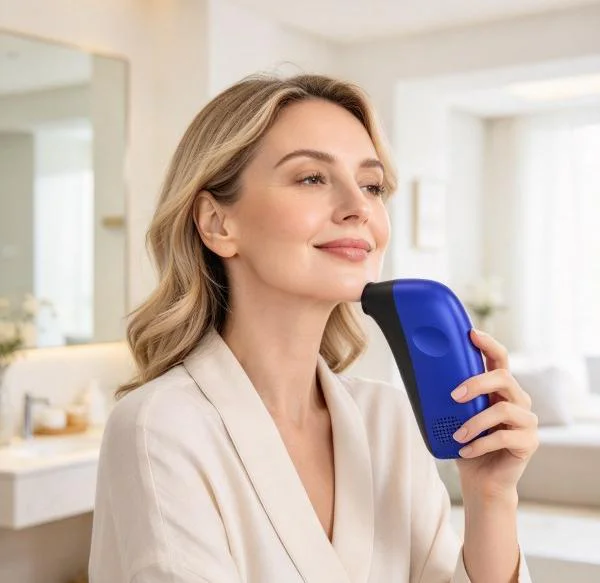
Facial paralysis and motor asymmetry persist when the cranial nerve VII remains compressed inside the rigid Fallopian canal, trapped in microvascular edema, neural hypoxia, and bioenergetic exhaustion. Targeted 960nm photobiomodulation (PBM) delivers non-ionizing optical energy through dense temporal bone and parotid fascia straight into the ischemic nerve trunk, stimulating mitochondrial ATP production and restoring microvascular drainage. Unlike systemic pharmaceuticals that risk hepatic, renal, or endocrine burden, this non-invasive approach provides localized bioenergetic support to swollen axonal pathways without metabolic toxicity or chemical dependency.
Understanding the progression of bell palsy symptoms allows individuals to act within critical therapeutic windows, pairing clinical care with an effective at-home bell palsy treatment to relieve tissue compression before secondary contractures set in.
When Half Your Face Suddenly Stops Responding
Waking up to brush your teeth and watching water spill uncontrollably from the corner of your mouth is terrifying. You look in the mirror to find one side of your forehead unmoving, your eyebrow refusing to lift, and your eyelid unable to close. Simple daily acts—chewing food without biting your cheek, taking a sip through a straw, or speaking clearly on a phone call—become frustrating struggles.
The psychological toll is equally heavy. Walking into a store, dining out, or attending a work meeting brings painful self-consciousness as strangers misinterpret your facial drop. At night, an inability to close the eyelid fully leaves the cornea exposed, dry, and irritated, requiring tape or thick ointments that blur your vision and fragment rest.
Standard medical interventions frequently hit therapeutic limits:
Oral corticosteroid tapers (prednisone): Effective at blunting immediate inflammatory swelling during the initial 72 hours, but carry risks of insomnia, elevated blood pressure, gastric burning, and mood swings while offering limited help once the acute window closes.
Aggressive facial electrical stimulation: Often misapplied in an effort to “shock” muscles awake, but frequently risks triggering permanent synkinesis, muscle spasm, or aberrant axonal regrowth.
Warm facial washcloths and heating pads: Provide fleeting surface comfort, but superficial conductive heat cools rapidly within the dermis, never penetrating the dense petrous temporal bone where the nerve is strangulated.
The Root Pathology: Compression Inside the Bony Canal
The primary driver of facial nerve motor failure is not muscle necrosis; it is mechanical strangulation inside the narrowest osseous channel in the human skeleton. The labyrinthine segment of the Fallopian canal measures less than 0.7 millimeters in diameter, creating a strict physical threshold:
Because the nerve trunk is locked inside compact petrous bone, surface creams and superficial heat cannot reach the ischemic focus. Reversing this standstill requires an external physical stimulus capable of traversing bony barriers to restore mitochondrial respiration, relieve capillary engorgement, and reactivate local lymphatic drainage.
The 960nm Wavelength Advantage for Deep Cranial Tissues
Optical therapy depends entirely on photon penetration mechanics. Visible red light (630nm–660nm) scatters heavily across melanin and superficial capillary blood, dissipating within the top two to four millimeters of dermal tissue.
Targeted 960nm near-infrared light sits within an optimal optical transmission window characterized by lower scatter through dense cortical bone, parotid gland tissue, and fibrous connective sheets:
OPTICAL TRANSMISSION DEPTH IN HUMAN CRANIOFACIAL TISSUE
========================================================================
Wavelength Spectrum    Primary Tissue Interaction       Effective Penetration
------------------------------------------------------------------------
650nm (Visible Red)    Melanin & Dermal Capillaries     Shallow (2-4mm)
850nm (Standard NIR)   Dermal Collagen & Hemoglobin     Moderate (6-10mm)
960nm (Targeted NIR)   Dense Bone & Deep Nerve Trunks   Deep (15-25mm)
========================================================================
Cellular Action Chain
When 960nm photons reach ischemic Schwann cells, neurofilaments, and vascular endothelial cells, they initiate documented repair pathways:
Cytochrome c Oxidase Photo-Acceptance: Unit IV of the mitochondrial respiratory chain absorbs near-infrared photons, displacing inhibitory nitric oxide and restoring the electron transport chain.
Mitochondrial ATP Recovery: Restored cellular respiration yields the adenosine triphosphate needed by axonal ion pumps ($Na^+/K^+$ ATPase) to re-establish resting membrane potential and nerve signal conduction.
Targeted Endothelial Vasodilation: Controlled photodissociation of nitric oxide expands the vasa nervorum microcirculation, supplying oxygen to starving nerve sheaths.
Edema Reabsorption: Improved vascular tone and lymphatic motility evacuate trapped interstitial fluid, decreasing internal pressure inside the Fallopian canal.
Comparing Facial Nerve Interventions
Clinical Dimension
Oral Corticosteroids / Antivirals
Hot Packs & 650nm Visible Red
Targeted 960nm Photobiomodulation
Tissue Penetration Depth
Systemic distribution; variable nerve entry
1–3 mm (arrested by skin and facial fat)
15–25 mm (transits bone to Fallopian canal)
Cellular Mechanism
Gene transcription repression of cytokines
Cutaneous hyperemia; zero ATP recovery
Mitochondrial enzyme activation and axonal repair
Side Effect & Risk Profile
High (hypertension, insomnia, gastric ulcers)
Negligible
Non-invasive, zero chemical rebound, non-thermal
Home Feasibility
Simple dosing, but strictly limited to acute phase
Accessible, but symptomatic relief fades fast
10–12 minute quiet daily home sessions
Annual Cumulative Cost
$250–$600 in prescriptions and clinic copays
$20–$50 (very limited therapeutic scope)
Single device acquisition with multi-year utility
Detailed Clinical Application Case
The data below details an 8-week structured home protocol monitored for a 48-year-old female high school guidance counselor presenting with acute idiopathic facial paralysis on her left side.
Patient Profile and Baseline Status
Age / Biological Sex: 48 / Female
Clinical Presentation: Complete left facial flaccidity, unable to close left eye (4mm lagophthalmos), mouth angle drooping, speech dysarthria
Prior Regimen: 10-day oral prednisone taper (completed within first 2 weeks, with minimal motor recovery), artificial tear drops every 2 hours
Baseline House-Brackmann Score: Grade V / VI (Severe dysfunction; barely perceptible motion)
Baseline Sunnybrook Facial Grading Scale: 21 / 100 (Indicates severe motor deficit and asymmetry)
Baseline Corneal Exposure Gap: 4.2 mm on attempted gentle eye closure
Application Targets: Stylomastoid foramen (behind the earlobe), parotid gland region (facial nerve trunk division), and the zygomatic/buccal motor branch exits.
Dosing Routine: 12 minutes per session once daily for weeks 1 through 4; stepping down to 3 maintenance sessions per week during weeks 5 through 8.
CLINICAL TRACKING: 8-WEEK RECOVERY MILESTONES
========================================================================
Evaluation Interval   House-Brackmann   Sunnybrook Score   Observed Functional Changes
------------------------------------------------------------------------
Baseline (Day 0)      Grade V           21 / 100           Severe lagophthalmos (4.2mm), drooling
Week 2                Grade IV          39 / 100           Eye gap down to 2.1mm; drinking improved
Week 4                Grade II          74 / 100           Complete eye closure, voluntary smiling
Week 8 (Follow-Up)    Grade I           94 / 100           Normal symmetry, speech clear, zero eye tape
========================================================================
Direct Patient Observation
“Looking in the mirror that first week and seeing half my face frozen was devastating. I could not drink water without it leaking, and taping my eye shut every night to protect my cornea was miserable. The steroid pills gave me bad heartburn, but once the prescription ended, my recovery stalled out completely. Using the 960nm handheld unit was gentle and comforting. There was no buzzing, shocking, or intense heat—just a soothing, deep warmth that seemed to relax the tight ache behind my ear. By the fourth week, my eyelid was closing on its own without tape, and my smile came back evenly. Being able to speak clearly in front of my students again without feeling self-conscious has restored my life.”
Sensory Expectations and Clinical Safety Boundaries
Applying 960nm photobiomodulation to craniofacial structures is gentle and relaxing, but knowing what to expect physically and recognizing clinical boundaries ensures safe use.
Expected Physical Sensation
The treatment is non-thermal and non-ablative. Within two to three minutes of starting a session, users feel a mild, deep, soothing warmth radiating through the cheek and behind the earlobe as microvascular blood flow expands. There is no stinging, muscle twitching, electrical vibration, or skin redness. Tissues feel relaxed and unburdened rather than tender or agitated.
Clinical Contraindications
Active Facial Malignancies: Never shine photobiomodulation directly over confirmed, suspected, or untreated tumors, such as parotid malignancies or skin lesions.
Undiagnosed Progressive Weakness: Facial paralysis accompanied by hearing loss, severe vertigo, or visual changes requires urgent neurologic imaging (MRI) to rule out acoustic neuroma or stroke before starting home therapy.
Active Ocular Infections: Do not place the device directly over an acutely infected or ulcerated eye without specialist supervision.
Implanted Electronic Hardware: Individuals with cochlear implants or implanted vagus nerve stimulators in the head and neck region must consult their medical team before applying near-infrared light fields.
Recovery Milestones and Financial Value
Restoring compressed axonal pathways follows natural biological rates of nerve regeneration (roughly 1 millimeter per day). Photobiomodulation does not force instant, artificial nerve impulses; it systematically relieves internal pressure, restores ATP production, and supports cellular repair.
PHYSIOLOGICAL RECOVERY ROADMAP
========================================================================
Phase 1: Weeks 1–2 (Microvascular Decongestion)
* Reduced deep aching behind the mastoid bone and around the jaw
* Softening of facial tissue tightness; initial reduction in eye exposure gap

Phase 2: Weeks 3–4 (Axonal Re-energization & Motor Return)
* Gradual restoration of voluntary eyelid closure and mouth corner movement
* Clearer speech articulation and easier liquid consumption without spills

Phase 3: Weeks 5+ (Symmetry & Functional Stabilization)
* Transition from daily application to 2-3 weekly maintenance sessions
* Harmonious bilateral muscle symmetry without aberrant twitching or synkinesis
========================================================================
Outpatient specialized physical therapy, clinical laser therapy, or neuro-rehabilitation visits routinely cost between $100 and $180 per session. Over a typical eight-to-twelve-week recovery window, travel time, missed work, and copays frequently pass $1,500. Having a dedicated, calibrated 960nm handheld system at home gives you access to consistent optical therapy whenever you need it, eliminating ongoing clinic fees and offering shared utility for the whole household.
Practical Home Routine and Frequently Asked Questions
When incorporating photobiomodulation alongside gentle facial massage, mirror feedback training, and proper eye protection, near-infrared light provides the metabolic foundation needed for tissue recovery. Reviewing technical parameters, broad beam coverage, and gentle positioning methods ensures you deliver effective optical energy directly to the affected nerve trunk without creating mechanical irritation.
Frequently Asked Questions
Can 960nm light therapy help if several months have passed since my symptoms started?
Yes. While early intervention within the first few weeks is ideal, long-standing motor weakness often involves sluggish microcirculation, chronic tissue hypoxia, and dormant axonal segments. The 960nm wavelength penetrates deep into the stylomastoid area to restore cellular energy production, aiding nerve remodeling and tissue mobility even in chronic stages.
How does 960nm photobiomodulation differ from electric facial muscle stimulators?
Electrical stimulation forces denervated muscles to contract artificially via electrical current, which can tire depleted muscle fibers and increase the risk of misdirected nerve regrowth (synkinesis). Calibrated 960nm photobiomodulation uses gentle, non-electrical light photons that support the nerve’s natural metabolic recovery, encouraging self-regulating repair without unnatural muscle jolts.
Is it safe to apply near-infrared light around the facial nerve branches?
Yes. The 960nm wavelength delivers non-ionizing, non-thermal light that passes gently through skin and bone without causing cellular damage or burns. Keep your eyes closed during application, use standard protective eyewear when treating the upper cheek, and avoid pressing the device firmly against fragile areas.
Facial paralysis, mouth asymmetry, and severe eye lag persist when cranial nerve VII remains mechanically trapped in microvascular edema, cellular hypoxia, and bioenergetic breakdown within the rigid Fallopian canal. Targeted 960nm photobiomodulat...
Chronic allergic rhinitis persists when persistent submucosal swelling blocks natural ostiomeatal drainage routes, trapping inflammatory proteins within the nasal passages. While conventional home remedies for allergic rhinitis offer temporary sur...
Chronic rhinitis persists because vascular dysregulation and stagnant mucosal microcirculation leave deep nasal passages trapped in an ongoing inflammatory loop. When searching for an elusive allergic rhinitis cure, patients often discover that co...
Lateral epicondylitis, commonly called tennis elbow, is not a sudden swelling that disappears overnight; it is a structural metabolic stall inside dense connective tissue. When conventional options fall short, non-invasive photobiomodulation (PBM)...
 Handheld Home-Use Therapy Device