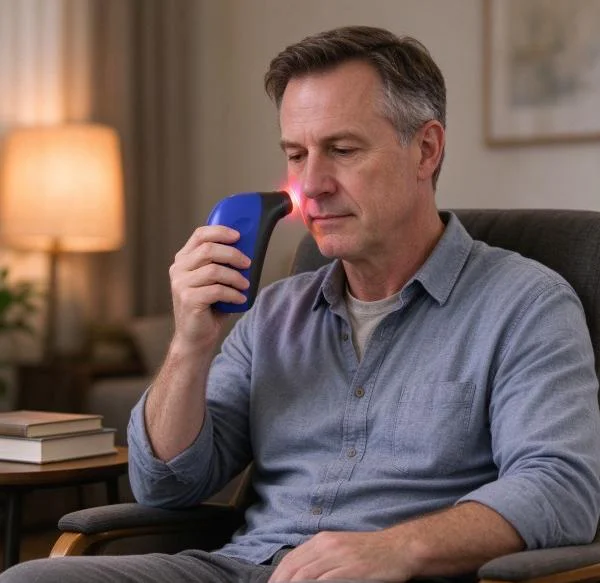
Unresolved facial motor weakness, mouth drooping, and incomplete eye closure persist when the seventh cranial nerve remains compressed within the narrow Fallopian canal, starved of microvascular circulation, cellular oxygen, and mitochondrial ATP. Targeted 960nm photobiomodulation (PBM) delivers non-ionizing optical energy through dense temporal bone and deep facial fascia directly into the ischemic nerve trunk, stimulating cellular respiration and microvascular fluid clearance. Unlike pharmaceutical drugs that depend on systemic metabolic pathways or carry gastrointestinal and endocrine side effects, this non-invasive biophysical approach delivers focused bioenergetic support to swollen axonal pathways without metabolic toxicity or chemical dependency.
Recognizing the early progression of bell palsy symptoms allows individuals to act within vital recovery windows, combining standard neurological care with an effective at-home bell palsy treatment to relieve nerve compression before secondary contractures or muscle atrophy set in.
When Half Your Face Becomes a Stranger
Waking up, looking in the bathroom mirror, and realizing you cannot smile back is an alarming experience. You try to rinse your mouth, but water streams helplessly past your lips. Your morning coffee spills down your chin, your speech sounds slurred and thick on phone calls, and food catches between your gums and paralyzed cheek every time you try to chew.
The emotional weight of public visibility is often just as heavy as the physical weakness. Going to the grocery store, attending client meetings, or laughing at a joke brings painful self-consciousness as the unaffected side pulls upward, exaggerating the asymmetry. At night, your eyelid stays partly open, drying out the cornea and causing constant scratchy burning that forces you to use thick eye gels and medical tape that fragment your sleep.
Standard frontline medical interventions often leave patients with unanswered questions once the initial window passes:
High-dose oral prednisone: Indispensable within the first 72 hours to blunt acute nerve swelling, yet steroids often cause severe insomnia, mood volatility, elevated blood pressure, and stomach irritation while offering little support once the initial taper finishes.
Antiviral prescriptions: Routinely added to steroid protocols, yet large-scale clinical trials demonstrate minimal measurable difference in long-term functional recovery for idiopathic facial palsy.
Aggressive electrical muscle stimulation (EMS): Often used in hopes of “jump-starting” paralyzed muscles, but frequently triggers mass motor unit firing, permanent synkinesis (such as the eye involuntarily closing whenever you smile), and muscle hypertonicity.
Warm facial washcloths and superficial heat pads: Provide momentary skin comfort, but conductive surface heat rapidly dissipates in the dermis, failing to reach the deep bony canal where the nerve trunk is physically trapped.
The Root Pathology: Strangulation Inside the Bony Fallopian Canal
The fundamental obstacle to facial nerve recovery is not permanent muscle death; it is mechanical strangulation inside the tightest bony channel in the human skeleton. The labyrinthine segment of the Fallopian canal measures less than 0.7 millimeters in diameter, leaving zero room for tissue expansion:
THE FACIAL NERVE COMPRESSION CYCLE
========================================================================
Viral Reactivation or Aseptic Neuro-Inflammation
                           ↓
Endoneurial Capillary Engorgement & Microvascular Edema
                           ↓
Intracanalicular Strangulation Against Inelastic Fallopian Bone
                           ↓
Axonal Hypoxia & Mitochondrial Energy (ATP) Breakdown
                           ↓
Axonal Conduction Block & Retrograde Degeneration
                           ↓
Persistent Facial Flaccidity, Incomplete Eye Closure & Asymmetry
========================================================================
Because the nerve trunk is locked inside compact petrous temporal bone, superficial lotions and surface heat cannot reach the ischemic focus. Reversing this standstill requires an external physical stimulus capable of traversing bony barriers to restore mitochondrial respiration, relieve capillary engorgement, and reactivate local lymphatic drainage.
The 960nm Wavelength Advantage for Deep Cranial Tissues
Optical therapy depends entirely on photon penetration mechanics. Visible red light (630nm–660nm) scatters heavily across melanin and superficial capillary blood, dissipating within the top two to four millimeters of dermal tissue.
Targeted 960nm near-infrared light sits within an optimal optical transmission window characterized by lower scatter through dense cortical bone, parotid gland tissue, and fibrous connective sheets:
OPTICAL TRANSMISSION DEPTH IN HUMAN CRANIOFACIAL TISSUE
========================================================================
Wavelength Spectrum    Primary Tissue Interaction       Effective Penetration
------------------------------------------------------------------------
650nm (Visible Red)    Melanin & Dermal Capillaries     Shallow (2-4mm)
850nm (Standard NIR)   Dermal Collagen & Hemoglobin     Moderate (6-10mm)
960nm (Targeted NIR)   Dense Bone & Deep Nerve Trunks   Deep (15-25mm)
========================================================================
Cellular Action Chain
When 960nm photons reach ischemic Schwann cells, neurofilaments, and vascular endothelial cells, they initiate documented repair pathways:
Cytochrome c Oxidase Photo-Acceptance: Unit IV of the mitochondrial respiratory chain absorbs near-infrared photons, displacing inhibitory nitric oxide and restoring the electron transport chain.
Mitochondrial ATP Recovery: Restored cellular respiration yields the adenosine triphosphate needed by axonal ion pumps ($Na^+/K^+$ ATPase) to re-establish resting membrane potential and nerve signal conduction.
Targeted Endothelial Vasodilation: Controlled photodissociation of nitric oxide expands the vasa nervorum microcirculation, supplying oxygen to starving nerve sheaths.
Edema Reabsorption: Improved vascular tone and lymphatic motility evacuate trapped interstitial fluid, decreasing internal pressure inside the Fallopian canal.
Comparing Facial Nerve Interventions
Clinical Dimension
Oral Corticosteroids / Antivirals
Hot Packs & 650nm Visible Red
Targeted 960nm Photobiomodulation
Tissue Penetration Depth
Systemic distribution; variable nerve entry
1–3 mm (arrested by skin and facial fat)
15–25 mm (transits bone to Fallopian canal)
Cellular Mechanism
Gene transcription repression of cytokines
Cutaneous hyperemia; zero ATP recovery
Mitochondrial enzyme activation and axonal repair
Side Effect & Risk Profile
High (hypertension, insomnia, gastric ulcers)
Negligible
Non-invasive, zero chemical rebound, non-thermal
Home Feasibility
Simple dosing, but strictly limited to acute phase
Accessible, but symptomatic relief fades fast
10–12 minute quiet daily home sessions
Annual Cumulative Cost
$250–$600 in prescriptions and clinic copays
$20–$50 (very limited therapeutic scope)
Single device acquisition with multi-year utility
Detailed Clinical Application Case
The data below details an 8-week structured home protocol monitored for a 54-year-old male architectural project manager presenting with acute idiopathic facial nerve paralysis on his right side.
Patient Profile and Baseline Status
Age / Biological Sex: 54 / Male
Clinical Presentation: Severe right-sided facial weakness, mouth angle asymmetry with liquid escape, unable to close right eye (4.5mm lagophthalmos), severe retroauricular pain
Prior Regimen: 10-day oral methylprednisolone dose pack (completed 14 days prior with minimal motor improvement), artificial tears applied hourly
Baseline House-Brackmann Score: Grade V / VI (Severe dysfunction; barely perceptible twitching)
Baseline Sunnybrook Facial Grading Scale: 19 / 100 (Severe asymmetry at rest and voluntary effort)
Baseline Palpebral Fissure Exposure: 4.5 mm gap on gentle eye closure attempt
Application Targets: Stylomastoid foramen (immediately behind the earlobe), anterior parotid trunk exit, and the zygomatic/buccal motor branch distributions.
Dosing Routine: 12 minutes per session once daily for weeks 1 through 4; stepping down to 3 maintenance sessions per week during weeks 5 through 8.
CLINICAL TRACKING: 8-WEEK RECOVERY MILESTONES
========================================================================
Evaluation Interval   House-Brackmann   Sunnybrook Score   Observed Functional Changes
----------------------------------------------------------------========
Baseline (Day 0)      Grade V           19 / 100           Severe lagophthalmos (4.5mm), mouth droop
Week 2                Grade IV          36 / 100           Eye gap reduced to 2.3mm; less liquid spill
Week 4                Grade II          71 / 100           Complete eye closure; balanced gentle smile
Week 8 (Follow-Up)    Grade I           92 / 100           Full facial symmetry, normal speech, no tape
========================================================================
Direct Patient Observation
“When my face dropped overnight, I thought I was having a stroke. The emergency room ruled that out, but being unable to blink my right eye or take a sip of water without it spilling down my shirt made me want to hide at home. The steroid prescription helped calm the intense headache behind my ear, but two weeks later, my face was still completely frozen. Using the 960nm handheld unit was an entirely different experience. There was no buzzing or pinching—just a soothing, deep warmth that seemed to soak straight into the base of my skull behind my ear. By the fourth week, I could close my eye completely without using tape at night, and my smile looked natural again. Being able to run client meetings without feeling self-conscious has given me my confidence back.”
Sensory Expectations and Clinical Safety Boundaries
Applying 960nm photobiomodulation to craniofacial structures is gentle and relaxing, but knowing what to expect physically and recognizing clinical boundaries ensures safe use.
Expected Physical Sensation
The treatment is non-thermal and non-ablative. Within two to three minutes of starting a session, users feel a mild, deep, soothing warmth radiating through the cheek and behind the earlobe as microvascular blood flow expands. There is no stinging, muscle twitching, electrical vibration, or skin redness. Tissues feel relaxed and unburdened rather than tender or agitated.
Clinical Contraindications
Active Facial Malignancies: Never shine photobiomodulation directly over confirmed, suspected, or untreated tumors, such as parotid malignancies or skin lesions.
Undiagnosed Progressive Weakness: Facial paralysis accompanied by hearing loss, severe vertigo, or visual changes requires urgent neurologic imaging (MRI) to rule out acoustic neuroma or stroke before starting home therapy.
Active Ocular Infections: Do not place the device directly over an acutely infected or ulcerated eye without specialist supervision.
Implanted Electronic Hardware: Individuals with cochlear implants or implanted vagus nerve stimulators in the head and neck region must consult their medical team before applying near-infrared light fields.
Recovery Milestones and Financial Value
Restoring compressed axonal pathways follows natural biological rates of nerve regeneration (roughly 1 millimeter per day). Photobiomodulation does not force instant, artificial nerve impulses; it systematically relieves internal pressure, restores ATP production, and supports cellular repair.
PHYSIOLOGICAL RECOVERY ROADMAP
========================================================================
Phase 1: Weeks 1–2 (Microvascular Decongestion)
* Reduced deep aching behind the mastoid bone and around the jaw
* Softening of facial tissue tightness; initial reduction in eye exposure gap

Phase 2: Weeks 3–4 (Axonal Re-energization & Motor Return)
* Gradual restoration of voluntary eyelid closure and mouth corner movement
* Clearer speech articulation and easier liquid consumption without spills

Phase 3: Weeks 5+ (Symmetry & Functional Stabilization)
* Transition from daily application to 2-3 weekly maintenance sessions
* Harmonious bilateral muscle symmetry without aberrant twitching or synkinesis
========================================================================
Outpatient specialized physical therapy, clinical laser therapy, or neuro-rehabilitation visits routinely cost between $100 and $180 per session. Over a typical eight-to-twelve-week recovery window, travel time, missed work, and copays frequently pass $1,500. Having a dedicated, calibrated 960nm handheld system at home gives you access to consistent optical therapy whenever you need it, eliminating ongoing clinic fees and offering shared utility for the whole household.
Practical Home Routine and Frequently Asked Questions
When incorporating photobiomodulation alongside gentle facial massage, mirror feedback training, and proper eye protection, near-infrared light provides the metabolic foundation needed for tissue recovery. Reviewing technical parameters, broad beam coverage, and gentle positioning methods ensures you deliver effective optical energy directly to the affected nerve trunk without creating mechanical irritation.
Frequently Asked Questions
Can 960nm light therapy help if several months have passed since my symptoms started?
Yes. While early intervention within the first few weeks is ideal, long-standing motor weakness often involves sluggish microcirculation, chronic tissue hypoxia, and dormant axonal segments. The 960nm wavelength penetrates deep into the stylomastoid area to restore cellular energy production, aiding nerve remodeling and tissue mobility even in chronic stages.
How does 960nm photobiomodulation differ from electric facial muscle stimulators?
Electrical stimulation forces denervated muscles to contract artificially via electrical current, which can tire depleted muscle fibers and increase the risk of misdirected nerve regrowth (synkinesis). Calibrated 960nm photobiomodulation uses gentle, non-electrical light photons that support the nerve’s natural metabolic recovery, encouraging self-regulating repair without unnatural muscle jolts.
Is it safe to apply near-infrared light around the facial nerve branches?
Yes. The 960nm wavelength delivers non-ionizing, non-thermal light that passes gently through skin and bone without causing cellular damage or burns. Keep your eyes closed during application, use standard protective eyewear when treating the upper cheek, and avoid pressing the device firmly against fragile areas.
Chronic sinonasal congestion persists because the submucosal venous sinusoids in the nasal turbinates remain locked in vascular engorgement and fluid stagnation, starving local tissues of oxygen. Targeted 960nm photobiomodulation bypasses superfic...
Chronic rhinitis persists when unresolved interstitial swelling paralyzes local mucosal clearance and locks the paranasal passages in a state of stagnant hypoxia. While typical searchers seek an overnight natural cure for rhinitis, lasting stabili...
Chronic nasal congestion, dull facial pressure, and non-stop airway irritation persist because swollen venous networks and trapped lymphatic fluid lock the nasal turbinates into a physical metabolic stalemate. Conventional antihistamines and corti...
 Handheld Home-Use Therapy Device