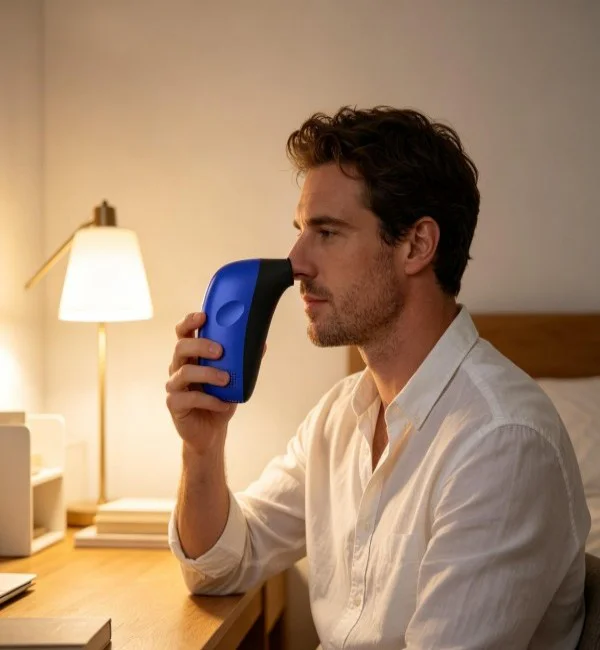
Idiopathic facial nerve paralysis remains difficult to resolve because inflammatory swelling traps the seventh cranial nerve inside the rigid, narrow Fallopian canal, creating a severe ischemic and metabolic bottleneck. When individuals seek a comprehensive bell palsy treatment, relieving this deep microvascular confinement is essential. Targeted 960nm photobiomodulation (PBM) delivers near-infrared photons through overlying muscle, gland, and temporal bone structures to boost local microcirculation, reduce fluid pressure, and restore cellular energy directly within the stylomastoid foramen. Unlike repetitive pharmaceutical treatments that impose metabolic burdens on the liver and digestive tract, focused light therapy provides clean, non-invasive rehabilitation support with zero chemical toxicity.
When Half Your Face Freezes Without Warning
Waking up unable to move one side of your face brings an overwhelming wave of vulnerability. The onset is sudden and disorienting, turning everyday facial expressions into an exhausting physical battle.
The daily friction manifests in distressing, tangible ways:
The Inability to Blink or Close the Eye: The upper eyelid remains motionless, leaving the exposed cornea burning, watery, and constantly vulnerable to abrasions unless taped shut or covered with ointment.
Loss of Oral Control: Taking a drink of water or coffee turns into an embarrassing ordeal as fluid dribbles past unresponsive lips, while chewing forces food to pack awkwardly between the teeth and cheek.
Slurred Articulation: Clear communication falters on labial consonants like b, p, and m, making routine professional calls or classroom discussions intensely frustrating.
Social Anxiety and Isolation: Catching a glimpse of an asymmetric reflection or enduring curious stares from strangers prompts many individuals to retreat from public interactions altogether.
Standard early care often leaves people feeling stranded once the initial acute window passes. Oral steroid prescriptions usually conclude within ten to fourteen days, leaving individuals to manage lingering weakness, facial tightness, and slow nerve signaling on their own.
Relying on recurring over-the-counter pain relievers carries persistent risks of stomach irritation without addressing poor local blood flow.
At the same time, standard hot washcloths and basic heating pads dissipate their energy entirely within the first 1 to 2 millimeters of superficial skin, failing to reach the compressed nerve trunk locked deep inside the mastoid bone canal.
The Biological Vice: Ischemia in the Fallopian Canal
Understanding the underlying progression of severe bell palsy symptoms requires looking closely at the rigid anatomy housing the facial nerve:
The seventh cranial nerve travels through the Fallopian canal—the narrowest bony corridor of any cranial nerve in the human skeleton. When inflammatory swelling occurs, the rigid bone cannot yield, creating a high-pressure anatomical vice.
The tiny micro-capillaries supplying the nerve sheath (vasa nervorum) collapse under the rising fluid pressure, creating an oxygen-starved, hypoxic pocket where inflammatory byproducts—such as bradykinin and substance P—cannot drain via normal lymphatic routes.
Deprived of essential oxygen and glucose, Schwann cells and axonal terminals suffer a severe deficit of adenosine triphosphate (ATP), the vital cellular fuel needed to maintain the sodium-potassium pumps that power nerve signals.
Without sufficient ATP, action potentials cannot travel down the nerve, leaving corresponding facial muscles completely flaccid.
Surface creams, skin-level warmth, and temporary symptom suppressors cannot relieve this deep ischemic entrapment sealed inside the temporal bone.
The Optical Science: Why 960nm Reaches the Temporal Canal
Standard commercial red light panels rely on visible red light (630nm to 660nm). These shorter wavelengths scatter rapidly within the epidermis and dermis, offering zero penetration through cranial bone or deep fascia.
Standard near-infrared light at 850nm penetrates deeper, yet still encounters notable absorption from microvascular hemoglobin.
A calibrated 960nm near-infrared beam operates in a specialized optical transmission window. It features low melanin scatter and bypasses superficial water absorption barriers, allowing active photon packets to pass smoothly through the parotid gland, facial muscles, and dense temporal bone directly into the compressed facial nerve trunk.
Skin & Dermis (0–3 mm):            ████████████████████████████████████████
                                   ▼ 650nm: Trapped entirely in outer skin
Parotid & Muscular Layer (3–20 mm):▒▒▒▒▒▒▒▒▒▒▒▒▒▒▒▒▒▒▒▒▒▒▒▒▒▒▒▒▒▒▒▒▒▒▒▒▒▒▒
                                   ▼▼▼ 850nm: Energy drops through dense tissue
Fallopian Canal Core (20–40 mm):   ░░░░░░░░░░░░░░░░░░░░░░░░░░░░░░░░░░░░░░░
                                   ▼▼▼▼▼▼ 960nm: Direct optical penetration to nerve trunk
When 960nm photons reach the inflamed nerve sheath, they initiate a biological recovery cascade:
Cytochrome c Oxidase Activation: Photons are absorbed by unit IV of the mitochondrial respiratory chain, releasing inhibitory nitric oxide (NO) and reopening pathways for cellular oxygen consumption.
Accelerated ATP Generation: Cellular energy production increases, giving Schwann cells and axons the metabolic fuel necessary to restore membrane polarization and support axonal regeneration.
Microvascular Decompression: Liberated nitric oxide diffuses into surrounding capillary walls, promoting vasodilation, easing intracanalicular fluid pressure, and clearing stagnant metabolic waste from the nerve trunk.
This targeted biological mechanism provides clear physical medicine logic, demonstrating that light therapy supports nerve recovery by restoring cellular bioenergetics rather than relying on surface stimulation.
Multi-Method Intervention Comparison
Evaluation Dimension
Oral Corticosteroids & Antivirals
Hot Compresses & Superficial 650nm Light
Targeted 960nm Photobiomodulation
Tissue Penetration Depth
Systemic circulatory distribution
1 to 2 mm (confined to skin surface)
25 to 45 mm (traverses temporal bone & canal)
Cellular Mechanism
Systemic chemical immunosuppression
Surface thermal relaxation
Excites Cytochrome c Oxidase; elevates ATP
Side Effect & Toxicity Risk
Gastric ulcers, insomnia, mood swings
Low risk, but risks superficial scalds
Zero chemical toxicity; non-invasive physical energy
Home Usability
Oral dosage with strict tapering schedules
Messy water prep, quickly cools down
Handheld, quiet, portable 10–12 min daily routines
Cost Over 1 Year
$180 – $420 (prescriptions, consultations)
$30 – $65 (heating pads, warm compresses)
Single equipment setup; zero recurring costs
Documented Clinical Observation: Facial Nerve Recovery Record
The following observational data comes from a structured clinical tracking log evaluating an outpatient using deep near-infrared light therapy alongside gentle facial neuromuscular re-education exercises.
Patient Background: 52-year-old male, civil litigation attorney and active university lecturer.
Clinical Presentation: Idiopathic peripheral facial paralysis (Right side; 21 days post-onset; completed standard 10-day oral prednisone course with minimal motor recovery; persistent retroauricular tenderness).
Baseline Diagnostic Metrics: House-Brackmann Facial Nerve Grading Scale: Grade V (severe dysfunction; barely perceptible motion at corner of mouth; inability to close right eye; noticeable resting asymmetry). Voluntary eyelid closure gap: 5.0 mm.
Structured 8-Week Rehabilitation Progression
Weeks 1–2 (Microvascular Decompression Phase): Targeted 960nm beam applied over the stylomastoid foramen, retroauricular area, and cheek branches for 12 minutes daily, paired with gentle, passive facial massage.
Results: Deep retroauricular throbbing resolved completely by day 9. Voluntary eyelid closure gap narrowed from 5.0 mm to 2.0 mm.
Weeks 3–4 (Axonal Repair & Active Re-Education Phase): Maintained daily 12-minute sessions, introducing guided mirror facial movement exercises (avoiding gross mass movement).
Results: House-Brackmann grade improved to Grade III (moderate dysfunction; complete eye closure with effort; noticeable smile symmetry returning; no fluid leakage while drinking).
Weeks 5–8 (Functional Consolidation & Maintenance): Application frequency shifted to 3 sessions per week for residual neuromuscular tone.
Results: Final status reached House-Brackmann Grade I (normal facial function; complete bilateral symmetry during smiling, frowning, and blinking; zero synkinesis observed).
“Standing in a courtroom unable to smile, blink, or speak clearly felt like a professional nightmare. Three weeks after the steroid pack ended, my right cheek still hung completely limp, and I had to tape my eye shut just to sleep.
Using the 960nm device felt completely different from holding a warm cloth to my ear. There was no scalding steam or surface stinging—just a deep, soothing warmth that settled straight into the bone behind my jawline. By the third week, my eyelid closed on its own, and by the sixth week, my natural smile was fully back.”
— Recorded User Case Log, Facial Rehabilitation Follow-up
Operating Sensations, Safety Boundaries, and Contraindications
Applying a calibrated 960nm optical device does not produce skin prickling, electric shocks, or sharp vibrations. Users experience a comfortable, deep thermal sensation that gradually spreads behind the ear and across the cheek as local blood vessels dilate and muscle tension eases.
Appropriate Candidates
Individuals navigating acute or post-acute peripheral facial nerve paralysis looking to support nerve metabolic recovery.
Those seeking an effective non-drug home protocol to complement their daily mirror-based neuromuscular re-education.
Clear Safety Boundaries & Contraindications
Active Malignancies: Do not apply active light beams directly over diagnosed parotid gland tumors, skull base lesions, or facial skin malignancies.
Implanted Electronic Devices: Avoid holding active optical heads directly over cochlear implants or cardiac pacemakers.
Central Neurological Deficits (Stroke): If facial weakness is accompanied by arm numbness, leg weakness, slurred speech, or confusion, seek immediate emergency medical care to rule out cerebrovascular events.
Medical Heat Restrictions: Consult an attending neurologist if you have a diagnosed condition contraindicating localized deep warmth.
Phased Recovery Timeline and Financial Practicality
Facial nerve axons and surrounding microvascular networks recover along predictable physiological milestones:
Weeks 1 to 2 (Vascular Unloading): Deep microcirculation improves, allowing pooled fluid to drain from the narrow canal. The heavy retroauricular pressure eases, and eye tear regulation stabilizes.
Weeks 3 to 4 (Axonal Conduction Recovery): Nerve fibers leverage restored ATP to resume electrical conduction. Motor control returns to the eyelid and lip corners, reducing asymmetry during speech.
Week 5 and Beyond (Neuromuscular Maintenance): Treatments shift to two or three sessions weekly, protecting recovering nerve branches as natural facial symmetry and muscle tone solidify.
The Real Cost: Specialty Therapy vs. At-Home Management
The accumulated costs of frequent specialist appointments and clinical therapies add up quickly over several months:
Ongoing Clinical Visits:
[Neurology Follow-ups] + [Physical Therapy / Biofeedback Sessions @ $120–$180 each] = $1,400–$2,800+ (plus commute times)

Dedicated At-Home 960nm Light Device:
A single one-time setup that equips your home for private, consistent, daily rehabilitation sessions.
Investing in calibrated home equipment offers an accessible, dependable framework to support long-term nerve health without the stress of constant travel and recurring clinic fees.
Practical Questions and Real-World Answers
Can photobiomodulation replace my daily facial re-education exercises?
No. Photobiomodulation resolves tissue hypoxia, clears trapped inflammatory byproducts, and restores the ATP needed for nerve repair. However, gentle active neuromuscular exercises in front of a mirror remain necessary to retrain cortical pathways and prevent abnormal nerve cross-wiring (synkinesis). Combining targeted light with focused exercise provides the most dependable route to facial symmetry.
How is a 960nm device different from a cosmetic red light facial mask?
Cosmetic facial masks emit short visible red light (630–660nm) designed for dermal skin rejuvenation, which scatters completely in the skin’s superficial layer. A calibrated 960nm near-infrared beam bypasses surface barriers, delivering concentrated photon energy deep through facial muscle, parotid tissue, and dense bone straight into the facial nerve trunk.
How often should I use the device on my face each day?
Clinical data indicates that one 10 to 12-minute daily session over the stylomastoid foramen and affected facial nerve pathways delivers an optimal photon dose. Running prolonged sessions beyond 20 minutes offers no additional therapeutic value, as mitochondrial photoreceptors reach energy saturation within that standard timeframe.
Chronic allergic rhinitis persists when persistent submucosal swelling blocks natural ostiomeatal drainage routes, trapping inflammatory proteins within the nasal passages. While conventional home remedies for allergic rhinitis offer temporary sur...
Chronic nasal congestion, dull facial pressure, and non-stop airway irritation persist because swollen venous networks and trapped lymphatic fluid lock the nasal turbinates into a physical metabolic stalemate. Conventional antihistamines and corti...
Chronic lateral epicondylalgia persists when repetitive wrist extension produces angiofibroblastic micro-tearing at the common extensor origin, leaving the hypovascular tendon attachment in a state of ischemic degeneration. While conventional prot...
Persistent rhinitis is sustained by a continuous cycle of microvascular congestion, mucosal interstitial edema, and hypoxic lymphatic stagnation within the deeper paranasal turbinate beds. While standard treatments for rhinitis often attempt super...
 Handheld Home-Use Therapy Device