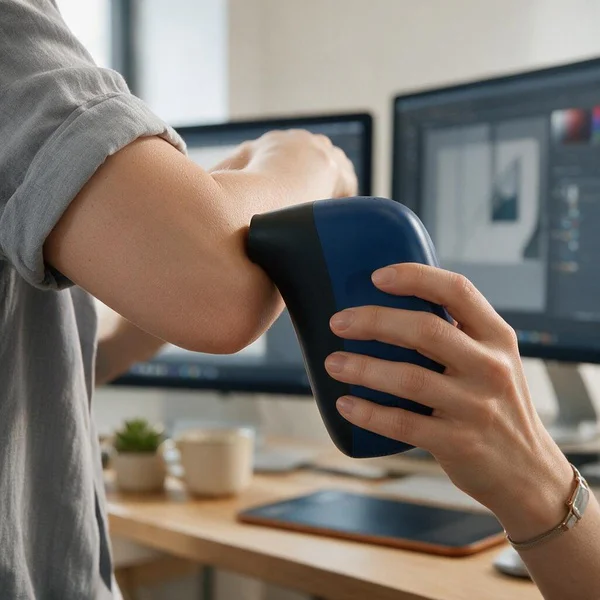
Persistent lateral epicondylalgia resists standard recovery because the extensor carpi radialis brevis (ECRB) origin sits in an avascular watershed zone, trapping micro-tears in metabolic starvation. Targeted 960nm photobiomodulation bypasses superficial skin layers to deposit photon energy deep into hypovascular tendon insertions, accelerating cellular repair without metabolic toxicity or systemic side effects. Rather than relying on temporary fixes or questionable cures for tennis elbow, this non-invasive bio-optical approach revitalizes damaged tenocytes directly at the mitochondrial level. When integrated alongside structured tennis elbow physical therapy, targeted light delivers the physiological foundation required to restore grip strength and long-term joint function.
When Everyday Tasks Hurt: The Daily Reality of Chronic Elbow Strain
Chronic lateral epicondylalgia turns basic, automatic hand movements into frustrating challenges that wear you down physically and mentally.
The Heavy Skillet Test: You reach into the kitchen cabinet to lift a cast-iron pan, and a sharp, breath-taking pinch shoots straight through the bony outer knob of your elbow, forcing you to drop it back onto the shelf.
The Awkward Handshake: Meeting a business client becomes a source of quiet hesitation as an ordinary, firm grip sends a hot, throbbing ache radiating down your forearm extensors.
The Frustrating Mouse Hand: After just twenty minutes of clicking and scrolling at your desk, your forearm feels tight and cramped, turning a routine workday into an endurance test.
The Broken Night’s Sleep: Tucking an arm beneath your pillow or rolling onto your side places direct pressure on the lateral epicondyle, waking you up with a deep, pulsing ache that refuses to settle.
Attempting to push through with traditional early-stage measures often leads to disappointing dead ends:
NSAIDs and Pain Relievers: Oral ibuprofen and naproxen dull immediate neural pain signals, but ongoing use irritates gastric linings and strains renal filtration without repairing torn tendon fibrils.
Cortisone Injections: Steroid shots can blunt pain for a few weeks, yet clinical studies confirm that repeated corticosteroids weaken tendon collagen integrity, noticeably increasing future re-tear rates.
Superficial Heat Wraps and Rubs: Menthol creams and conventional heating pads warm the top 1 to 2 millimeters of skin, but their thermal energy dissipates in dermal capillary beds long before touching dense tendon structures buried deep below.
The Root Pathology: Metabolic Stalemate in Dense Tendon Tissue
Finding the best treatment for tennis elbow requires understanding that this condition is not an acute inflammatory episode. It is an angiofibroblastic tendinosis locked in microvascular stagnation.
Repetitive Wrist Extension & Gripping
                  │
                  ▼
Micro-Fissures at Extensor Carpi Radialis Brevis (ECRB)
                  │
                  ▼
Fascial Swelling & Microcapillary Bed Collapse
                  │
                  ▼
Severe Local Ischemia & Cellular ATP Depletion
                  │
                  ▼
Lactic Acid, Bradykinin, and Substance P Stagnation
                  │
                  ▼
Disorganized Type III Scarring & Chronic Pain Loop
The common extensor tendon origin has limited natural vascularity. When repetitive mechanical strain triggers micro-fissures, the surrounding connective sheath swells and pinches delicate microcapillaries shut.
Without steady arterial blood flow, local tenocytes run out of oxygen and essential nutrients. Cells cannot synthesize the adenosine triphosphate (ATP) required to clear metabolic byproducts like lactic acid, bradykinin, and Substance P. These noxious waste products pool within the tight fibrous bundles, keeping local pain receptors on high alert. Deprived of energy, fibroblasts deposit irregular, structurally weak Type III collagen scar tissue, leaving the tendon prone to re-injury under everyday mechanical loads.
The 960nm Bio-Optical Advantage: Penetrating Deep to the Periosteum
Breaking this metabolic deadlock requires targeted photon energy delivered into the hypovascular target zone without overheating superficial skin.
Optical Transmission: Why 960nm Reaches Where Others Cannot
Standard consumer red light panels (630nm–660nm) and traditional near-infrared units (810nm–850nm) face distinct physical limitations. Shorter wavelengths scatter heavily within the skin’s epidermal melanin layer, while 810nm is largely absorbed by dermal capillary hemoglobin beds.
The 960nm wavelength operates within a distinct bio-optical transmission window. It features low tissue scattering combined with balanced water absorption characteristics. This physical profile enables collimated photons to pass through skin, subcutaneous fat, and the dense aponeurosis, penetrating 30mm to 50mm straight to the periosteum and tendon-bone junction.
The Mitochondrial Recovery Chain
Once 960nm photons reach the stalled tenocytes, they spark a documented cellular recovery chain:
Photodissociation at Cytochrome c Oxidase: Photons target Unit IV of the mitochondrial electron transport chain, dislodging inhibitory nitric oxide (NO) from catalytic binding sites.
Reactivation of ATP Synthesis: With the respiratory chain unblocked, cellular ATP generation accelerates, supplying the metabolic power necessary for protein repair and cellular housekeeping.
Endogenous Capillary Dilation: The liberated nitric oxide diffuses into local microvascular walls, dilating collapsed capillary loops and flushing out stagnant inflammatory metabolites.
Physiological Matrix Remodeling: Re-energized tenocytes transition away from producing disorganized scar tissue and begin synthesizing strong, linear Type I collagen aligned with daily tensile stress.
Direct Clinical Modality Comparison
Metric
Oral NSAIDs / Analgesics
Superficial Heat & 650nm Red Light
Targeted 960nm Deep Photobiomodulation
Tissue Penetration Depth
Systemic circulation (non-targeted)
1 mm to 3 mm (surface dermal layers)
30 mm to 50 mm (penetrates joint capsule & tendon origin)
Non-invasive, zero systemic toxicity, zero habituation
Home Usability
High (oral dosing)
High (passive wraps or heating pads)
High (compact, handheld targeted administration)
Cost Over 1 Year
$250 – $600 (ongoing prescriptions & refills)
$40 – $150 (consumable gels, heating pads)
Single hardware investment; zero recurring consumable fees
Documented Clinical Case Record
The following clinical data records the structured rehabilitation of a patient suffering from chronic, work-limiting lateral epicondylalgia who had plateaued on standard conservative measures.
Clinical Parameter
Documented Patient Case Profile
Patient Profile
Male, 46 years old, Lead Automotive Technician & Avid Pickleball Player
Clinical Diagnosis
Grade 2 Extensor Carpi Radialis Brevis (ECRB) Tendinosis, Right Dominant Arm
Baseline Symptoms
Severe grip deficit, pin-point lateral epicondyle tenderness, pain score VAS 8/10 when using a torque wrench
Prior Interventions
8 weeks of standard forearm counterforce bracing, 1 cortisone injection (relapsed after 60 days), oral naproxen
Treatment Protocol
Targeted 960nm non-cold beam, 12 minutes per session, 4 sessions weekly, followed by eccentric tendon loading
Week 2 Milestone
Resting dull ache decreased from VAS 8/10 to 4/10; forearm grip dynamometer measurement gained 24%
Twice-weekly 10-minute preventive sessions; zero relapses documented at 9-month clinical follow-up
Patient Perspective: A Real-World Experience
“After five months of struggling with this, simply picking up a heavy power drill filled me with dread. My stomach couldn’t handle any more anti-inflammatory pills, and stretching felt like pulling on a frozen rope. When I started using the 960nm device, the difference in sensation was obvious right away. It is definitely not a cold laser, but it doesn’t burn your skin like an electric heating pad either. It produces this steady, deep, soaking warmth that feels like it unlocks tight, frozen tissue from the inside out. Within three weeks, the sharp catch in my outer elbow was practically gone. I can finally torque down bolts and play weekend sports without worrying about my arm giving out.”
Realistic Expectations: Sensations, Candidacy, and Safety Boundaries
Understanding practical parameters ensures safe application and steady therapeutic progress:
Sensory Experience: The device creates a soothing, deep internal warmth. It is a non-cold, photo-thermal therapeutic modality with no electrical shocks, pinching, or needle-like stinging sensations.
Appropriate Candidates: Well-suited for individuals managing persistent tennis elbow, chronic golfer’s elbow, extensor strain, or occupational repetitive stress who want a non-pharmacological, low-dependency recovery method.
Clear Contraindications: Do not apply over known active tumors, suspected malignancies, directly over the thyroid gland, across the abdomen during pregnancy, or over implanted electronic medical devices such as pacemakers. Avoid application over acute, active bleeding sites or open wounds.
Progressive Recovery Timeline and Practical Economics
Tendon tissue remodeling follows biological schedules that cannot be rushed. Recovery typically advances through three distinct stages:
[Weeks 1 - 2: Microvascular Induction]
- Nitric oxide release opens compressed microcapillaries
- Forearm tension and morning joint stiffness decrease by 30% to 40%
- Resting background ache drops from severe to manageable
                         │
                         ▼
[Weeks 3 - 4: Active Cellular Remodeling]
- ATP synthesis accelerates tenocyte collagen output
- Organized Type I collagen replaces fragile Type III scar tissue
- Functional grip strength returns during daily household tasks
                         │
                         ▼
[Long-Term: Structural Maintenance]
- Weekly or bi-weekly 10-minute touch-up sessions
- Clears metabolic waste buildup from repetitive physical tasks
- Prevents chronic relapse loops during heavy workloads
Financial Analysis: Clinical Visits vs. Personal Home Care
Outpatient physical therapy clinics routinely bill between $90 and $175 per individual session. Over a standard 12-week course of 24 to 36 clinic visits, insurance copays and out-of-pocket fees frequently climb past $2,200 to $4,500—without accounting for drive times, waiting rooms, and time away from work.
A dedicated at-home 960nm device delivers substantial financial value. The one-time hardware investment provides unlimited, on-demand sessions in the comfort of your living room, while offering shared utility for family members managing joint stiffness, tendonitis, or chronic muscle fatigue.
Combining 960nm Therapy with Everyday Home Care
To lock in long-term joint stability, combine your targeted light sessions with sensible physical therapy protocols. Start by ensuring the skin over your outer elbow is clean and dry. Rest the emitter head in gentle, direct contact with the most tender tendon insertion point for 10 to 12 minutes to open capillary beds and elevate cellular ATP.
Once the joint feels loose and warmed, transition directly into controlled eccentric exercises:
Eccentric Wrist Extension Drops: Rest your forearm on a flat table with your wrist extending over the edge, palm down. Using a light 1- to 2-pound dumbbell, assist the weight up with your unaffected hand, then slowly lower it downward using only the affected wrist over a smooth 4-second count. Perform 3 sets of 10 repetitions.
Forearm Pronation and Supination: Hold a lightweight hammer near the end of the handle with your elbow bent at 90 degrees. Slowly rotate your forearm inward and outward in a controlled arc to strengthen rotational stabilizers.
Finger Extension Resistance: Wrap a thick rubber band around your fingers and thumb. Slowly spread your hand wide against the tension, pause for 2 seconds, and return smoothly to strengthen the extensor balance.
To examine clinical beam spot footprints, energy density ratings, and certified protocols for managing chronic joint strain, review the clinical-grade best treatment for tennis elbow handheld specifications and practical deployment guidelines.
Frequently Asked Questions
Can targeted 960nm photobiomodulation completely replace physical therapy?
No. Photobiomodulation and physical rehabilitation perform complementary functions. The 960nm light repairs cellular energy, relieves hypoxia, and flushes metabolic toxins, while eccentric exercise provides the mechanical tension needed to align new collagen fibers correctly. Using light therapy right before exercise creates the optimal physiological conditions for tissue remodeling.
Why does 960nm light feel warm during application?
Unlike low-power red LEDs, the 960nm wavelength has a minor, physiologically beneficial water absorption coefficient. As collimated photons travel deep into dense connective tissue and vascular beds, a small fraction of photon energy converts into a mild, soothing endogenous warmth that aids local vascular dilation without overheating superficial skin layers.
How soon will I notice my grip strength returning to normal?
While baseline muscular stiffness and sharp tenderness often begin to ease within the first 10 to 14 days, measurable gains in structural grip strength usually develop between weeks 3 and 6. Tendon collagen cross-linking and remodeling require continuous biological time, making treatment consistency essential.
Lateral epicondylalgia persists because repetitive mechanical tension triggers microvascular ischemia and angiofibroblastic degeneration at the common extensor tendon origin, locking dense connective fibers in an energy-starved state. While athlet...
Chronic nasal inflammation lingers because engorged venous sinusoids and sluggish lymphatic drainage trap the mucosal lining in an ongoing metabolic standstill. If you are exploring a rhinitis natural treatment without dependency on ongoing medica...
Chronic sinonasal congestion persists because the submucosal venous sinusoids in the nasal turbinates remain locked in vascular engorgement and fluid stagnation, starving local tissues of oxygen. Targeted 960nm photobiomodulation bypasses superfic...
Adhesive capsulitis lingers because fibrotic contracture and chronic ischemia fuse the glenohumeral joint capsule, choking off local microcirculation beneath thick layers of deltoid muscle and dense connective tissue. Searching for how to cure fro...
 Handheld Home-Use Therapy Device