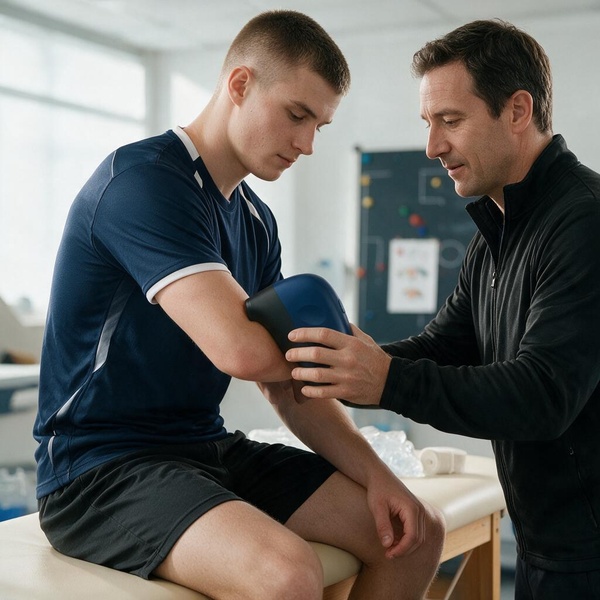
Lateral epicondylitis lingers because dense tendon tissue lacks the rich microcirculation needed to clear metabolic waste and repair chronic micro-tears. If you are searching for how to relieve tennis elbow without perpetual medication, targeted 960nm photobiomodulation (PBM) delivers concentrated light photons directly into the hypovascular extensor tendon origin. This deep physical therapy stimulation reactivates cellular respiration, promotes local blood flow, and accelerates natural tissue recovery. Unlike long-term anti-inflammatory drugs that place chronic filtration demands on your gastrointestinal tract, liver, and kidneys, targeted near-infrared light provides safe, localized recovery support.
When a Simple Grip Becomes a Daily Roadblock
Tennis elbow rarely starts on a tennis court. It quietly builds up during routine activities: typing project proposals, tightening plumbing fixtures, lifting a gallon of whole milk, or carrying grocery bags into the house.
Over time, this mechanical strain creates sharp, radiating forearm aches that derail your day:
The Involuntary Drop Reflex: You lift a ceramic coffee mug, feel a sudden shock down your forearm, and your grip reflexively releases before your brain can stop it.
Morning Joint Lock: You wake up with your elbow feeling cold, rigid, and glued shut, requiring ten minutes of slow massaging just to hold a toothbrush.
Interrupted Sleep: Rolling onto your affected side presses the sore lateral epicondyle directly against the mattress, triggering a deep, throbbing ache that wakes you up.
Constant Guarding: You hesitate to shake hands with colleagues, carry a laptop bag, or play catch with your kids out of fear of triggering a sudden flare-up.
First-line options often leave people frustrated. Prescription NSAIDs blunts pain for a few hours, but extended consumption brings real risks of gastric ulcers, intestinal inflammation, and kidney stress without rebuilding torn fibers.
Countertop menthol gels evaporate on the skin surface, while conventional electric heating pads merely warm the top layer of skin (1 to 2 millimeters deep), failing to reach the thick, oxygen-starved tendon insertion underneath.
The Metabolic Stalemate Inside the Chronic Tendon
To understand how to treat tennis elbow fast, you have to examine the physiological bottleneck at the extensor carpi radialis brevis (ECRB) anchor point:
Repetitive Forearm Micro-Trauma
              │
              ▼
Capillary Occlusion at Epicondyle Anchor
              │
              ▼
Local Tissue Hypoxia & Acidic Waste Buildup
              │
              ▼
Cellular Energy (ATP) Depletion & Chronic Scar Formation
Tendons are dense, fibrous structures with limited vascular pathways compared to red skeletal muscle. When chronic tension creates repetitive micro-tears, local capillaries compress and collapse.
This creates an oxygen-depleted, hypoxic pocket where inflammatory byproducts—such as bradykinin, substance P, and lactic acid—pool without adequate lymphatic drainage.
Starved of oxygen, local fibroblasts experience a severe shortage of adenosine triphosphate (ATP), the vital biochemical energy required to organize resilient type-I collagen fibers.
Instead of functional tendon regeneration, the body lays down weak, disorganized scar tissue that reinjures under everyday loads.
Surface creams only desensitize superficial nerve endings while the underlying metabolic logjam remains trapped deep inside the joint.
The Physics of 960nm: Deep Photon Penetration
Consumer red light masks and lamps rely on visible red light (630nm to 660nm), which scatters rapidly and absorbs almost completely within the epidermis. Typical near-infrared panels operate at 850nm, where hemoglobin absorption still limits total photon delivery through thick fascial sheaths.
A calibrated 960nm near-infrared beam operates inside an optimal optical therapeutic window, minimizing melanin scatter while bypassing superficial water absorption barriers to send photon packets directly into dense tendon fibers and periosteal layers.
Skin Dermis (0–3 mm):         ████████████████████████████████████████
                              ▼ 650nm: Energy trapped in outer skin
Subcutaneous Fat (3–12 mm):   ▒▒▒▒▒▒▒▒▒▒▒▒▒▒▒▒▒▒▒▒▒▒▒▒▒▒▒▒▒▒▒▒▒▒▒▒▒▒▒
                              ▼▼▼ 850nm: Energy drops through superficial tissue
Dense Tendon Core (15–35 mm): ░░░░░░░░░░░░░░░░░░░░░░░░░░░░░░░░░░░░░░░
                              ▼▼▼▼▼▼ 960nm: Direct optical penetration to tendon core
When 960nm photons reach the damaged tendon bed, they initiate a precise cellular cascade:
Cytochrome c Oxidase Excitation: Photons are absorbed by unit IV of the mitochondrial respiratory chain, photodissociating inhibitory nitric oxide (NO) from catalytic sites.
Rapid ATP Resynthesis: With the electron transport chain unblocked, cellular ATP generation accelerates, supplying the energy fibroblasts need for collagen remodeling.
Targeted Microvascular Dilation: Liberated nitric oxide diffuses into local vascular smooth muscle, expanding collapsed capillary beds to flush out stagnant inflammatory metabolites.
This targeted biological mechanism provides clear physical medicine logic, proving that real cellular rehabilitation is about energy delivery, not temporary nerve masking.
Multi-Method Intervention Comparison
Comparison Category
Oral NSAIDs / Prescription Analgesics
Superficial Heating Pads / 650nm Light
Targeted 960nm Deep Photobiomodulation
Tissue Penetration Depth
Non-targeted systemic circulation
1 to 3 mm (confined to dermis)
30 to 45 mm (deep tendon, periosteum)
Cellular Mechanism
Inhibits systemic COX enzymes chemically
Mild cutaneous capillary dilation
Excites Cytochrome c Oxidase; boosts ATP
Side Effect & Toxicity Risk
Risk of stomach ulcers, liver/kidney strain
Potential surface skin burns or redness
Zero chemical toxicity; non-invasive physical energy
The following observational data comes from an 8-week structured tracking log evaluating an outpatient using deep light therapy alongside eccentric forearm exercises.
Patient Background: 48-year-old male, master carpenter and residential framer.
Baseline Measurements: Nirschl Pain Phase Scale at Phase 5 (severe discomfort during daily hammer swinging and carrying plywood sheets; baseline grip dynamometer reading: 21.6 kg on right arm vs. 47.3 kg on unaffected left arm).
Detailed 8-Week Rehabilitation Progression
Weeks 1–2 (Microcirculation Priming): Targeted 960nm light applied over the right lateral epicondyle for 12 minutes once daily, paired with passive wrist stretches.
Results: Severe night throbbing subsided by day 8. Morning joint stiffness dropped from 25 minutes to under 5 minutes.
Weeks 3–4 (Tendon Remodeling Phase): Maintained daily 12-minute 960nm sessions while introducing low-load eccentric wrist extensions using an elastic resistance bar.
Results: Dynamometer grip measurement improved to 32.8 kg. Patient completed light woodwork tasks without midday forearm splints.
Weeks 5–8 (Functional Maintenance): Shifted to 3 sessions per week following heavy physical framing shifts.
Results: Final grip strength reached 44.9 kg (95% parity with the unaffected arm). Nirschl Pain Score stabilized at Phase 1 (mild tightness only after continuous, heavy framing work).
“By month eight, picking up my cordless drill felt like a hot wire tearing through the side of my elbow. I tried forearm braces, ice packs, and prescription gels, but the burning returned the moment I drove screws into a stud.
When I started using the 960nm device, there was no buzzing, vibration, or skin sting—just a deep, soothing warmth that stayed inside the joint for hours. Within four weeks, I was carrying heavy toolboxes with one hand without my grip giving out.”
— Recorded User Case Log, Maintenance Follow-up
Operating Sensations, Safety Boundaries, and Contraindications
Applying targeted 960nm light does not create skin stinging, electric pulses, or jarring vibrations. The therapy produces a comfortable, steady warmth that diffuses through tight forearm muscles as local vascular tone relaxes.
Appropriate Candidates
Office professionals, tradespeople, and athletes dealing with recurring forearm tendon irritation from repetitive wrist movements.
Individuals looking for a dependable non-drug home protocol to complement their daily stretching and strengthening routines.
Clear Safety Boundaries & Contraindications
Active Malignancies: Do not apply active light beams directly over diagnosed or suspected tumor sites.
Implanted Electronic Devices: Keep active optical heads away from direct contact with cardiac pacemakers or defibrillators.
Active Hemorrhage: Contraindicated on open skin lacerations, active bleeding areas, or within the first 24 hours of traumatic joint tears.
Medical Heat Restrictions: Consult your physical therapist if you have a diagnosed medical condition where localized warmth is contraindicated.
Phased Recovery Timeline and Financial Practicality
Dense tendons heal along predictable biological timelines. Real recovery requires steady, phased application:
Weeks 1 to 2 (Vascular Priming): Capillaries open and blood flow increases around the tendon sheath. The sensation of heavy, throbbing joint stiffness significantly subsides.
Weeks 3 to 4 (Cellular Synthesis): Tendon fibroblasts use renewed ATP to synthesize collagen fibers. Functional grip strength improves, reducing sharp guarding during daily tasks.
Week 5 and Beyond (Maintenance Care): Sessions taper to two or three times weekly, serving as protective care against repetitive occupational fatigue.
Breaking Down the True Costs
Routine outpatient clinic visits accumulate substantial financial and scheduling strain over several months:
In-Clinic Physical Therapy Visits:
[Initial Consultation] + [12–16 Visits @ $110–$160 each] = $1,400–$2,600+ (plus transit & lost work hours)

Dedicated At-Home 960nm Device:
A single one-time setup that equips your entire household for consistent, stress-free daily use.
When building an effective plan for how to relieve tennis elbow, choosing well-calibrated physical therapy equipment is critical for restoring lasting forearm function.
Practical Guidance and FAQ
Can this light therapy protocol replace physical therapy exercises?
No. Photobiomodulation resolves tissue hypoxia, clears inflammatory compounds, and restores the ATP needed for tissue repair. However, mechanical loading through eccentric exercise remains necessary to align new collagen fibers correctly. Combining targeted light with focused exercise provides the most dependable route to full arm function.
How does 960nm light differ from conventional home red light panels?
Most commercial red light panels emit short red wavelengths (630–660nm) across a wide area, which disperse almost entirely in the skin’s surface layers. A dedicated 960nm near-infrared beam targets dense, deeper collagen formations beneath the skin, delivering concentrated photon energy right where the tendon anchors into the elbow bone.
How often should I position the device on my forearm each day?
Our clinical tracking shows that one 10 to 15-minute daily session over the lateral epicondyle delivers the optimal energy dose. Applying the device for longer periods on the same spot does not speed up results, as cellular photoreceptors naturally hit an energy plateau within that standard session.
Adhesive capsulitis lingers because fibrotic contracture and chronic ischemia fuse the glenohumeral joint capsule, choking off local microcirculation beneath thick layers of deltoid muscle and dense connective tissue. Searching for how to cure fro...
Lateral epicondylalgia persists because avascular micro-tearing within the common extensor tendon creates a hypoxic, degenerative zone that simple rest and topical gels cannot resolve. When searching for how to cure tennis elbow fast or how to hea...
Peripheral facial nerve palsy lingers because the inflamed seventh cranial nerve swells inside the narrow, unyielding Fallopian canal, crushing its own microvascular supply and trapping axons in metabolic paralysis. Targeted 960nm photobiomodulati...
Facial motor weakness, eyelid retraction failure, and labial droop persist when cranial nerve VII remains mechanically strangulated inside the Fallopian canal, trapped in microvascular edema, cellular hypoxia, and bioenergetic breakdown. Targeted ...
 Handheld Home-Use Therapy Device