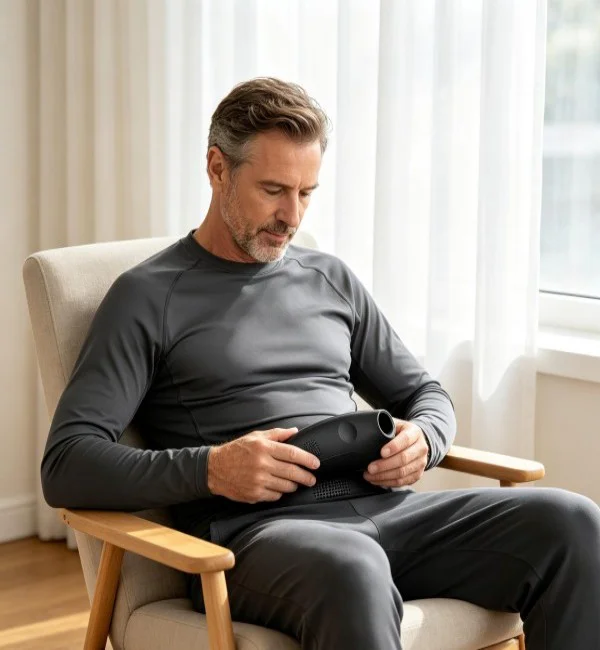
An inflamed prostate and progressive glandular enlargement persist because impaired pelvic microcirculation and chronic venous stasis trap deep parenchymal tissue in a state of continuous hypoxia. Men searching for a sustainable, natural way to shrink prostate pressure frequently discover that pharmaceuticals only manage surface symptoms while introducing difficult systemic side effects. Targeted 960nm photobiomodulation (PBM) delivers concentrated near-infrared photons past dense pelvic floor muscles to stimulate capillary perfusion, accelerate metabolic waste clearance, and restore cellular energy directly within congested stromal tissue. Unlike continuous medication regimens, this non-invasive physical therapy provides deep biological support without liver metabolism burdens or sexual performance compromises.
When Urination Dominates Your Entire Daily Routine
Living with an inflamed prostate changes how you move through the world. What was once an unconscious bodily function becomes an ongoing source of physical discomfort and social anxiety.
The disruption appears in exhausting daily patterns:
Fragmented Sleep Cycles: Waking up four or five times each night to stand over the toilet, waiting through painful hesitation for a weak, split stream.
The Constant Pressure Sensation: Enduring a relentless, heavy ache in the perineum and lower pelvis that makes sitting through a morning commute or an office meeting unbearable.
Urgency Anxiety: Mapping out restrooms in restaurants, airports, and client offices, worried that sudden bladder pressure will strike without warning.
Daytime Exhaustion: Navigating demanding professional duties and family life on broken rest, carrying continuous pelvic fatigue and mental fogginess.
Standard clinical interventions often create new challenges. Alpha-blockers relax smooth muscle around the bladder neck, but frequent side effects include orthostatic dizziness, persistent fatigue, and retrograde ejaculation.
5-alpha reductase inhibitors slow glandular growth over months, yet carry documented risks of long-term libido loss and erectile dysfunction.
Meanwhile, conventional sitz baths or warm heating pads dissipate thermal energy within the first two millimeters of skin, completely failing to reach the prostate nestled deep beneath the pelvic fascia.
The Hidden Metabolic Stalemate of Pelvic Stagnation
The reason chronic lower urinary tract symptoms linger lies in the microvascular anatomy of the male pelvic basin:
The prostate is surrounded by a dense capsule and a complex venous network known as Santorini’s plexus. When age-related cellular proliferation or tension constricts these micro-vessels, blood flow stagnates.
This creates a localized hypoxic environment where inflammatory byproducts—such as prostaglandins, bradykinin, and metabolic cellular waste—cannot drain through restricted pelvic lymphatics.
Starved of oxygen and glucose, glandular and smooth muscle cells experience an acute deficit of adenosine triphosphate (ATP), the vital cellular fuel required to maintain normal resting muscle tone and cell repair mechanisms.
Instead of draining naturally, the gland remains congested and firm, compressing the prostatic urethra and obstructing normal bladder outflow.
Surface warmth and systemic symptom-blockers fail to resolve this underlying vascular stagnation locked deep within the pelvic floor.
Optical Physics: How 960nm Reaches Deep Pelvic Structures
Standard wellness panels rely heavily on visible red light (630nm to 660nm), which scatters immediately in the dermal layer and cannot penetrate subcutaneous pelvic fat or muscular tissue. Standard near-infrared at 850nm penetrates deeper, yet encounters notable absorption by microvascular hemoglobin.
A calibrated 960nm near-infrared beam operates inside an optimal optical transmission window. It features low melanin scatter and bypasses high water-absorption barriers, enabling active photon packets to pass smoothly through perineal skin and dense pelvic floor musculature directly into congested stromal tissue.
Perineal Skin & Dermis (0–3 mm):   ████████████████████████████████████████
                                   ▼ 650nm: Captured entirely in outer dermis
Pelvic Floor Muscle (3–25 mm):     ▒▒▒▒▒▒▒▒▒▒▒▒▒▒▒▒▒▒▒▒▒▒▒▒▒▒▒▒▒▒▒▒▒▒▒▒▒▒▒
                                   ▼▼▼ 850nm: Substantial energy drop in muscle
Prostatic Glandular Bed (25–55 mm):░░░░░░░░░░░░░░░░░░░░░░░░░░░░░░░░░░░░░░░
                                   ▼▼▼▼▼▼ 960nm: Direct photon penetration to glandular stroma
Once 960nm photons reach the congested prostatic tissue, they trigger a biological repair sequence:
Cytochrome c Oxidase Excitation: Near-infrared light targets complex IV of the mitochondrial respiratory chain, photodissociating inhibitory nitric oxide (NO) and restoring normal cellular oxygen uptake.
Accelerated ATP Synthesis: Restored mitochondrial respiration produces abundant ATP, supplying stromal and muscular tissue with the biochemical energy needed to resolve involuntary spasms.
Microvascular Redistribution: Liberated nitric oxide acts on surrounding vascular smooth muscle, expanding collapsed micro-capillaries to drain trapped inflammatory fluids and ease internal urethral tension.
This predictable cellular mechanism explains why photobiomodulation provides dependable physical medicine logic, helping men manage symptoms naturally rather than relying solely on chemical blockers.
Objective Method Comparison for Glandular Relief
Evaluation Dimension
Prescription Alpha-Blockers & 5-ARIs
Sitz Baths & Superficial Heating Pads
Targeted 960nm Photobiomodulation
Tissue Penetration Depth
Systemic chemical circulatory distribution
1 to 2 mm (confined to perineal skin)
35 to 55 mm (traverses pelvic floor to prostate)
Cellular Mechanism
Blocks receptor sites or alters DHT synthesis
Surface thermal relaxation of skin
Excites Cytochrome c Oxidase; elevates ATP
Side Effect & Toxicity Risk
Sexual dysfunction, hypotension, dizziness
Low risk, but risks superficial scalds
Zero systemic toxicity; non-invasive physical energy
Home Usability
Oral dosage with ongoing pharmacy refills
Messy water preparation, immobile setup
Handheld, quiet, portable 12–15 min daily sessions
Cost Over 1 Year
$300 – $750 (recurring prescriptions, visits)
$40 – $90 (basins, bath salts, heating pads)
Single equipment setup; zero recurring costs
Documented Clinical Observation: Pelvic Health Progress Record
The following observational data comes from a structured clinical tracking log evaluating an outpatient using targeted light therapy alongside standard lifestyle hydration habits.
Patient Background: 58-year-old male, civil engineer and long-distance commuter.
Clinical Presentation: Moderate benign prostatic hyperplasia treatments seeker (3-year history; nocturia 4 to 5 times nightly, persistent perineal tightness during extended sitting, discontinued tamsulosin due to severe dizziness).
Baseline Diagnostic Metrics: International Prostate Symptom Score (IPSS) rated at 21/35 (severe symptom category; weak stream, intermittency, incomplete emptying). Nocturia frequency: 4.4 episodes per night. Quality of Life (QoL) score: 5/6 (“mostly dissatisfied”).
Structured 8-Week Rehabilitation Progression
Weeks 1–2 (Microvascular Decongestion Phase): Targeted 960nm beam applied to the perineal region for 15 minutes once daily before evening rest.
Results: Nocturia episodes decreased from 4.4 to 2.8 per night by day 12. Sitting perineal ache softened notably during workday commutes.
Results: IPSS score dropped to 13/35 (moderate range). Nocturia stabilized at 1 to 2 awakenings per night, allowing 4 to 5 hours of continuous sleep.
Weeks 5–8 (Maintenance & Stability Phase): Application frequency adjusted to 3 sessions per week for steady maintenance.
Results: Final IPSS reached 7/35 (mild range). Nocturia averaged 1 episode per night. QoL score improved to 1/6 (“pleased”), with normal stream initiation and no daytime hesitancy.
“For three years, my life revolved around finding a bathroom. Driving to job sites was miserable because sitting on that constant, throbbing perineal ache made me want to pull over every twenty miles. The prescription pills made me so dizzy I couldn’t climb ladders at work, so I just quit taking them.
Using the 960nm device felt completely different from sitting in a warm bath. There was no water mess or skin stinging—just a deep, soothing warmth that settled straight up into the pelvic floor. By the fourth week, I was sleeping five solid hours before waking up once to use the bathroom, and my stream was strong and steady again.”
— Recorded User Case Log, Pelvic Health Follow-up
Operating Sensations, Safety Boundaries, and Contraindications
Applying a calibrated 960nm optical device does not produce electric shocks, abrasive vibration, or skin irritation. Users experience a comfortable, deep thermal sensation that gradually spreads through the pelvic floor as local blood vessels dilate and muscle tension eases.
Appropriate Candidates
Men managing persistent urinary hesitancy, nighttime awakenings, or perineal pressure associated with non-bacterial pelvic stasis.
Individuals seeking a non-drug home method to support their daily pelvic comfort and bladder outflow.
Clear Safety Boundaries & Contraindications
Active Malignancies: Do not apply active light beams directly over diagnosed prostate cancer, pelvic tumors, or active bladder lesions.
Implanted Electronic Devices: Avoid positioning active optical units directly over sacral nerve modulators or cardiac electronic implants.
Acute Bacterial Prostatitis: If sudden high fever, chills, severe acute urinary retention, or cloudy urethral discharge develop, seek immediate emergency medical care for antibiotic intervention.
Medical Heat Restrictions: Consult an attending urologist if you have a medical diagnosis contraindicating localized deep warmth in the pelvic region.
Phased Recovery Timeline and Cost Practicality
Pelvic tissues and congested microvascular networks recover along predictable physiological milestones:
Weeks 1 to 2 (Vascular Priming): Deep blood flow expands through the pelvic floor. Stagnant fluid begins draining from congested stromal spaces, easing perineal pressure.
Weeks 3 to 4 (Muscular Relaxation): Restored cellular ATP relieves involuntary smooth muscle spasms around the bladder neck. Nighttime bathroom trips decrease, and urine stream velocity improves.
Week 5 and Beyond (Routine Maintenance): Treatments shift to two or three sessions weekly, protecting pelvic tissues against recurring congestion from long periods of sitting.
The True Cost: Clinic Visits vs. At-Home Management
Long-term management through frequent specialist appointments and lifelong pharmacy prescriptions creates significant financial strain:
Recurring Clinic Visits & Prescriptions:
[Urology Consultations] + [Prescription Copays] + [Monitoring Labs] = $900–$2,200 annually

Dedicated At-Home 960nm Light Device:
A single one-time setup that equips your home for private, consistent, long-term pelvic care.
If you are evaluating safe home protocols, reviewing the technical parameters of deep-tissue photobiomodulation is an essential step. Learn more about beam spot dimensions, optical power density, and step-by-step instructions by visiting the guide to enlarged prostate and pelvic therapy for complete technical specifications.
Practical Questions and Real-World Answers
Can photobiomodulation replace my prescribed urological medications?
No. Photobiomodulation is a supportive physical modality designed to relieve tissue congestion, boost ATP, and improve local microcirculation. Never discontinue prescription medications without consulting your prescribing physician. Many men use targeted light alongside their medical plans to reduce reliance on secondary symptom relief.
How is a 960nm device different from sitting on a standard heating pad?
Standard heating pads transfer superficial conductive heat that disperses within the skin and superficial adipose tissue, often causing cutaneous sweat and irritation. A calibrated 960nm near-infrared beam bypasses surface barriers, delivering photon energy deep through the pelvic floor musculature directly to the congested prostatic tissue.
How often should I use the light on the perineal area each day?
Clinical observations show that one 12 to 15-minute daily session applied to the perineal region provides an optimal photon dose. Running extended sessions beyond 20 minutes offers no added therapeutic benefit, as cellular photoreceptors reach natural saturation within that standard timeframe.
Chronic nasal inflammation lingers because engorged venous sinusoids and sluggish lymphatic drainage trap the mucosal lining in an ongoing metabolic standstill. If you are exploring a rhinitis natural treatment without dependency on ongoing medica...
Lateral epicondylalgia persists because micro-shearing creates an avascular, degenerative core at the common extensor origin that passive rest and topical creams cannot reach. When searching for how to cure tennis elbow fast or trying to determine...
Persistent joint stiffness and cartilage tenderness often stem from a deep, stagnant microcirculatory bottleneck inside dense synovial capsules. Targeted 960nm photobiomodulation penetrates straight through periarticular connective tissue to kicks...
 Handheld Home-Use Therapy Device