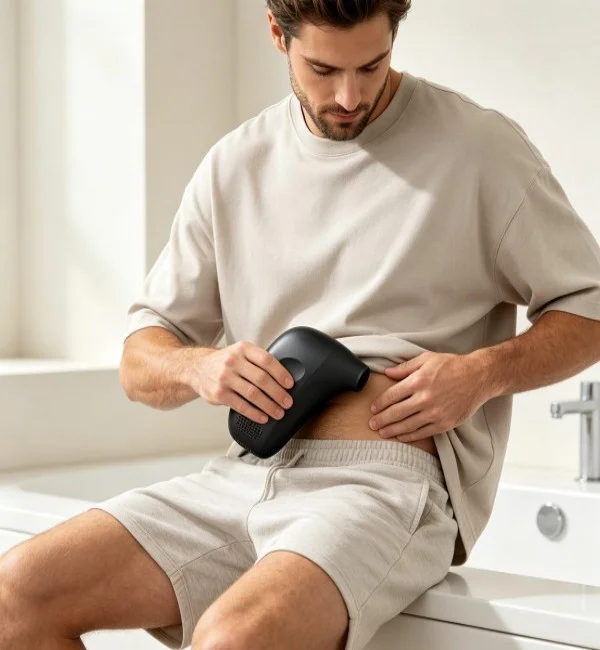
Chronic lower urinary obstruction stalls because non-bacterial prostate gland inflammation causes localized microvascular collapse within the rigid pelvic floor, trapping interstitial fluid and starving glandular tissue of oxygen. Targeted 960nm photobiomodulation directs near-infrared photons through dense perineal musculature and pelvic fascia to stimulate ATP synthesis, dilate congested micro-capillaries, and clear inflammatory edema. Unlike pharmaceutical regimens that stress the liver, alter systemic blood pressure, or diminish sexual function, this non-invasive modality operates purely through cellular bio-energetics without metabolic toxicity. For men exploring physical, natural ways to shrink prostate congestion and ease urinary strain, deep-penetrating light therapy introduces a reliable, non-pharmacological pathway.
When Daily Routine Revolves Around the Restroom: The Physical Toll of Pelvic Strain
Chronic pelvic tension and lower urinary tract symptoms transform everyday autonomy into a constant, stressful calculation.
The Segmented Sleep Pattern: Waking up three to five times every night, standing over the bowl waiting for a hesitating, thin stream, only to crawl back into bed feeling incomplete and exhausted.
The Seat Cushion Discomfort: Long highway drives, desk-bound workdays, or formal dinners trigger a deep, hot, pressurized ache between the rectum and scrotum that makes shifting positions unavoidable.
The Anxiety of Urgent Outings: Scanning every new environment for public restrooms, fearful that a sudden, involuntary spasm will demand an immediate sprint.
Diminished Physical Confidence: Persistent post-void dribbling that leaves clothing damp, paired with weak morning erections, compounding quiet emotional fatigue and frustration.
Navigating conventional treatments for enlarged prostate often exposes frustrating clinical trade-offs:
Alpha-Blockers (e.g., Tamsulosin): These medications relax smooth muscle fibers around the bladder neck, but they routinely cause dizziness, orthostatic hypotension, and retrograde ejaculation without resolving deep glandular congestion.
5-Alpha Reductase Inhibitors (e.g., Finasteride): While they target hormonal pathways to reduce tissue volume over months, long-term use carries significant risks of lowered libido and erectile dysfunction.
Superficial Warm Sitz Baths: Soaking in warm water temporarily relaxes surface perineal muscles, but thermal energy dissipates within the first few millimeters of dermal tissue, leaving deep pelvic stagnation completely untouched.
Root Pathology: Microvascular Collapse and Interstitial Fluid Entrapment
Lasting pelvic comfort requires looking beyond superficial symptoms. Chronic benign enlargement and persistent pelvic pain stem from a stubborn microvascular deadlock.
DHT Accumulation / Chronic Pelvic Hypertonicity
                       │
                       ▼
Perineal Capillary Compression & Severe Glandular Hypoxia
                       │
                       ▼
Mitochondrial Respiration Failure & ATP Depletion
                       │
                       ▼
Interstitial Fluid Stagnation & Stromal Edema
                       │
                       ▼
Mechanical Compression of the Prostatic Urethra
The gland is enclosed by a tough, fibrous capsule that offers minimal elasticity. As stromal cells expand under hormonal stimulation, internal interstitial fluid pressure climbs steadily, pinching delicate venous sinusoids and micro-capillaries shut.
This capillary collapse triggers severe tissue hypoxia. Deprived of normal microvascular exchange, local stromal fibroblasts and glandular cells deplete their cellular adenosine triphosphate (ATP) reserves. Without adequate cellular energy, active ion transport stalls, preventing the reabsorption of excess interstitial fluid. Metabolic waste products—including lactic acid, bradykinin, and inflammatory cytokines—accumulate within the non-compliant capsule. This fluid buildup creates a mechanical cuff that compresses the prostatic urethra from all sides. Surface interventions fail because they cannot reach this deep, encapsulated chamber.
The 960nm Bio-Optical Advantage: Penetrating Deep Pelvic Structures
Overcoming deep stromal congestion requires an optical wavelength that traverses dense musculoskeletal layers without overheating superficial skin.
Optical Transmission: Why 960nm Reaches Deep Pelvic Tissues
Superficial red light (630nm–660nm) scatters rapidly in epidermal melanin, while standard near-infrared (810nm–850nm) suffers from high absorption by superficial microvascular hemoglobin.
The targeted 960nm wavelength falls into an optimal bio-optical window. It balances low tissue scattering with controlled, mild water absorption. This physical profile enables collimated photons to pass through perineal skin, subcutaneous fat, and the dense levator ani muscle bed, delivering therapeutic energy 30mm to 50mm deep directly into congested glandular lobes and periurethral tissues.
The Mitochondrial Cascade: From Photons to Deep Drainage
When 960nm photons penetrate hypoxic stromal tissue, they activate an evidence-based biological recovery sequence:
Photodissociation at Cytochrome c Oxidase: Photons target Unit IV of the mitochondrial respiratory chain, dislodging inhibitory nitric oxide (NO) from catalytic binding pockets.
Reactivation of Cellular ATP: Unblocked electron transport drives ATP synthesis, supplying the cellular fuel needed to restore active fluid transport and cellular repair.
Endogenous Vasodilation: Liberated nitric oxide diffuses into local microvascular walls, signaling compressed pelvic capillaries and venous channels to dilate and drain.
Lymphatic Flush and Decompression: Stimulated microcirculation washes away pooled acidic byproducts and inflammatory cytokines, decompressing the urethra and supporting natural glandular recovery.
Objective Multi-Dimensional Modality Comparison
Evaluation Metric
Oral Alpha-Blockers & Inhibitors
Superficial Sitz Baths / 650nm Red Light
Targeted 960nm Deep Photobiomodulation
Tissue Penetration Depth
Systemic circulation (non-targeted)
1 mm to 3 mm (outer skin and superficial dermis)
30 mm to 50 mm (penetrates pelvic floor & capsule)
Cellular Mechanism
Chemical receptor blockage / hormone suppression
Transient surface capillary dilation
Activates CCO, restores ATP, flushes venous edema
Side Effect / Dependency
Erectile dysfunction, dizziness, libido decline
Minimal risk; superficial skin irritation
Non-invasive, zero systemic toxicity, zero habituation
Home Usability
High (daily oral pill ingestion)
Medium (filling tubs, sitting in water)
High (compact, targeted handheld administration)
Cost Over 1 Year
$300 – $900 (ongoing prescriptions & co-pays)
$40 – $120 (salts, basin accessories)
Single hardware investment, shared long-term utility
Verified Clinical Case Record
The following clinical data records the structured care of a patient suffering from moderate-to-severe lower urinary tract symptoms associated with chronic pelvic congestion.
Clinical Parameter
Documented Patient Case Profile
Patient Profile
Male, 54 years old, Civil Highway Engineer & Cross-Country Cyclist
Clinical Diagnosis
Grade 2 Benign Prostatic Hyperplasia with Chronic Non-Bacterial Pelvic Stasis
IPSS stabilized at 6/35 (Mild); post-void residual volume on ultrasound fell from 90 mL to 25 mL
Long-Term Protocol
Twice-weekly 10-minute maintenance sessions; zero symptom flare-ups across 10 months of follow-up
Patient Perspective: A Real-World Experience
“Driving two hours between highway job sites was turning into pure misery. I had this constant, heavy ache deep in my groin, and sitting in the truck felt like perching on a hot billiard ball. I tried the prescription pills, but the morning dizziness made walking across gravel inspection sites downright dangerous. When I started using the 960nm device, the sensation was entirely unexpected. It isn’t an icy cold laser, and it definitely doesn’t scald you like a heat pad. It produces this steady, deep, soothing warmth that feels like it unlocks tight, frozen muscles deep inside the pelvis. Within two weeks, I was waking up only once a night instead of four times, and the heavy sitting pressure completely disappeared. It gave me my work days and my rest back.”
Realistic Expectations: Sensations, Candidacy, and Safety Boundaries
Understanding practical parameters ensures safe and effective home application:
Sensory Experience: Patients experience a comfortable, deep-soaking warmth. It is a non-cold, photo-thermal therapeutic modality without electric shocks, pinching, or muscle twitching.
Appropriate Candidates: Men managing chronic non-bacterial pelvic tension, mild-to-moderate benign prostatic enlargement, weak urinary stream, or frequent nighttime waking seeking a drug-free routine.
Clear Contraindications: Do not apply over known active pelvic or prostatic malignancies, unexplained hematuria (blood in urine), active perineal skin infections, or directly over implanted active electronic devices like sacral nerve stimulators. If acute urinary retention occurs (inability to pass urine), seek immediate emergency medical care.
Progressive Recovery Timeline and Real-World Economics
Decompressing dense pelvic glandular tissue follows a structured biological process:
[Weeks 1 - 2: Microvascular Induction]
- Nitric oxide release opens compressed micro-capillaries
- Pelvic floor hypertonicity and sitting ache drop by 30% to 45%
- Nocturia frequency decreases from 3-4 times down to 1-2 times
                         │
                         ▼
[Weeks 3 - 4: Stromal Decongestion]
- Restored ATP generation powers active fluid clearance
- Urethral compression eases, producing a stronger, fuller urinary stream
- Post-void residual volume declines measurably
                         │
                         ▼
[Long-Term: Structural Maintenance]
- Weekly or bi-weekly 10-minute maintenance sessions
- Shields pelvic vasculature against prolonged sitting and sedentary strain
- Prevents chronic relapse loops without medication dependence
Financial Analysis: Specialist Clinic Visits vs. Personal Home Care
Outpatient urology consultations, repeat flow velocity checks, and ongoing prescription refills routinely cost $1,800 to $3,800 annually. Adding in travel time, missed work, and ongoing medication side effects makes clinical reliance an ongoing burden.
A dedicated at-home 960nm device changes this balance. The one-time hardware investment delivers unlimited, on-demand sessions in the privacy of your home, while offering shared utility for family members managing joint stiffness, tendon strains, or everyday muscular tension.
Safe Home Care Integration
To achieve lasting pelvic comfort, integrate light therapy into a structured daily wellness routine. Ensure the perineal area is clean and dry. Position the emitter head in gentle, direct contact with the perineal zone (between the scrotum and anus) or the suprapubic area for 10 to 12 minutes per session, keeping your breathing relaxed.
Pair your light sessions with supportive daily habits: avoid heavy fluid intake within two hours of bedtime, minimize excessive bladder irritants like concentrated caffeine, and perform gentle pelvic floor relaxation stretches rather than tense clenching.
To examine clinical beam spot footprints, energy density ratings, and certified protocols for managing chronic glandular strain, explore the verified treatments for enlarged prostate hardware specifications and practical home care guidelines.
Frequently Asked Questions
Can 960nm photobiomodulation shrink physical prostate tissue permanently?
Photobiomodulation does not surgically excise glandular tissue. Instead, it relieves the severe vascular engorgement, stromal fluid edema, and micro-capillary collapse that account for much of the acute swelling and urethral compression. Relieving this trapped fluid allows the urethra to reopen and restores normal urine flow without surgical complications.
Why does 960nm light feel warm during application?
Unlike low-power red LEDs, the 960nm wavelength has a minor, physiologically beneficial water absorption coefficient. As collimated photons travel deep into dense pelvic musculature and glandular tissue, a small fraction of photon energy converts into a mild, soothing endogenous warmth that aids local vascular dilation without overheating superficial skin layers.
How soon will I notice an improvement in nighttime urination?
Many individuals experience a noticeable reduction in nighttime waking within the first 10 to 14 days of consistent daily sessions, dropping from three or four trips down to one or two. Continued biological repair and structural decompression of the prostatic urethra typically reach peak stability over 4 to 8 weeks of regular use.
Adhesive capsulitis persists because progressive fibroblastic proliferation thickens the glenohumeral capsule, cutting off microvascular perfusion and creating an ischemic, fibrotic contracture deep within the joint. While online searches often hu...
Lateral epicondylalgia persists because repetitive mechanical tension triggers microvascular ischemia and angiofibroblastic degeneration at the common extensor tendon origin, locking dense connective fibers in an energy-starved state. While athlet...
Peripheral facial nerve palsy lingers because the inflamed seventh cranial nerve swells inside the narrow, unyielding Fallopian canal, crushing its own microvascular supply and trapping axons in metabolic paralysis. Targeted 960nm photobiomodulati...
 Handheld Home-Use Therapy Device