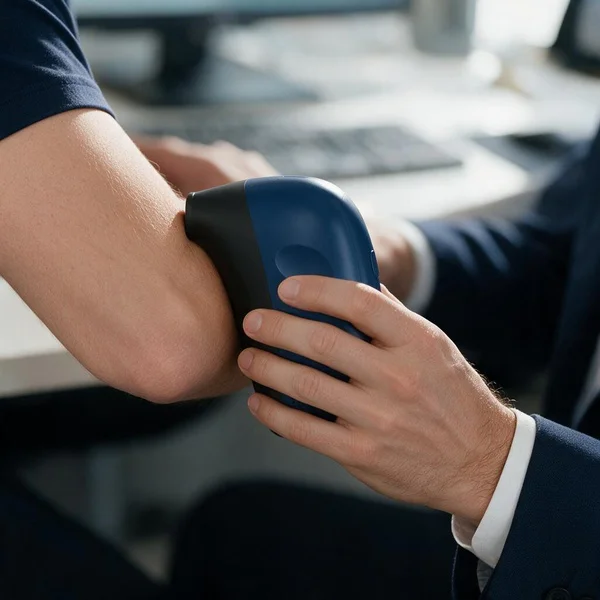
Lateral epicondylalgia persists because avascular micro-tearing within the common extensor tendon creates a hypoxic, degenerative zone that simple rest and topical gels cannot resolve. When searching for how to cure tennis elbow fast or how to heal tennis elbow quickly, aggressive stretching and anti-inflammatory pills fall short because resolving angiofibroblastic tendinosis requires restoring baseline cellular metabolism and microvascular flow rather than suppressing symptom markers. Targeted 960nm photobiomodulation (PBM) delivers non-ionizing optical energy through dense fibrous tissue directly into the extensor carpi radialis brevis (ECRB) origin, stimulating mitochondrial respiration, clearing inflammatory waste, and promoting tendon remodeling. Because this physical modality acts via cellular photon absorption, it imposes zero metabolic burden on the gastrointestinal tract and liver, offering an evidence-based pathway when learning how to fix tennis elbow quickly without pharmaceutical reliance.
The Daily Toll of Extensor Degeneration and Where Common Approaches Stall
Trying to pick up a morning cup of coffee only to drop it from a sudden, searing jolt on the outside of your elbow is infuriating. Simple routines become constant reminders of physical vulnerability: turning a stiff doorknob, clicking a mouse during a workday, gripping a steering wheel, or lifting a grocery bag sends sharp, electric twinges straight down the forearm. At night, resting your forearm on a mattress can trigger an irritating, deep ache that disrupts sound sleep, leaving you both physically guarded and mentally drained.
Standard first-line treatments often face biological dead ends:
Oral NSAIDs & Painkillers: Medications dull acute nociceptive signaling, but tendon tissue has minimal blood flow to carry systemic drugs effectively. Extended NSAID use increases the risk of gastric ulcers, renal stress, and cardiovascular side effects without reversing underlying tendon breakdown.
Corticosteroid Injections: While steroid injections offer short-term symptom relief, clinical trials reveal they frequently weaken collagen tensile strength, increasing long-term tendon rupture risk and recurrence rates.
Forearm Counterforce Braces: Strapping a band around the upper forearm reduces mechanical tension at the insertion point, but it merely acts as a temporary splint without reversing cellular hypoxia or repairing micro-tearing.
Standard Conductive Heating Pads: Conductive heat warms the superficial skin, but it disperses within the dermis and fails to penetrate the dense, fibrocartilaginous attachment of the ECRB tendon beneath the lateral epicondyle.
Cosmetic Red Light Devices (650nm/850nm): Low-power red LEDs scatter heavily in the skin and superficial fascia, failing to deliver the photon density needed to reach the deep tendinous junction.
The Root Pathology: Angiofibroblastic Tendinosis and Vascular Hypoperfusion
Chronic tennis elbow is predominantly a degenerative condition (tendinosis) rather than active acute inflammation (tendinitis):
Under repetitive load, micro-trauma accumulates faster than the tendon can repair itself. Because tendon insertions naturally possess poor blood supply, the area becomes ischemic. The body lays down weak, haphazard Type III collagen rather than strong, aligned Type I collagen. Without sufficient capillary blood flow, local cells cannot produce enough energy to reorganize the collagen matrix, and lactic acid along with neurogenic pain markers (Substance P, CGRP) pool in place. Surface-level cooling or heating cannot break this cycle because neither restores microvascular perfusion within the dense tendon core.
Targeted Optical Depth: Why 960nm Reaches Deep Tendinous Insertions
Light energy cannot trigger cellular rehabilitation if photons are absorbed or scattered before reaching the target tissue. The human elbow presents distinct anatomical barriers, including skin melanin, subcutaneous fat, and dense connective tendon fibers:
650nm (Visible Red Light): Absorbed heavily by cutaneous melanin and hemoglobin; loses over 90% of its energy within the first 1 to 2 millimeters of tissue, leaving deep tendon insertions unaddressed.
850nm (Standard Near-Infrared): Penetrates superficial soft tissues well, but scatters broadly when encountering dense collagenous tendon fibers and periosteal bone interfaces.
960nm (Targeted Deep NIR): Operates within an optimal optical transmission window. By balancing low scattering across dense fibrous tissue with strategic water absorption, 960nm achieves 20 to 35 millimeters of focused penetration straight through the extensor aponeurosis to the tendon-bone junction.
Once 960nm photons penetrate the hypoxic tendon, they trigger restorative cellular processes:
Cytochrome c Oxidase Activation: Photons bind to Complex IV in the mitochondrial respiratory chain of hypoxic tenocytes, restoring cellular respiration and boosting adenosine triphosphate (ATP) production.
Nitric Oxide Photodissociation: Near-infrared energy frees nitric oxide (NO) from mitochondrial binding sites, prompting local microvascular dilation to re-establish blood flow without altering systemic blood pressure.
Collagen Matrix Remodeling: Restored cellular energy enables tenocytes to synthesize mature Type I collagen, clear localized metabolic waste, and downregulate sensory nerve hypersensitivity.
Comparing Modern Options for Tendon Rehabilitation
Evaluation Parameter
Oral Medications & Steroid Shots
Surface Heat & 650nm Red Light
Targeted 960nm Photobiomodulation
Tissue Penetration Depth
Absorbed systemically; minimal tendon perfusion
1–2 mm (superficial skin warming)
20–35 mm (reaches deep tendon insertions and bone)
Cellular Mechanism
Blocks COX pathways or suppresses immune responses
Superficial cutaneous thermal transfer
Energizes mitochondrial ATP and frees nitric oxide
Structural Tissue Risks
Risk of collagen degradation and stomach irritation
None
None; clean biophysical modulation
Daily Home Convenience
Regular oral dosing schedule
Messy towels, temporary surface warmth
8–10 minute structured handheld session
Annual Cumulative Cost
$300 – $900 in prescriptions and specialist visits
Minimal ($20 – $50)
One-time equipment investment with lasting utility
Monitored Clinical Case Tracking: Tendon Recovery at Home
The following observational clinical tracking evaluates an individual using high-intensity 960nm near-infrared therapy at home for chronic, treatment-resistant lateral epicondylitis.
Patient Profile and Baseline Diagnostics
Age: 47
Sex: Male
Diagnosis: Chronic unilateral lateral epicondylalgia of the dominant right arm (duration 6 months)
Baseline Status: Visual Analog Scale (VAS) pain score 8/10 during grip testing, 5/10 at rest. Patient-Rated Tennis Elbow Evaluation (PRTEE) score 72/100. Pain-free grip strength limited to 14 kg (contralateral normal: 44 kg). Severe difficulty turning doorknobs and lifting light tools; failed standard physical therapy and oral NSAIDs.
Protocol: Targeted 960nm emitter positioned over the lateral epicondyle and proximal extensor muscle belly, 8 minutes once daily at an irradiance of 120 mW/cm², followed by unweighted eccentric wrist extension movements.
Progressive Objective Data
Checkpoint
Rehabilitation Phase
Documented Structural & Symptomatic Response
VAS Pain Score
Pain-Free Grip Strength
PRTEE Score
Day 0
Baseline
Severe lateral tenderness, sharp pain on resisted wrist extension, drop-grip episodes
8 / 10
14 kg
72 / 100
Day 14
Microvascular Reset
Deep dull ache softened; morning stiffness reduced; ability to hold a mug without sharp pain
5 / 10
22 kg
51 / 100
Day 30
Collagen Remodeling
Lateral epicondyle palpation tenderness down significantly; resumed light computer work pain-free
2 / 10
35 kg
24 / 100
Day 60
Functional Recovery
Firm handshake restored without apprehension; returned to full tool usage and recreational sports
0 / 10
43 kg
8 / 100
“For six months, my right arm felt practically useless. Gripping a cordless drill or lifting a cast-iron skillet sent a sickening jolt right through my outer elbow, and resting my arm on the armrest of my desk chair left me with an irritating, burning ache all afternoon. Wearing a tight forearm strap barely took the edge off, and painkillers just tore up my stomach. When I started applying 960nm light over the tendon, there was no surface burn or vibration, just a deep, penetrating warmth that seemed to get right beneath the bone. By the fourth week, that knife-like catch when picking things up completely vanished, and my grip strength finally returned.”
Sensations, Candid Boundaries, and Clinical Safety Rules
Using a high-intensity 960nm device produces a comfortable, deep warming sensation that eases regional muscle tension. It does not produce cutaneous burning, surface stinging, or electrical muscle twitches.
Maintaining realistic boundaries ensures safe and responsible home use:
Suitable Applications: Individuals managing chronic lateral or medial epicondylalgia, persistent forearm extensor strain, or stubborn tendon stiffness seeking an evidence-based, drug-free physical therapy protocol at home.
Contraindications: Never apply the emitter directly over active malignant tumors, areas with active skin infections, fresh internal hemorrhages, or across electronic medical implants like pacemakers or neurostimulators. If you have received a localized corticosteroid injection in the elbow within the past two weeks, wait until local tissue settles before applying deep photobiomodulation.
Physiological Recovery Timeline and Economic Analysis
Tendon remodeling requires steady, consistent cellular stimulation over time:
Weeks 1 to 2 (Microvascular Launch): Local capillaries dilate, oxygenation returns to ischemic tenocytes, and resting joint ache softens.
Weeks 3 to 4 (Tendon Remodeling): Collagen synthesis shifts toward organized Type I fibers, tissue tenderness drops, and pain-free grip strength begins to return.
Weeks 5 to 8 (Functional Stabilization): Tensile strength normalizes, allowing pain-free loading during work and daily activities with minimal recurrence risk.
Recurring outpatient physical therapy visits and specialty consultations often range from $120 to $250 per session, easily totaling $2,000 to $4,000 over a prolonged treatment cycle when factoring in copays and travel time. Incorporating a dedicated 960nm handheld system into your home routine provides continuous, clinic-grade care on your own schedule, giving you an accessible, non-pharmacological solution that can support long-term musculoskeletal wellness for the entire household.
Frequently Asked Questions
Can 960nm light therapy resolve tennis elbow pain immediately?
No. While 960nm light improves microcirculation and relieves ischemic pain early in the process, genuine tendon recovery requires the synthesis and reorganization of dense collagen fibers. Lasting functional recovery takes several weeks of consistent cellular stimulation paired with gradual, unweighted eccentric loading.
How does 960nm near-infrared light differ from standard red light therapy wraps?
Standard red light wraps generally combine 650nm visible red and 850nm light designed for superficial dermal coverage. Dense forearm tendons and joint capsules scatter shorter wavelengths quickly. The 960nm wavelength sits in an optimal transmission window that penetrates through thick connective tissue, delivering therapeutic photons directly to the bone-tendon junction.
When should I use the light in relation to my daily activities or exercises?
Using the light 10 minutes prior to gentle eccentric wrist exercises or daily tasks helps warm local tissue, enhance capillary blood flow, and reduce resting stiffness. You can also apply a session in the evening to clear metabolic waste accumulated from daily arm use and promote restorative rest.
Chronic phantom sound persists because inner ear hair cells and the stria vascularis suffer from microvascular ischemia, trapping cochlear structures in severe metabolic starvation and cellular hypoxia. Targeted 960nm photobiomodulation penetrates...
Chronic airway congestion lingers because microvascular pooling traps stagnant interstitial fluid behind rigid facial bones, generating localized hypoxia that topical sprays and homeopathic pellets never resolve. When looking into red light therap...
Chronic nasal inflammation lingers because the submucosal capillary beds inside the turbinates remain locked in vascular congestion and lymphatic stagnation, trapping tissue in persistent hypoxia. Targeted 960nm photobiomodulation delivers near-in...
Persistent lateral epicondylalgia resists standard recovery because the extensor carpi radialis brevis (ECRB) origin sits in an avascular watershed zone, trapping micro-tears in metabolic starvation. Targeted 960nm photobiomodulation bypasses supe...
 Handheld Home-Use Therapy Device