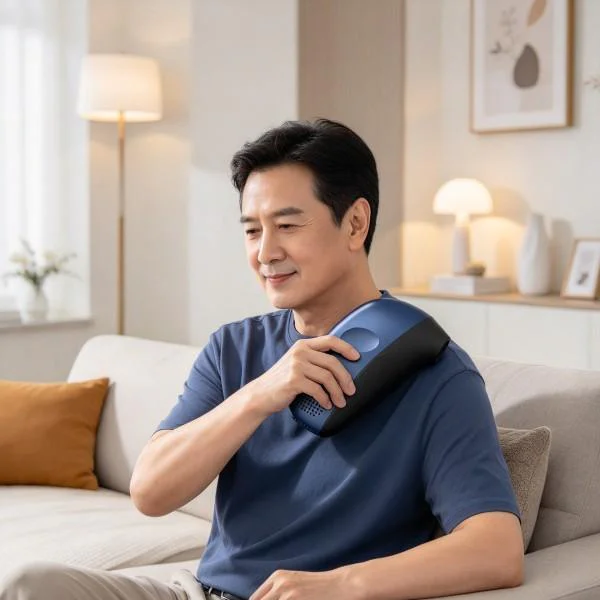
Medial epicondylitis lingers because the dense, poorly vascularized common flexor tendon origin traps micro-tears in a persistent metabolic bottleneck that topical balms and oral painkillers cannot reach. For those exploring golf elbow treatment alternatives beyond temporary symptom suppression, targeted 960nm photobiomodulation (PBM) provides a non-invasive physical therapy method that passes directly through dense connective tissue to restart localized microvascular repair. Unlike repeated systemic anti-inflammatory drugs or localized steroid injections, this focused optical energy provides zero metabolic toxicity to your stomach, liver, or kidneys while supporting collagen rebuilding directly at the bone-tendon junction.
Daily Struggles of Inner Elbow Strain and Conventional Care Limits
Living with persistent golf elbow makes everyday hand and forearm tasks feel like an ordeal. Gripping a steering wheel firmly, carrying a heavy grocery sack, or unscrewing a jar lid produces a sharp, burning pinch along the inner bony knob of the elbow. Even clicking a mouse repeatedly, carrying a briefcase, or pulling open a heavy door triggers a deep, toothache-like throb that radiates down into the wrist flexors and ring finger.
As the condition becomes chronic, simple daily routines break down. You catch yourself dropping objects because your fingers give out under sudden grip load. At night, sleeping with a bent arm pinches the inflamed medial compartment, waking you with a throbbing elbow ache and tingling in the pinky side of your hand.
Many people cycle through standard conservative golfer’s elbow treatments, only to run into clear physical boundaries:
Oral NSAIDs and topical analgesic gels: They temporarily numb sensory nerve endings, but systemic circulation cannot drive sufficient molecules into hypovascular tendon fibers, and long-term use frequently irritates the stomach lining.
Forearm counterforce bands: They alter the mechanical angle of muscle pull, but wearing a tight band for hours compresses underlying ulnar microvessels and leaves the damaged tendon enthesis stiff and unhealed.
Drugstore ice packs and superficial heating pads: Cold application slows natural cellular repair by constricting capillary blood flow, while standard heating pads only warm the top few millimeters of skin, failing to penetrate the thick flexor mass anchored against cortical bone.
The Pathological Impasse: Avascular Tendinosis and Cellular Gridlock
Persistent inner elbow distress is rarely a simple acute inflammatory episode. In physical medicine and rehabilitation, it is identified as tendinosis—a degenerative condition where tenocytes enter a low-energy, hypoxic standstill behind dense collagen layers.
Repetitive Flexor Tension & Repetitive Micro-Tears
  ↓
Avascular Medial Epicondyle Zone Starved of Capillary Flow
  ↓
Mitochondrial ATP Exhaustion & Tissue Hypoxia
  ↓
Disorganized Type III Collagen & Persistent Grip Weakness
The pronator teres and flexor carpi radialis share an attachment footprint at the medial epicondyle that sits in a distinct watershed zone with naturally sparse capillary networks. After repetitive mechanical strain, local microvessels undergo micro-thrombosis rather than initiating a productive healing response.
Deprived of oxygen and nutrients, resident tenocytes lack the cellular fuel to synthesize aligned, durable Type I collagen fibers, leaving weak, disorganized Type III collagen in its place. Accumulated metabolic waste products, substance P, and acidic byproducts pool in the interstitial matrix, keeping local pain receptors constantly activated. Surface-level interventions cannot break this cycle because they lack the physical energy required to penetrate dense connective tissue.
The 960nm Solution: Bypassing Dense Connective Tissue Barriers
When physical rehabilitation specialists design advanced physical modalities for inner elbow tendinosis, wavelength selection dictates clinical success.
Optical Physics: Why 960nm Succeeds Where Red Light Fails
Common red light wavelengths (630nm to 660nm) scatter and absorb heavily within epidermal melanin and superficial blood vessels, losing energy within the first few millimeters of tissue. While 850nm near-infrared light travels deeper, it still scatters significantly when confronting the dense, multi-layered collagen matrix of the common flexor tendon sheath.
Targeted 960nm near-infrared light operates within an optimal optical transmission window for human musculoskeletal structures. It exhibits low scatter against dense, fibrous connective tissue and cortical bone surfaces, allowing photons to penetrate smoothly through the skin and fascia directly into the deep flexor tendon origin and underlying periosteum.
Photobiological Mechanisms: Cellular Energy and Vascular Drainage
Once photons arrive at the degenerative tendon core, they activate a precise photobiological cascade:
Cytochrome c Oxidase Photo-Activation: Photons bind to unit IV of the mitochondrial respiratory chain, clearing inhibitory nitric oxide bonds and restoring cellular respiration.
Adenosine Triphosphate (ATP) Resynthesis: Tenocytes regain the energy reserves required to fuel active protein synthesis, switching tissue repair from fragile Type III collagen back to organized, load-bearing Type I collagen fibers.
Nitric Oxide (NO) Vasodilation: Controlled photodissociation of nitric oxide dilates surrounding microvessels, flushing out accumulated acidic byproducts and delivering fresh oxygenated blood to the hypovascular tendon origin.
Multi-Factorial Treatment Comparison
Evaluation Metric
Oral NSAIDs & Cortisone Injections
Superficial Heat & Standard Red Light (650nm)
Targeted 960nm Deep Tissue PBM
Tissue Penetration Depth
Systemic distribution; minimal concentration at the dense tendon core
1 to 3 mm (absorbed primarily within skin and superficial capillaries)
Penetrates dense tendon collagen, aponeurosis, and cortical bone interfaces
Single hardware acquisition; reusable across multi-year home use
Clinical and Home Application Case Record
The following structured tracking log documents a real-world home rehabilitation program monitoring changes across an eight-week intervention cycle.
Patient Profile and Baseline Assessment
Participant: Male, 47 years old, Commercial Plumber and Recreational Golfer.
Diagnostic Assessment: Grade II chronic medial epicondylosis of the dominant right arm (symptoms persisting for 8 months; failed rest, counterforce bracing, and two ultrasound therapy rounds).
Baseline Markers: Patient-Rated Forearm and Elbow Evaluation (PRTEE) score: 69/100. Pain-free grip strength: 17.5 kg (uninjured left hand: 45.0 kg). Visual Analog Scale (VAS) during tool use and swing follow-through: 8/10.
Structured Protocol
Intervention: Non-invasive 960nm near-infrared deep photobiomodulation (handheld unit).
Application Sites: Right medial humeral epicondyle (common flexor enthesis), pronator teres muscle belly, and proximal wrist flexor mass.
Dosage Schedule: 8 minutes per site, once daily in the evening for 14 consecutive days; reduced to 3 sessions per week during weeks 3 through 8, paired with slow eccentric wrist flexion exercises.
Progressive Metric Tracking Log
Follow-up Milestone
VAS Pain Score (0–10)
PRTEE Score (0–100)
Pain-Free Grip Strength (Dynamometer)
Functional Tool Handling & Daily Impact
Day 1 (Baseline)
8 / 10
69 / 100
17.5 kg
Unable to tighten pipe fittings or carry heavy toolboxes; severe morning elbow tightness
Day 7
6 / 10
55 / 100
21.0 kg
Evening throb settles within an hour of resting; morning stiffness cut in half
Day 14
4 / 10
36 / 100
27.2 kg
Able to handle pipe wrenches without sharp inner elbow pain; zero nighttime resting ache
Day 30
2 / 10
19 / 100
36.0 kg
Completed full plumbing job shifts without mid-day brace support; steady grip
Day 60 (Follow-up)
0–1 / 10
8 / 100
43.5 kg
Near-symmetric grip strength restored; completely independent of oral painkillers
“Lifting heavy pipe sections and wrenching fittings with chronic inner elbow pain was pure agony for over eight months. Every time I gripped a tool tightly, a sharp, burning catch went right through that inner elbow bone, and my grip would slip without warning. Braces pinched my arm, and pain pills only wrecked my digestion. When I began holding the 960nm device over the inner elbow each night, I felt a deep, soothing warmth sink right down to the bone. Within two weeks, that constant deep ache calmed down, and I could finally carry my tool chest and grip a wrench without dreading the pain.”
Physical Sensation and Clinical Safety Boundaries
Applying a targeted 960nm unit does not feel like an aggressive cold laser or a superficial hot pad. As the near-infrared energy penetrates into the flexor tendon sheath, you will feel a comfortable, deep soothing warmth that gradually relaxes forearm muscular tightness. There are no painful prickling sensations, no electric shocks, and no skin burning.
Ideal Candidates
Trade workers, desk professionals, and athletes managing chronic medial elbow stiffness and grip strain from repetitive hand tasks.
Patients who want to support their physical therapy exercises or chiropractic adjustments at home without relying on continuous NSAID intake.
Chronic tendon sufferers looking for a sustained maintenance solution to keep fibrous tissue elastic and well-perfused.
Clear Safety Boundaries and Contraindications
Active Malignancies: Never apply the device directly over known, active, or suspected neoplastic tumors.
Implanted Medical Electronics: Do not shine the unit directly over cardiac pacemakers, spinal cord stimulators, or specialized electronic implants.
Active Hemorrhage: Avoid treatment immediately following severe acute trauma or torn tissue while active internal bleeding is present.
Acute Septic Joint Concerns: If the elbow joint is swollen with red hot skin, accompanied by a fever or chills, seek immediate medical evaluation to rule out infectious bursitis or joint infection before applying physical therapy.
Biological Recovery Milestones and Economic Reality
Tendon remodeling requires adherence to biological timelines rather than looking for unrealistic overnight solutions.
Navigating chronic tendon rehabilitation across clinics, ongoing physical therapy co-pays, diagnostic elbow imaging, multiple braces, and lost work shifts regularly tallies up to $1,200 to $3,500 every year. Adding a dedicated 960nm handheld wellness device gives you an evidence-based clinical modality right at your desk or bedside table, providing convenient long-term care for elbow, shoulder, or foot issues across your household without ongoing clinic bills.
Practical Application and Frequently Asked Questions
Can I use this device on the same day I perform my rehabilitation exercises?
Yes. Using your 960nm device immediately before gentle eccentric loading exercises is highly effective. The near-infrared photons open local microvascular flow, improve tendon elasticity, and reduce resting nerve irritability, allowing you to perform your rehab drills with improved range of motion and less discomfort.
How does this approach differ from shockwave therapy or ultrasound?
Ultrasound primarily vibrates fluid molecules through acoustic shear waves, and shockwave uses high-energy mechanical acoustic pulses to create micro-trauma. In contrast, 960nm photobiomodulation works purely through photochemical energy. It directly excites mitochondrial respiratory enzymes without producing tissue trauma, mechanical micro-tearing, or intense procedural pain.
How long does each session take, and can I treat both elbows?
A standard application requires just 8 minutes per targeted zone, meaning an entire elbow session is finished in under 20 minutes. If you experience bilateral discomfort from repetitive desk typing or trade work, you can treat both arms back-to-back while reading or watching television.
Chronic sinus congestion persists because inflamed mucosal tissue inside the maxillary and frontal cavities becomes trapped in a cycle of poor microcirculation, localized oxygen deprivation, and stalled lymphatic drainage. Targeted 960nm photobiom...
Chronic sinus pain persists when constricted microvessels and trapped fluids lock the mucosal lining into a low-oxygen state behind facial bones. Targeted 960nm photobiomodulation (PBM) delivers coherent optical energy through cortical bone struct...
Recalcitrant outer elbow pain persists because repetitive tensile strain causes microvascular collapse and failed tendon remodeling at the extensor carpi radialis brevis origin, leaving the connective tissue starved of oxygen. While individuals tr...
 Handheld Home-Use Therapy Device