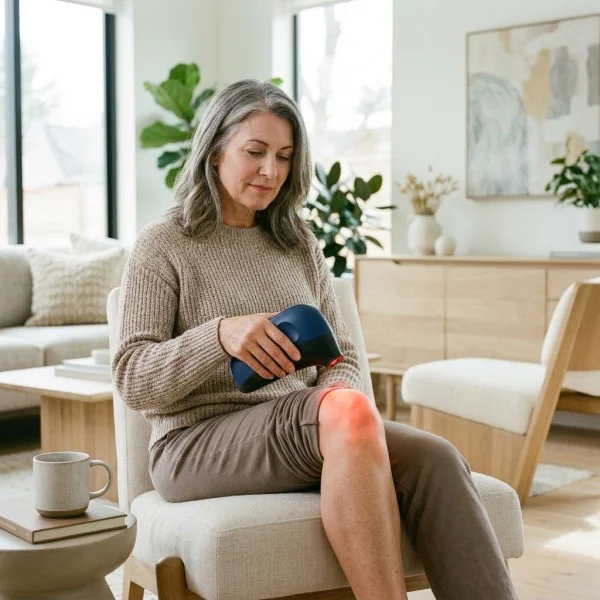
Recalcitrant outer elbow pain persists because repetitive tensile strain causes microvascular collapse and failed tendon remodeling at the extensor carpi radialis brevis origin, leaving the connective tissue starved of oxygen. While individuals try common treatments for tennis elbow pain like rest, forearm braces, and pain medications, these superficial approaches fail to stimulate cellular remodeling within the avascular tendon core. Targeted 960nm photobiomodulation (PBM) introduces an advanced physical modality: near-infrared photons pass directly through dense forearm tendons and periosteum to reactivate mitochondrial ATP synthesis and clear trapped metabolic waste. This targeted therapy accelerates tennis elbow rehab without systemic drug toxicity, gastrointestinal irritation, or steroid-induced tendon degeneration.
The Daily Burden of Weakened Grip and Forearm Fatigue
Living with chronic lateral epicondylitis turns routine hand movements into painful obstacles. Squeezing a water bottle, lifting a cast-iron skillet, or turning a door handle sends a sharp, sickening ache radiating through the outer elbow down to the wrist. By mid-day, typing on a keyboard or clicking a mouse causes a deep, persistent burn along the forearm extensors that makes focus impossible. The quiet worry of dropping objects and the frustration of losing hobbies like gardening, weight training, or racket sports gradually wear down your daily morale.
Oral anti-inflammatory medications temporarily mask nerve discomfort, but chronic use risks gastric ulcers, kidney strain, and masks continuous tendon breakdown.
Corticosteroid injections offer rapid short-term relief, yet multiple clinical trials link them to long-term collagen disruption, elevated recurrence rates, and higher risk of tendon rupture.
Forearm compression bands alter muscle tension vectors during use, but sustained mechanical pressure further restricts microvascular blood flow across the already ischemic tendon insertion.
Superficial hot packs and paraffin baths soothe the surface skin of the forearm, but conductive heat drops off within two millimeters of the epidermis, completely blocked by dense fascial sheaths.
Root Pathology: Microvascular Ischemia and Failed Tendon Repair
The underlying pathology of persistent elbow pain is angiofibroblastic tendinosis rather than active acute inflammation. Repetitive micro-trauma triggers disorganized fibroblast proliferation and chaotic, non-functional capillary bud formation, producing immature collagen fibers that fail to bear normal tensile loads.
This swollen, disorganized tissue creates mechanical backpressure on low-pressure microvascular loops. As blood flow stalls, local tissue oxygenation drops significantly. Deprived of oxygen, resident tenocytes suffer adenosine triphosphate (ATP) depletion, halting the synthesis of mature type I collagen. Lactic acid and sensory neuropeptides accumulate within the tendon core, perpetuating chronic pain that surface creams and passive rest cannot resolve.
960nm Photobiology: Piercing the Dense Fibrous Enthesis
Effective photobiomodulation in tendon pathology requires delivering therapeutic photon fluence through dense, highly reflective connective tissue. Standard visible red light (630–660nm) absorbs heavily into epidermal melanin and dermal hemoglobin, dissipating in superficial layers. Shorter near-infrared light (810–850nm) scatters intensely across the parallel, dense collagen bundles of forearm tendons.
Targeted 960nm radiation operates in an optimal near-infrared window, pairing low collagen scattering with balanced tissue transmission to bypass the skin, fascial sheath, and periosteum:
Tissue Layer
 Epidermis       │ 650nm (Red Light)    ──► Quenched by superficial melanin (<2mm)
                 │
 Deep Fascia     │ 850nm (Short NIR)    ──► Scattered by dense collagen fibers (3–5mm)
                 │
 ECRB Tendon/Bone│ 960nm (Targeted Deep)──► Transmits through tendon to enthesis (15–20mm)
                 ▼
The Biological Healing Sequence
Complex IV Excitation: 960nm photons target mitochondrial Cytochrome c Oxidase, displacing inhibitory nitric oxide and restoring the inner-membrane proton pump.
ATP Synthesis Surge: Adenosine triphosphate generation climbs rapidly, fueling tenocytes to synthesize mature type I collagen fibrils and clear cellular debris.
Endothelial Nitric Oxide Release: Photonic liberation of nitric oxide prompts regional microvascular vasodilation, opening collapsed capillaries and washing out acidic pain metabolites.
Lymphatic Decompression: Restored vascular outflow lowers interstitial hydrostatic pressure, allowing hyperplastic, swollen tendon tissue to retract and relieving mechanical tension across the lateral epicondyle.
Multi-Modal Comparison: Strategies for Lateral Epicondylalgia
Evaluation Parameter
Oral NSAIDs & Cortisone Injections
Superficial Heat & Red Light Wraps
Targeted 960nm Photobiomodulation
Tissue Penetration Depth
Systemic chemical circulation
1–3 mm (stops at skin and outer fat)
15–20 mm (transmits through dense tendon)
Cellular Mechanism
COX-2 enzyme blockade; collagen catabolism
Superficial conductive warmth
Mitochondrial activation, ATP restoration, tenocyte remodeling
None; non-ionizing, non-thermal, zero structural damage
Home Usability
High; oral tablets or clinic appointments
Moderate; messy water preparation or wraps
Exceptional; compact handheld ergonomic session at home
Annual Financial Impact
$450–$1,100 on doctor visits and prescriptions
$50–$120 on heating pads and elastic bands
Single equipment acquisition; zero recurring consumable fees
Documented Clinical Case Record
Patient Profile: 43-year-old female, professional graphic designer and amateur rock climber.
Clinical Diagnosis: Chronic lateral epicondylalgia of the dominant left arm with partial micro-tearing at the ECRB tendon footprint (Duration: 8 months).
Baseline Presentation: Visual Analog Scale (VAS) pain score of 7.5/10 with resisted wrist extension, Patient-Rated Tennis Elbow Evaluation (PRTEE) score of 68/100, maximum pain-free grip strength of 11 kg (uninjured right arm: 32 kg). Previous treatments included physical therapy with ultrasound (minimal change) and oral meloxicam (stopped due to gastric upset).
Treatment Protocol: Application of a calibrated 960nm handheld photobiomodulation device directly over the left lateral epicondyle and radial extensor muscle belly, 10 minutes per session, once daily for 8 consecutive weeks alongside progressive eccentric wrist loading.
Longitudinal Progress Log
Timeline
Frequency
Key Measured Metrics
Functional Outcomes & Patient Presentation
Baseline
Intake assessment
VAS: 7.5/10; PRTEE: 68; Grip: 11 kg
Severe pain gripping stylus, holding coffee cup, or opening jars
Week 2
7 sessions/wk
VAS: 5.0/10; PRTEE: 45; Grip: 18 kg
Resting forearm burning resolved; increased tolerance for daily mouse work
Week 4
7 sessions/wk
VAS: 2.0/10; PRTEE: 22; Grip: 26 kg
Pain-free computer design work; able to carry grocery bags without bracing
Week 8
4 sessions/wk
VAS: 0/10; PRTEE: 4; Grip: 31 kg
Symmetric grip strength restored; resumed low-grade bouldering without flare-up
“Using my design tablet became excruciating—holding a stylus for twenty minutes left my forearm on fire, and I was dropping coffee cups because my grip would suddenly give out. Anti-inflammatories tore up my stomach and ice packs just made the tendon feel stiffer. When I began applying the 960nm device, there was no painful vibration or shock—just a steady, deep warmth penetrating straight into the tendon attachment. By the third week, the sharp twinges while clicking and drawing were completely gone, and after two months, I was back on the climbing wall without any brace.”
Application Experience, Boundaries, and Medical Precautions
A session with a calibrated 960nm unit produces a gentle, deeply comforting thermal sensation across the lateral epicondyle and forearm extensor belly. Because this wavelength operates outside ionizing radiation and high-heat ablation spectra, there is zero electric shock, tissue burning, or surface stinging.
Safe Application Boundaries
Target Users: Individuals seeking non-pharmacological support for chronic extensor tendinopathy, persistent tennis elbow rehab, occupational forearm strain, and repetitive strain injuries.
Strict Contraindications: Do not shine the emitter over active cutaneous malignancies, directly across open infected lacerations, over areas with implanted electronic pacing devices, or in patients experiencing acute active joint hemorrhage.
Navigating chronic lateral elbow pain through repeated orthopedic consultations, physical therapy co-pays, and prescription rounds easily tallies between $1,500 and $3,200 annually, not counting lost working hours and productivity. Integrating a clinical-grade 960nm handheld system into your home routine delivers targeted optical energy directly to damaged tendon matrices with zero ongoing refill expenses, providing an accessible, drug-free wellness solution for the entire household.
Consistent daily use provides calibrated optical power density, clearing congested tissue beds and supporting long-term joint function across athletic and workplace demands.
Frequently Asked Questions
Can 960nm photobiomodulation permanently cure my tennis elbow?
Photobiomodulation does not alter biomechanics or act as an instant miracle. Instead of making unrealistic claims, it addresses the physiological bottleneck of chronic tendinopathy: it flushes pooled inflammatory fluid, restores cellular ATP, and promotes healthy collagen remodeling, giving the tendon the biological resources needed to heal under proper load management.
How does 960nm light differ from an ordinary heating pad?
Heating pads warm only the outer epidermal layers, with thermal energy dissipating within 2 millimeters of superficial skin. A targeted 960nm device emits near-infrared photons that travel 15 to 20 millimeters through dense tendons and fascia, directly stimulating tenocyte mitochondria.
Can I pair 960nm light therapy with eccentric rehab exercises?
Yes. Using 960nm light immediately prior to eccentric loading exercises warms the collagen matrix, increases microvascular perfusion, and enhances cellular responsiveness, making rehabilitation exercises significantly more comfortable and productive.
Understanding how to fix erectile dysfunction requires targeting microvascular insufficiency and cavernous smooth muscle fibrosis rather than relying solely on temporary chemical vasodilation. Recurrent vascular difficulties persist because chroni...
An inflamed prostate and progressive glandular enlargement persist because impaired pelvic microcirculation and chronic venous stasis trap deep parenchymal tissue in a state of continuous hypoxia. Men searching for a sustainable, natural way to sh...
Benign prostatic hyperplasia and chronic pelvic congestion linger because the transition zone of the prostate sits deep within a rigid pelvic floor, where microvascular compression causes localized ischemia and fluid entrapment. Targeted 960nm pho...
 Handheld Home-Use Therapy Device