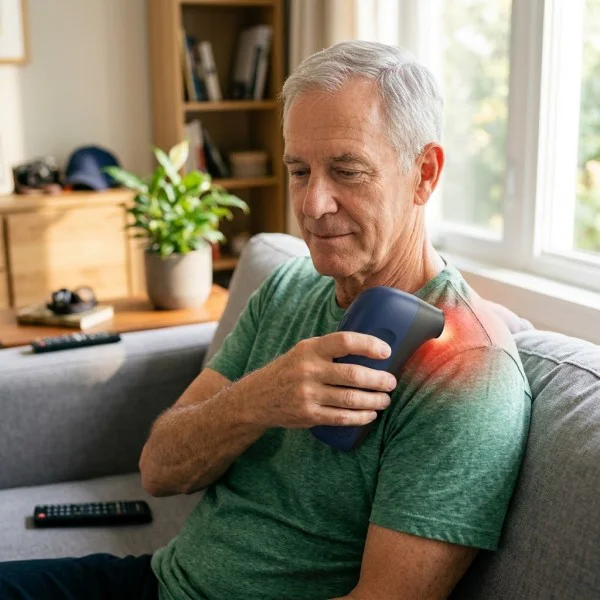
Chronic outer elbow tenderness and grip failure persist when the extensor carpi radialis brevis (ECRB) origin stalls in an angiofibroblastic degenerative cycle marked by microvascular collapse, localized tissue hypoxia, and failed collagen synthesis. Targeted 960nm photobiomodulation (PBM) delivers non-ionizing optical energy through dense fibrous aponeuroses and periosteal attachments directly into the hypovascular enthesis, restoring cellular ATP production and capillary perfusion. Unlike non-steroidal anti-inflammatory drugs that place toxic metabolic strain on the kidneys and digestive tract while inhibiting structural collagen synthesis, this non-invasive biophysical approach accelerates localized tissue drainage and tenocyte repair without systemic side effects or rebound inflammation.
Whether you are seeking a reliable clinical protocol for elbow pain tennis elbow treatment, incorporating targeted tennis elbow pt exercises, or looking for a structured tennis elbow exercises treatment at home, applying calibrated near-infrared energy directly to the tendon footprint breaks the microcirculatory standstill where superficial lotions and standard braces fail.
When Daily Hand and Forearm Tasks Become Painful Hurdles
Living with chronic lateral epicondylalgia turns minor everyday motions into agonizing tests of endurance. Squeezing toothpaste onto a brush, lifting a half-empty teapot, clicking a computer mouse, or turning a stiff brass doorknob sends sharp, electric twinges tearing through the outer elbow into the wrist extensors. By mid-afternoon, typing an email or holding a telephone provokes a persistent, bone-deep ache right over the lateral epicondyle that forces you to rest your arm on the desk.
At night, resting your forearm against a firm mattress triggers a throbbing sensation that frequently breaks sleep architecture. Common first-line remedies often leave individuals stuck in a cycle of diminishing returns:
Oral NSAIDs (naproxen, meloxicam): Temporarily mask pain by interrupting prostaglandin synthesis, but frequent use causes stomach lining erosion and gut dysbiosis while actively impairing tenocyte proliferation and tendon collagen cross-linking.
Corticosteroid injections: Deliver brief, dramatic pain relief for a few weeks, yet randomized clinical trials prove they lead to high recurrence rates, microvascular necrosis, and irreversible structural tendon atrophy at 6-to-12-month checkups.
Forearm counterforce bands: Shift mechanical anchor points during manual tasks, but they constrict local venous return and do nothing to repair disordered tendon collagen fibers once removed.
Superficial heating pads and menthol rubs: Stimulate surface skin thermoreceptors, but conductive thermal energy dissipates entirely within the subdermal fat layer, never reaching the dense, avascular tendon-bone junction.
The Biological Bottleneck in the Hypovascular Enthesis
Chronic lateral epicondylalgia is rarely an acute inflammatory issue; it is a degenerative tendinosis characterized by localized microvascular failure and cellular energy exhaustion. Repetitive eccentric wrist loads create microscopic tears at the common extensor origin, establishing a persistent metabolic loop:
Because the common extensor tendon origin is naturally hypovascular—receiving sparse baseline blood flow compared to vascularized muscle tissue—it cannot clear metabolic waste or synthesize dense Type I collagen fibers on its own once damaged. Breaking this stagnation requires a targeted physical stimulus that traverses dense connective tissue to restore mitochondrial respiration, cellular energy, and microvascular flow.
Penetration Physics: Why 960nm Reaches Deep Connective Tissue
Photobiomodulation efficacy depends entirely on optical penetration physics. Superficial red light (630nm–660nm) scatters heavily in epidermal melanin and hemoglobin, depositing almost all radiant energy within the first two to three millimeters of superficial dermis.
Targeted 960nm near-infrared light sits within an optical transmission window optimized for deep, dense connective tissues, offering significantly lower scattering through fibrous aponeuroses, deep fascia, and periosteal bone:
When 960nm photons reach hypoxic tenocytes, fibroblasts, and microvascular endothelial cells, they trigger a cascade of cellular repair:
Cytochrome c Oxidase Photo-Activation: Photons are absorbed by unit IV of the mitochondrial respiratory chain, displacing bound nitric oxide that blocks cellular oxygen consumption during chronic hypoperfusion.
Mitochondrial ATP Resynthesis: Electron transport accelerates, generating fresh adenosine triphosphate (ATP) to power tenocyte protein synthesis, cellular repair enzymes, and active ion transport pumps.
Endothelial Nitric Oxide Release: Photodissociation releases controlled, non-thermal nitric oxide directly into local capillary smooth muscle, prompting targeted microvascular vasodilation and bringing fresh oxygenated blood to the avascular tendon zone.
Collagen Synthesis and Waste Evacuation: Enhanced cellular energy fuels prolyl hydroxylase activity for organized Type I collagen synthesis, while improved local circulation washes away substance P, bradykinin, and trapped acidic metabolites.
Systemic distribution; very low local tendon uptake
1–3 mm (arrested in skin and superficial fat)
15–25 mm (passes dense fascia to tendon enthesis)
Cellular Mechanism
COX inhibition or gene transcription suppression
Superficial cutaneous warmth; zero ATP gain
Mitochondrial enzyme photo-activation and tenocyte repair
Side Effect & Risk Profile
High (GI bleeding, cartilage/tendon necrosis, relapse)
Negligible
Non-invasive, zero chemical rebound, non-thermal
Home Feasibility
Simple dosing, but offers no structural tissue repair
Accessible, but symptomatic relief vanishes within an hour
10–12 minute quiet, non-invasive home sessions
Annual Cumulative Cost
$300–$900 in recurring pills, copays, and injections
$20–$50 (very limited therapeutic scope)
Single device acquisition with multi-year household use
Detailed Clinical Case Record
The clinical data below outlines an 8-week structured home protocol monitored for a 51-year-old male commercial plumbing contractor presenting with chronic unilateral lateral epicondylalgia (Grade II tendinosis) in his dominant right arm.
Patient Profile and Baseline Parameters
Age / Biological Sex: 51 / Male
Clinical Presentation: Severe lateral elbow aching, sharp pain on resisted wrist extension (Cozen’s test positive), inability to turn pipe wrenches or carry toolboxes, nocturnal sleep interruptions
Prior Therapies: Oral diclofenac 75mg daily for 5 months, one cortisone injection 3 months prior (pain relapsed after 5 weeks), constant elbow sleeve wear
Baseline Patient-Rated Tennis Elbow Evaluation (PRTEE): 78 / 100 (Indicates severe pain and functional disability)
Baseline Pain-Free Grip Strength (Dynamometer): 17.1 kg (Marked deficit compared to unaffected left arm: 47.8 kg)
Baseline Diagnostic Ultrasound: Significant hypoechoic thickening and intrasubstance tears within the common extensor tendon origin, accompanied by periosteal cortical irregularity
Application Sites: Direct contact over the lateral epicondylar prominence, the extensor carpi radialis brevis tendon origin, and the proximal extensor muscle belly.
Dosing Routine: 12 minutes per session once daily for weeks 1 through 4; tapering to 3 maintenance sessions per week during weeks 5 through 8.
CLINICAL TRACKING: 8-WEEK RECOVERY PROGRESSION
========================================================================
Evaluation Interval   PRTEE Score (0-100)   Grip Strength (kg)   Observed Functional Changes
------------------------------------------------------------------------
Baseline (Day 0)      78 / 100              17.1 kg              Severe pain holding wrench, dropped kettle
Week 2                58 / 100              23.4 kg              Night throb gone; morning stiffness reduced
Week 4                27 / 100              35.8 kg              Able to carry toolboxes; typing without pain
Week 8 (Follow-Up)     7 / 100              46.2 kg              Normal heavy wrench grip, negative Cozen's
========================================================================
Direct Patient Observation
“Working with heavy pipe fittings and power wrenches every day became impossible. Every turn of a wrench felt like someone was driving an ice pick into my elbow bone, and holding a cup of coffee in the morning made my hand tremble. The cortisone shot worked for a month, but then the pain roared back worse than before, and taking anti-inflammatories every day gave me terrible heartburn. Using the 960nm handheld unit was an entirely different experience. There was no buzzing or skin burning—just a soothing, deep warmth that seemed to soak straight into that tight, tender spot on the bone. By the fourth week, the sharp catching sensation when gripping was completely gone, and I could finally sleep on my right side without waking up aching. I’m back on the job full-time with normal grip strength and zero pain medication.”
Sensory Expectations and Safety Boundaries
Applying 960nm photobiomodulation to the lateral elbow is comfortable, gentle, and straightforward, but recognizing its physical profile and clear contraindications ensures safe, effective recovery.
What You Will Feel
Targeted 960nm near-infrared energy is non-thermal and non-ablative. Within two to three minutes of direct application, you will notice a mild, soothing sensation of deep warmth spreading through the joint capsule and forearm extensors as microvascular perfusion expands. There is no electrical shock, stinging, vibrating sensation, or skin redness. Tissues feel relaxed, supple, and unburdened rather than tender or irritated.
Clinical Contraindications
Active Malignancies: Never apply photobiomodulation directly over known, suspected, or untreated oncological lesions in the upper extremity.
Acute Hemorrhage or Fractures: Do not use light fields over acute traumatic fractures of the radial head, unhealed surgical incisions, or active subcutaneous bleeding.
Implanted Electronics: Individuals with local electronic implants or neurostimulators situated near the upper extremity or ipsilateral chest quadrant should consult their physician before applying near-infrared light nearby.
Active Septic Arthritis: Sudden joint swelling accompanied by systemic high fever, severe redness, and purulent joint effusion requires emergency orthopedic medical care, not home light therapy.
Recovery Milestones and Financial Value
Restoring dense, hypovascular tendon fibers follows natural biological collagen turnover timelines. Photobiomodulation does not artificially mask sensory nerve endings; it systematically clears microvascular stagnation and supports cellular collagen remodeling.
PHYSIOLOGICAL RECOVERY ROADMAP
========================================================================
Phase 1: Weeks 1–2 (Microvascular Mobilization)
* Marked drop in resting elbow throb and sharp morning stiffness
* Resolution of nocturnal pain, allowing comfortable sleeping on the affected side

Phase 2: Weeks 3–4 (Tenocyte Activation & Tissue Remodeling)
* Noticeable recovery in pain-free grip strength and lifting capacity
* Ability to type, turn doorknobs, and use handheld tools without sharp flare-ups

Phase 3: Weeks 5+ (Collagen Maturation & Stability)
* Shift from daily corrective sessions to 2-3 weekly maintenance sessions
* Resilient extensor tendon fibers capable of handling repetitive eccentric loads
========================================================================
Outpatient physical therapy appointments, shockwave therapy, and specialized laser sessions regularly cost between $90 and $175 per visit. Over a standard eight-to-twelve-week clinical rehabilitation program, copays, travel time, and lost work hours frequently add up to over $1,500. Having an ergonomic, multi-wavelength 960nm handheld system at home provides clinical-grade optical support whenever tendon tightness begins, offering immediate convenience and long-term utility for the whole household.
Practical Home Routine and Frequently Asked Questions
When incorporating photobiomodulation alongside sensible eccentric strengthening exercises (Tyler twist protocols), forearm stretching, and ergonomic workstation adjustments, near-infrared light provides the deep metabolic energy needed for tissue repair. Reviewing device technical parameters, broad beam coverage, and gentle positioning methods ensures you deliver effective optical energy directly to the affected tendon footprint without creating mechanical shear stress.
Frequently Asked Questions
Can 960nm light help if my tennis elbow has lasted for over a year?
Yes. Chronic cases lasting months or years are typically degenerative tendinosis rather than acute inflammation. The tendon origin is stuck in a low-oxygen, hypovascular state with disrupted collagen fibers. The 960nm wavelength penetrates deep into the avascular enthesis to activate Cytochrome c Oxidase, kickstarting the cellular energy and blood flow necessary to remodel chronic, stagnant tendon tissue.
How does 960nm photobiomodulation differ from an elbow heating pad?
Heating pads rely purely on thermal conduction, which warms only the epidermis and superficial fat before blood flow carries the heat away. Calibrated 960nm light utilizes specialized near-infrared photons that travel 15 to 25 millimeters deep through dense fascia and periosteal attachments without surface burns, stimulating mitochondrial enzymes directly inside the damaged tendon origin.
How often should I use the light once my elbow pain is gone?
Once you regain complete, pain-free grip strength and normal arm function—typically around week 4 or 5—you can step down from daily sessions to a maintenance schedule of two or three 10-minute sessions per week, especially after heavy lifting, sports, or intensive computer work. This prevents metabolic waste buildup and maintains healthy local microcirculation.
Persistent rhinitis is sustained by a continuous cycle of microvascular congestion, mucosal interstitial edema, and hypoxic lymphatic stagnation within the deeper paranasal turbinate beds. While standard treatments for rhinitis often attempt super...
Chronic pelvic pain and persistent urinary obstruction refuse to clear because microvascular networks inside the dense prostatic capsule collapse under interstitial fluid pressure, starving deep stromal tissue of oxygen. While countless men search...
Facial motor asymmetry and prolonged flaccidity persist when the seventh cranial nerve remains trapped in microvascular edema, neural hypoxia, and mitochondrial bioenergetic exhaustion inside the narrow Fallopian canal. Targeted 960nm photobiomodu...
Persistent breast inflammation lingers because microvascular congestion and interstitial edema compress delicate ductal networks from the outside, trapping fluids in an ongoing metabolic standstill that surface compresses and oral pills fail to pe...
 Handheld Home-Use Therapy Device