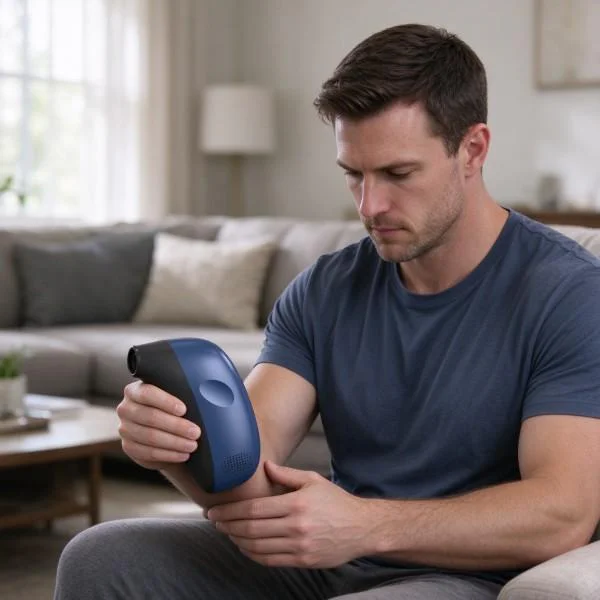
Medial epicondyle soreness persists because repetitive tension leaves the common flexor tendon trapped in a localized metabolic stall, where dense, avascular fibrous cords cannot draw enough nutritive blood flow to repair on their own. When searching for practical golf elbow treatment alternatives beyond short-term fixes, targeted 960nm photobiomodulation (PBM) serves as a non-invasive physical therapy method that passes straight through dense connective tissue to restore microvascular drainage and cellular energy at the bone-tendon interface. Unlike repeated anti-inflammatory pills or steroid injections, this focused optical approach delivers zero chemical burden to your stomach or liver while providing the cellular support necessary for true collagen renewal.
The Daily Toll of Medial Elbow Strain and Common Therapy Bottlenecks
Anyone living with recurring golf elbow knows how quickly routine physical habits turn painful. Turning a tight doorknob, lifting a cast-iron skillet off the stove, or carrying a loaded grocery bag sends a sharp, sickening catch straight through the inner knob of your elbow. Typing at a desk or clicking a mouse for hours triggers a persistent, toothache-like throb that radiates down your inner forearm into the wrist and ring finger.
As the weeks wear on, everyday manual tasks become frustrating. You find yourself dropping lightweight objects because your wrist flexors suddenly fatigue under modest loads. At night, sleeping with a bent arm compresses the already swollen medial compartment, waking you repeatedly with deep inner elbow aching and numbness in your little finger.
Many people explore conventional golfer’s elbow treatments, only to encounter clear physical boundaries:
Oral NSAIDs and topical patches: Mask acute nociceptive pain for a few hours, but systemic circulation delivers almost none of the active compounds into dense, hypovascular tendon fibers, while ongoing use frequently irritates the stomach lining.
Forearm counterforce bands: Mechanically disperse tension across the muscle belly during movement, but wearing them throughout the day compresses local microvessels and leaves the damaged tendon enthesis unhealed.
Drugstore gel packs and heating pads: Ice slows cellular repair by blunting local blood flow, while standard heating pads warm only the top 1 to 2 millimeters of skin, completely failing to reach the hypovascular enthesis where the tendon anchors into cortical bone.
The Pathological Impasse: Avascular Tendinosis and Cellular Gridlock
Persistent medial elbow distress is rarely a short-term inflammatory event. In modern physical medicine, it is classified as tendinosis—a chronic, degenerative state where cellular metabolism stalls behind dense connective tissue.
Repetitive Flexor Eccentric Loading & Micro-Tears
  ↓
Avascular Medial Epicondyle Zone Deprived of Capillary Flow
  ↓
Tenocyte Hypoxia & Mitochondrial ATP Depletion
  ↓
Disorganized Type III Collagen & Chronic Loss of Grip Strength
The pronator teres and flexor carpi radialis insert into the medial epicondyle through a shared tendon sheath that possesses naturally poor blood supply. Following repetitive micro-tears from manual tasks or athletic swings, local microvessels fail to deliver adequate arterial blood flow to sustain active repair.
Deprived of continuous oxygenation, local tenocytes enter an energetic deficit, halting the synthesis of robust, load-bearing Type I collagen and laying down weak, disorganized Type III collagen. Stagnant lactic acid, substance P, and inflammatory mediators remain trapped within the extracellular matrix, keeping local nerve fibers sensitized. Surface-level remedies cannot break this cycle because they cannot penetrate dense aponeurotic tissue.
The 960nm Solution: Delivering Bio-Photons Through Dense Tendon Tissue
When rehabilitation specialists evaluate non-invasive physical modalities for stubborn tendinopathy, wavelength selection dictates whether therapeutic energy reaches the target.
Optical Physics: Why 960nm Reaches Where Red Light Stops
Common visible red light (630nm to 660nm) encounters high absorption from epidermal melanin and superficial blood vessels, losing its energy within the first few millimeters of tissue. While 850nm near-infrared light travels deeper, it still scatters significantly when confronting the dense, multi-layered collagen matrix of the common flexor tendon sheath.
Targeted 960nm near-infrared light operates within an optimal optical transmission window for human musculoskeletal structures. It exhibits low scatter against dense, fibrous connective tissue and cortical bone surfaces, allowing photons to penetrate smoothly through the skin and fascia directly into the deep flexor tendon origin and underlying periosteum.
Photobiological Mechanisms: Cellular Energy and Vascular Drainage
Once photons arrive at the degenerative tendon core, they activate a precise photobiological cascade:
Cytochrome c Oxidase Photo-Activation: Photons bind to unit IV of the mitochondrial respiratory chain, clearing inhibitory nitric oxide bonds and restoring cellular respiration.
Adenosine Triphosphate (ATP) Resynthesis: Tenocytes regain the energy reserves required to fuel active protein synthesis, switching tissue repair from fragile Type III collagen back to organized, load-bearing Type I collagen fibers.
Nitric Oxide (NO) Vasodilation: Controlled photodissociation of nitric oxide dilates surrounding microvessels, flushing out accumulated acidic byproducts and delivering fresh oxygenated blood to the hypovascular tendon origin.
Multi-Factorial Treatment Comparison
Evaluation Metric
Oral NSAIDs & Corticosteroid Injections
Superficial Heat & Standard Red Light (650nm)
Targeted 960nm Deep Tissue PBM
Tissue Penetration Depth
Systemic distribution; negligible delivery into dense avascular tendon
1 to 3 mm (absorbed primarily within skin and superficial capillaries)
Penetrates dense tendon collagen, aponeurosis, and cortical bone interfaces
Single hardware acquisition; reusable across multi-year home use
Clinical and Home Application Case Record
The following structured tracking log documents a real-world home rehabilitation program monitoring changes across an eight-week intervention cycle.
Patient Profile and Baseline Assessment
Participant: Male, 53 years old, Landscape Architecture Contractor.
Diagnostic Assessment: Grade II chronic medial epicondylosis of the dominant right arm (symptoms persisting for 11 months; non-responsive to rest, compression sleeves, and two full rounds of clinical ultrasound).
Baseline Markers: Patient-Rated Forearm and Elbow Evaluation (PRTEE) score: 73/100. Pain-free grip strength: 16.0 kg (uninjured left hand: 46.5 kg). Visual Analog Scale (VAS) during pruning shear operation and heavy wheelbarrow transport: 8/10.
Structured Protocol
Intervention: Non-invasive 960nm near-infrared deep photobiomodulation (handheld unit).
Application Sites: Right medial humeral epicondyle (common flexor enthesis), pronator teres origin, and anterior wrist flexor muscle belly.
Dosage Schedule: 8 minutes per site, once daily in the evening for 14 consecutive days; reduced to 3 sessions per week during weeks 3 through 8, accompanied by slow eccentric wrist-flexion exercises.
Progressive Metric Tracking Log
Follow-up Milestone
VAS Pain Score (0–10)
PRTEE Score (0–100)
Pain-Free Grip Strength (Dynamometer)
Functional Tool Handling & Daily Impact
Day 1 (Baseline)
8 / 10
73 / 100
16.0 kg
Incapacitating pain when using hand pruners or lifting pavers; severe morning elbow stiffness
Day 7
6 / 10
58 / 100
20.5 kg
Post-work throbbing settles within 45 minutes; morning inner elbow tightness noticeably less
Day 14
4 / 10
38 / 100
27.0 kg
Managed lightweight job tasks without sharp shooting twinges; zero nighttime sleep disruptions
Day 30
2 / 10
21 / 100
36.8 kg
Completed full workdays operating motorized equipment without elbow bands; solid grip
Day 60 (Follow-up)
0–1 / 10
8 / 100
44.5 kg
Near-symmetric grip strength restored; completely independent of anti-inflammatory medications
“Hauling nursery stock, using hand shears, and laying brick pavers with a burning right elbow felt like torture for nearly a year. Every time I clamped down on a tool, a sharp jolt ripped through the inner knob of my elbow, and my hand would give out completely. Braces just cut off my circulation, and pain pills gave me chronic stomach cramps. When I started placing the 960nm device over that tender inner elbow bone each evening, I felt this soothing, deep warmth sink straight into the joint. By week two, the angry burning throb quieted down, and my grip strength came back so I could run my landscaping crew without being sidelined by pain.”
Physical Sensation and Clinical Safety Boundaries
Applying a targeted 960nm unit does not feel like an aggressive cold laser or a superficial hot pad. As the near-infrared energy penetrates into the flexor tendon sheath, you will feel a comfortable, deep soothing warmth that gradually relaxes forearm muscular tightness. There are no painful prickling sensations, no electric shocks, and no skin burning.
Ideal Candidates
Trade contractors, office workers, assembly workers, and golfers dealing with persistent inner elbow tightness, tender bony attachment points, and compromised grip power.
Patients who want to support their physical therapy exercises or chiropractic adjustments at home without relying on continuous NSAID intake.
Chronic tendon sufferers looking for a sustained maintenance solution to keep fibrous tissue elastic and well-perfused.
Clear Safety Boundaries and Contraindications
Active Malignancies: Never apply the device directly over known, active, or suspected neoplastic tumors.
Implanted Medical Electronics: Do not shine the unit directly over cardiac pacemakers, spinal cord stimulators, or specialized electronic implants.
Active Hemorrhage: Avoid treatment immediately following severe acute trauma or torn tissue while active internal bleeding is present.
Acute Septic Joint Concerns: If the elbow joint is swollen with red hot skin, accompanied by a fever or chills, seek immediate medical evaluation to rule out infectious bursitis or joint infection before applying physical therapy.
Biological Recovery Milestones and Economic Reality
Tendon remodeling requires adherence to biological timelines rather than looking for unrealistic overnight solutions.
Navigating chronic tendon rehabilitation across clinics, ongoing physical therapy co-pays, diagnostic elbow imaging, multiple braces, and lost work shifts regularly tallies up to $1,200 to $3,500 every year. Adding a dedicated 960nm handheld wellness device gives you an evidence-based clinical modality right at your desk or bedside table, providing convenient long-term care for elbow, shoulder, or foot issues across your household without ongoing clinic bills.
Practical Application and Frequently Asked Questions
Can I use this device on the same day I perform my rehabilitation exercises?
Yes. Using your 960nm device immediately before gentle eccentric loading exercises is highly effective. The near-infrared photons open local microvascular flow, improve tendon elasticity, and reduce resting nerve irritability, allowing you to perform your rehab drills with improved range of motion and less discomfort.
How does this approach differ from shockwave therapy or ultrasound?
Ultrasound primarily vibrates fluid molecules through acoustic shear waves, and shockwave uses high-energy mechanical acoustic pulses to create micro-trauma. In contrast, 960nm photobiomodulation works purely through photochemical energy. It directly excites mitochondrial respiratory enzymes without producing tissue trauma, mechanical micro-tearing, or intense procedural pain.
How long does each session take, and can I treat both elbows?
A standard application requires just 8 minutes per targeted zone, meaning an entire elbow session is finished in under 20 minutes. If you experience bilateral discomfort from repetitive desk typing or trade work, you can treat both arms back-to-back while reading or watching television.
Persistent lateral epicondylalgia locks the forearm into an ongoing healing crisis because the dense common extensor origin has notoriously poor natural vascularity, leaving damaged tendon fibers trapped in a low-oxygen stall that topical creams a...
Lateral epicondylalgia persists because micro-shearing creates an avascular, degenerative core at the common extensor origin that passive rest and topical creams cannot reach. When searching for how to cure tennis elbow fast or trying to determine...
Persistent breast engorgement and recurring ductal blockages linger because surrounding capillary beds leak interstitial fluid, creating swelling that mechanically pinches delicate milk channels shut from the outside. For postpartum mothers lookin...
 Handheld Home-Use Therapy Device