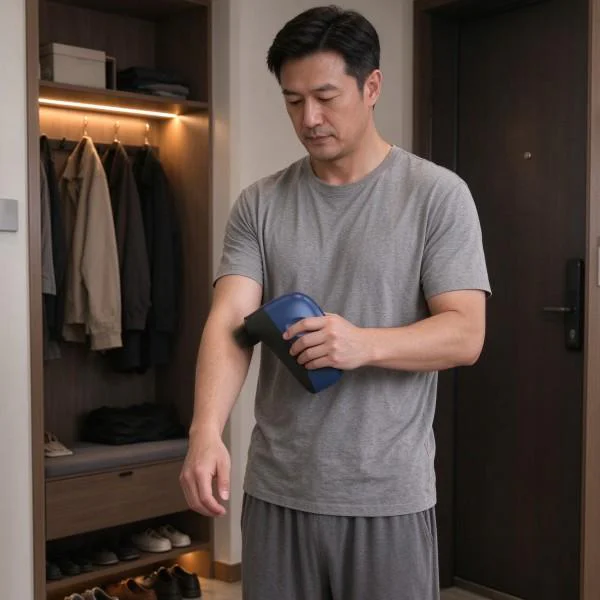
A predictable golfer’s elbow treatment requires resolving the stagnant microvascular environment where forearm flexor tendons fuse to the medial humeral epicondyle. Medial epicondylalgia persists because repetitive mechanical tension compresses regional capillary networks, leaving dense connective tissue starved of oxygen and unable to synthesize strong repair collagen. Targeted 960nm photobiomodulation (PBM) cuts through this tissue barrier, delivering focused photon energy through thick aponeurotic fascia directly to the ischemic bone anchor. Unlike oral pain medications that place a metabolic burden on the liver and kidneys, non-invasive 960nm light stimulates deep vascular clearance without chemical toxicity or rebound irritation.
The Daily Toll of Inner Elbow Soreness and Common Treatment Walls
Living with chronic medial epicondylalgia turns routine hand and wrist movements into an exhausting series of physical compromises. What starts as a mild ache on the inner bump of your elbow quickly escalates into a sharp catch whenever you turn a doorknob, lift a cast-iron pan, pull a suitcase, or grasp an everyday tool.
Work hours and recreational passions become painful hurdles. Typing on a keyboard or operating a mouse creates an uncomfortable pulling tension along the palmar side of your forearm, while swinging a golf club, throwing a ball, or carrying equipment triggers sudden, sharp twinges across the inner joint. Sleep brings little relief: lying on the affected arm or keeping the elbow bent overnight pulls against the irritated tendon anchor, leaving you with an achy joint and stiff fingers that take an hour to loosen every morning.
When people research how to treat golfer’s elbow, many search for an elusive cure for golf elbow, only to hit frustrating walls with conventional options:
Oral Pain Relievers & NSAIDs: Non-steroidal anti-inflammatories temporarily numb pain perception, but chronic medial elbow problems stem from degenerative collagen breakdown (tendinosis), not an acute fluid infection. Routine pill use stresses the stomach and kidneys without rebuilding damaged fibers.
Topical Rubs and Menthol Ointments: Creams and menthol rubs create a temporary cooling or warming sensation on the surface skin, but their chemical compounds cannot pass through the thick fascia to reach the damaged tendon insertion.
Forearm Counterforce Straps: Elastic compression bands dampen mechanical pulling forces while worn, but they act as an external splint rather than rebuilding degraded tendon fibers at the bone.
Aggressive Static Forearm Stretches: Pulling the fingers backward into extreme extension while tendon tissue is cold causes micro-trauma across delicate repair fibers, frequently reigniting sharp inflammation at the bone anchor.
Root Pathology: Microvascular Stagnation at the Medial Enthesis
The persistent nature of medial epicondylalgia comes down to the microvascular anatomy of tendon insertions. Unlike large, well-perfused forearm muscles, tendon-to-bone junctions (entheses) operate as watershed zones with minimal baseline blood supply.
Repetitive Wrist Flexion & Forearm Pronation
                    │
                    ▼
Micro-Fissures at the Common Flexor Tendon Anchor
                    │
                    ▼
Capillary Occlusion & Local Tissue Hypoxia
                    │
                    ▼
Tenocyte Energy Depletion & Acidic Metabolite Pooling
                    │
                    ▼
Disorganized Type III Collagen & Persistent Joint Soreness
When repetitive wrist flexion or heavy gripping produces micro-tears in the flexor origin, surrounding capillary beds collapse under regional swelling. This shuts down local oxygen perfusion.
Deprived of oxygen, specialized tendon cells (tenocytes) cannot generate the adenosine triphosphate (ATP) needed to build strong, load-bearing Type I collagen fibers. Instead, the area fills with fragile, disorganized Type III collagen, while irritants like substance P and lactic acid collect around local nerve endings. Surface ice packs and warm towels cannot alter this state because superficial temperature shifts do not penetrate dense, hypovascular connective tissue.
960nm Light Physics: Reaching Through Dense Tendon Bands
Breaking through deep tendon hypoxia requires an optical wavelength capable of passing through thick superficial layers and dense connective bands without converting to surface skin heat.
Skin & Dermis       ───────────────────────────────
                    │  650nm (Trapped in superficial skin melanin)
Subcutaneous Layer  │  850nm (Disperses in shallow vascular muscle)
                    ▼
Dense Deep Fascia   ════════════════════════════════
Medial Epicondyle   │
& Flexor Enthesis   │  960nm (Minimal scattering in dense collagen;
                    │        deposits photons straight into the tendon core)
                    ▼
While 650nm visible red light aids superficial skin healing and 850nm light supports surface muscle tissue, both scatter significantly when hitting thick, fibrous tendon structures. A calibrated 960nm wavelength operates within an optimal optical window that minimizes melanin absorption and light scattering in dense collagen. This enables photons to penetrate 15mm to 30mm beneath the skin directly into the starved tendon insertion.
Upon reaching oxygen-depleted tenocytes, 960nm light initiates an evidence-based biological cascade:
Mitochondrial Photoreceptor Activation: Photons bind to Cytochrome c Oxidase within the mitochondrial inner membrane, displacing inhibitory nitric oxide and restoring the cellular electron transport chain.
Surge in ATP Production: Revitalized tenocytes access the bio-energy required to synthesize organized, high-strength Type I collagen fibrils, systematically replacing weak scar tissue.
Endothelial Nitric Oxide Release: Photodissociation releases bioactive nitric oxide (eNO), which dilates micro-capillaries to flush out trapped acidic waste products.
Decompression of Nociceptors: Clearing localized fluid congestion relieves mechanical pressure on trigeminal and radial nerve endings, easing the underlying ache.
This approach is grounded in physical rehabilitation engineering, delivering targeted biophysical energy directly to chronically starved connective tissue.
Comparison of Common Relief Approaches
Evaluation Metric
Oral NSAIDs & Cortisone Injections
Cold Compresses & General Red Light (650nm)
Targeted 960nm Photobiomodulation
Tissue Penetration Depth
Systemic distribution via digestive circulation
Surface skin (1–3 mm); blocked by dense fascia
Deep tissue focus (15–30 mm); reaches medial enthesis
Underlying Cellular Impact
Chemical receptor blockage or tissue suppression
Temporary sensory masking via surface heat
Cytochrome c Oxidase activation & collagen fiber remodeling
Negligible danger, but provides no structural repair
Favorable safety profile; non-invasive and non-chemical
Daily Home Usability
Oral pills at home; injections require clinic visits
High convenience with standard household items
High; ergonomic handheld sessions on your schedule
First-Year Financial Impact
Recurring prescription refills and copays ($200–$650+)
Minimal cash spend; high rate of recurring flare-ups
One-time equipment investment; multi-joint family use
Documented Clinical Recovery Record
This detailed clinical record tracks objective improvements during a structured home recovery protocol combining deep-penetrating 960nm light with progressive loading rehabilitation.
Patient Profile & Protocol Baseline
Demographics: 52-year-old male, master residential electrician and amateur golfer
Initial Evaluation: PRTEE (Patient-Rated Tennis Elbow Evaluation) score of 67/100; Maximum Pain-Free Grip Strength: 15 kg (unaffected right side: 46 kg); sharp catching pain when pulling heavy wire through conduits, twisting wire nuts, or gripping a fairway wood
Protocol Parameters: Handheld 960nm PBM unit; direct contact perpendicular to medial epicondyle and common flexor muscle belly; 5 minutes per point (10 minutes total per session); once daily, followed by controlled isometric wrist flexion
Clinical Progress Tracking Log
Tracking Milestone
PRTEE Score (0–100)
Pain-Free Grip Strength (kg)
Functional Range & Daily Task Tolerances
Day 0 (Baseline)
67
15 kg
Unable to use heavy wire cutters without acute catching pain; sleep disrupted by inner elbow ache
Week 1 (Day 7)
53
19 kg
Nocturnal aching settles; morning flexor tightness clears within 15 minutes of waking
Week 2 (Day 14)
35
27 kg
Able to twist conduit couplings with minimal discomfort; coffee mugs lifted pain-free
Week 3 (Day 21)
18
36 kg
Tolerating progressive dumbbell eccentric wrist flexions without next-day soreness
Week 4 (Day 28)
7
43 kg
Full workdays pulling wire completed comfortably; pain-free grip strength within 93% of uninjured arm
“For a full year, pulling electrical cables and tightening conduit nuts sent an agonizing sting straight through the inside of my elbow. Wearing a compression strap all day just squeezed my skin without fixing the root problem. Adding the 960nm wand to my evening routine was the turning point. It delivers a deep, soothing warmth that penetrates right down to the sore bone. Within three weeks, the sharp ache on my inner elbow quieted down completely. I can finally pull wire and swing my golf clubs on weekends without reaching for pain pills.”
— Documented home protocol participant feedback
What to Expect, Safe Application, and Usage Boundaries
Using a medical-grade 960nm handheld device creates a gentle, deeply relaxing warmth within dense joint structures. Because this method uses non-ablative photobiomodulation rather than surgical cutting beams or high-voltage electric currents, you will not experience electrical shocks, sharp skin stinging, or thermal burns.
Who Benefits Most from Home Light Care
Individuals with chronic, recurrent medial elbow discomfort lasting longer than six weeks.
Electricians, mechanics, desk workers, and athletes who need a structured plan for how to treat golfer’s elbow.
Anyone seeking a non-invasive, drug-free golfer’s elbow treatment to reduce reliance on daily pain pills.
Clear Medical Boundaries and Precautions
Active Cancerous Tissue: Never direct the light beam over suspected or known skin lesions or tumors.
Acute Local Infections: Avoid treating areas displaying intense heat, bright redness, visible drainage, or open skin tears.
Implanted Medical Electronics: Do not place the light output directly over cardiac pacemakers or implanted nerve stimulators.
Active Bleeding: Do not use over fresh hematomas or regions with active tissue hemorrhage.
Stage 1: Microvascular Activation (Weeks 1 - 2)
├── Daily 960nm sessions (10 mins) to clear ischemic metabolic waste
├── Gentle isometric wrist flexions (pain-free static holds, 5 reps x 30s)
└── Calming of sharp gripping pain and morning flexor stiffness

Stage 2: Collagen Realignment & Loading (Weeks 3 - 4)
├── Apply 960nm light directly before loading exercises to boost tissue elasticity
├── Progressive eccentric training (slow downward wrist drops with light resistance)
└── Steady recovery of daily grip stability and functional lifting power

Stage 3: Functional Durability & Long-Term Maintenance
└── 2 sessions weekly after strenuous work to prevent micro-injury buildup
The Cost Reality of Modern Tendon Recovery
Outpatient physical therapy clinics and specialized shockwave courses typically charge between $110 and $220 per appointment, rapidly exceeding $1,200 for a standard treatment block. A dedicated 960nm handheld device provides professional physical therapy parameters at home, delivering repeatable relief for everyday joint and tendon strain across the entire household.
Practical Questions Answered
When should I perform forearm exercises relative to the light session?
Use your 960nm device immediately before starting your exercises. The light stimulates local blood flow and boosts tissue elasticity, making the flexor tendon more pliable and receptive to gentle eccentric exercises without triggering muscle guarding.
Why does 960nm light work better than an electric heating pad?
An electric heating pad transfers heat only to superficial skin layers, which dilates cutaneous capillaries without reaching deep, dense fascia. The 960nm near-infrared beam bypasses surface water absorption, depositing therapeutic photons directly into the deep tendon anchor.
How soon can I expect my grip strength to improve?
Most individuals notice an easing of sharp twinges within 7 to 10 days of consistent daily application. Substantial improvements in functional grip strength typically develop between weeks two and four as healthy, organized Type I collagen fibers take hold.
Peripheral facial nerve palsy lingers because the inflamed seventh cranial nerve swells inside the narrow, unyielding Fallopian canal, crushing its own microvascular supply and trapping axons in metabolic paralysis. Targeted 960nm photobiomodulati...
Successful treatment of enlarged prostate symptoms often stalls because deep pelvic stromal tissue becomes locked in a cycle of venous congestion, localized oxygen starvation, and chronic smooth muscle tension. Targeted 960nm photobiomodulation (P...
 Handheld Home-Use Therapy Device