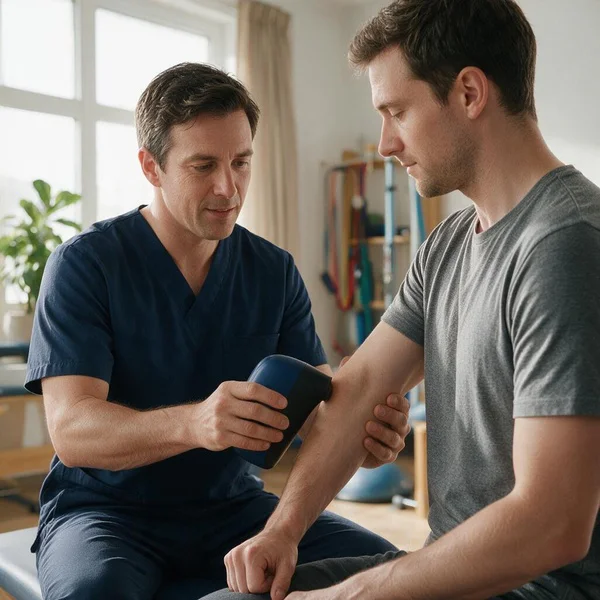
Lateral epicondylalgia becomes a chronic cycle when repetitive extensor strain creates angiofibroblastic tendinosis, choking capillary perfusion at the common extensor origin where blood supply is naturally sparse. While searching for how to treat tennis elbow at home often leads to topical gels or braces, targeted 960nm photobiomodulation (PBM) delivers near-infrared photon energy through dense aponeurotic tendon layers to reverse microvascular ischemia at the mitochondrial level. Because optical irradiation works purely through photochemical absorption rather than systemic drug pathways, it promotes tendinous tissue regeneration without stomach irritation, renal toxicity, or pharmacological tolerance risks.
The Daily Frustration of Grip Failure
Lateral epicondylitis makes routine movements surprisingly difficult. Picking up a full coffee pot, turning a stiff door handle, clicking a mouse, or lifting a grocery bag sends a sharp, sickening ache along the outer elbow that radiates down into the forearm extensors. By evening, a throbbing ache settles over the bony lateral epicondyle, making it tough to relax or fall asleep without keeping your arm in an awkward, braced position.
Standard self-care measures frequently run into physiological limits:
Oral NSAIDs and analgesic creams temporarily dull local pain receptors, but ongoing use risks peptic ulcers and blunts natural collagen remodeling pathways.
Forearm counterforce braces shift mechanical load slightly downward, yet wearing them all day compresses the radial nerve and creates forearm stiffness without repairing tendon micro-damage.
Cortisone injections quiet synovial swelling for three to six weeks, but studies reveal high recurrence rates along with tendon collagen thinning and increased rupture risk.
Standard heating pads and superficial hot towels produce temporary skin flushing, but the thermal energy dissipates entirely in subcutaneous fat without penetrating the avascular extensor tendon junction.
Finding what helps tennis elbow recover means moving beyond surface numbing and targeting the deeper tendon origin where metabolic repair has stalled.
Root Pathology: The Metabolic Deadlock of Tendinosis
Chronic tennis elbow is not an acute inflammatory condition; it is a degenerative tendon state marked by disordered fibroblastic proliferation, microvascular compromise, and collagen breakdown. The extensor carpi radialis brevis (ECRB) origin has a watershed hypovascular zone that struggles to repair itself after repetitive micro-trauma.
As damaged tendon fibers accumulate disorganized type III collagen and ground substance, interstitial pressure rises within the tendon sheath. This physical tension pinches local microcapillary beds, cutting off the oxygen supply needed for tissue repair.
Starved of fresh blood flow, tenocytes face a sharp deficit in adenosine triphosphate (ATP), leaving them unable to synthesize organized type I collagen fibrils or pump out inflammatory byproducts. Lactic acid, glutamate, and substance P accumulate in stagnant extracellular fluid, sensitizing peripheral sensory nerve endings. Surface rubs and creams cannot resolve this problem because they do not reach the hypoxic, low-flow zone locked beneath dense fibrous tissue.
960nm Optical Physics: Penetrating the Tendinous Origin
Delivering real therapeutic impact requires light that reaches past superficial layers. Common red wavelengths (630nm to 660nm) scatter inside the epidermis, making them useful for superficial wounds but ineffective against dense joint aponeuroses 15 to 30 millimeters deep. While 810nm and 850nm wavelengths penetrate moderately, they encounter considerable optical scattering when passing through dense, fibrous collagen bands.
The 960nm wavelength falls within an optimal near-infrared optical transmission window. It features low scatter across dense connective tissue and balanced water absorption, allowing photons to penetrate 20 to 35 millimeters through the common extensor origin, radial collateral ligament, and radiohumeral joint capsule.
960nm Near-Infrared Light → Cytochrome c Oxidase Activation → ATP Surge → Nitric Oxide Release → Capillary Perfusion
Once absorbed by mitochondrial Cytochrome c Oxidase (Complex IV) within tenocytes and microvascular endothelial cells, 960nm light triggers key physiological changes:
Recharges Cellular Collagen Synthesis: Photons stimulate electron transport across mitochondrial membranes, increasing ATP production so tenocytes can replace weak, disordered collagen with robust type I fibers.
Releases Endogenous Nitric Oxide (NO): Photons liberate bound nitric oxide from mitochondrial complexes into local microvessels. This relaxes smooth vascular muscle, reopens compressed capillaries, and clears trapped pain metabolites.
Calms Chronic Tendon Irritation: Normalizing cellular bioenergetics clears reactive oxygen species (ROS) spikes, shifting tenocytes out of a chronic degenerative loop and supporting structural tissue recovery.
Physical rehabilitation clinics routinely utilize these light parameters to manage chronic tendinopathy; applying this mechanism at home delivers clinical-grade cellular energy directly to stressed arm tendons.
Comparing Elbow Interventions Across Core Metrics
Core Metric
Oral NSAIDs & Cortisone Injections
Hot Compresses & Basic Red LEDs (630–660nm)
Deep 960nm Photobiomodulation
Tissue Penetration Depth
Distributed systemically; minimal localized focus on dense tendon insertions
1 to 3 mm; scattered within the outer epidermal and dermal layers
20 to 35 mm; passes through dense tendon fibers to the periosteum
Cellular Mechanism
Cyclooxygenase inhibition or broad steroid suppression of immune activity
Mild superficial skin warming; zero mitochondrial enzyme activation
Direct Cytochrome c Oxidase activation, ATP surge, microvascular NO release
Minor; potential skin redness from prolonged surface contact
Non-ionizing, non-thermal light; zero chemical tolerance or tendon weakening
Home Usability
Swallowing pills or scheduling invasive clinic appointments
Wet towels or wired pads limit arm mobility; temporary comfort
Ergonomic handheld session, 10–12 minutes daily from your favorite chair
Annual Cumulative Cost
$300 – $900 annually across clinic co-pays, prescriptions, and braces
Low upfront hardware cost, but delivers minimal deep tissue repair
Single hardware investment providing ongoing household care
Detailed Clinical Case Record
Documented in accordance with outpatient physical rehabilitation tracking standards. Identifying personal data removed.
Patient Background: Male, 47 years old, construction estimator and recreational pickleball player.
Clinical Diagnosis: Chronic Lateral Epicondylalgia, Right Dominant Arm (Duration: 8 months).
Case History: Marked tenderness over the lateral epicondyle, pain on resisted wrist extension (Cozen’s test positive), and inability to carry a briefcase or grip sports equipment. Oral naproxen caused gastric burning; counterforce bracing provided limited daytime relief.
Applied Protocol: Handheld 960nm deep photobiomodulation applied over the ECRB origin, radial head margin, and extensor muscle belly at 12 J/cm² per position, 10 minutes once daily for 6 weeks, paired with gentle progressive eccentric wrist loading. All oral analgesics were discontinued on Day 1.
Objective Clinical Parameters
Measured Parameter
Baseline (Day 0)
Week 2
Week 4
Week 6 (Evaluation Endpoint)
VAS Pain Score during Grip (0–10)
8.5
5.0
2.0
0.5 (Comfortable Grip)
Pain-Free Grip Strength (Dynamometer, kg)
14.5 kg (Severe Deficit)
22.0 kg
34.5 kg
44.0 kg (Symmetrical to Left)
PRTEE Score (Patient-Rated Tennis Elbow, 0–100)
76.5 (High Disability)
48.0
21.5
6.5 (Minimal Symptoms)
Maximal Resisted Wrist Extension Pain
Severe / Catching
Moderate Ache
Mild Tightness
Pain-Free Resistance
Nighttime Awakenings from Elbow Pain
3 to 4 Awakenings
1 Awakening
0 Awakenings
0 (Unbroken Sleep)
User Perspective: Real Feedback from Daily Recovery
“For eight months, lifting anything heavier than a coffee mug sent a sharp jolt through my outer elbow that made me drop whatever I was holding. Typing at my desk for an hour left my whole forearm aching, and shaking hands with clients was genuinely embarrassing. Bracing helped a little during the day, but the pain came right back the moment I took it off. When I added the 960nm device to my evening routine, the difference was obvious. There is no stinging, pulsing, or harsh surface heat—just a deep, soothing warmth that feels like it sinks right into the bone. By the end of the second week, my morning elbow stiffness had cleared up, and I could carry groceries without that familiar catching pain. Adding it right before my daily eccentric stretches made rehabilitation comfortable rather than frustrating.”
— Brian H., 47, Verified Home User, Georgia
Treatment Sensation and Clinical Safety Boundaries
What the Application Feels Like
Applying 960nm light does not create electrical shocks, vibration, or intense skin burning. As near-infrared energy penetrates into dense tendinous fibers and microvessels expand, users experience a mild, relaxing warmth through the elbow and proximal forearm. This comfortable sensation reflects local microcapillary dilation, helping loosen tight extensor musculature without tissue irritation.
Ideal Candidates
Adults managing chronic lateral or medial epicondylalgia seeking non-invasive home care.
Individuals whose daily jobs require extensive computer use, manual dexterity, or tool handling.
People recovering from tendon overload who want to prepare their tissues before doing targeted eccentric loading exercises.
Clear Contraindications
Active Neoplasms: Never shine therapeutic optical sources directly over confirmed or suspected malignant lesions.
Acute Localized Infection: Avoid applying light over elbow areas showing active cellulitis or purulent bursitis.
Direct Electronic Implants: Do not hold the direct optical emitter over cardiac pacemakers or neurostimulators.
Pregnancy: Avoid application directly over the abdominal or lumbosacral regions.
Progressive Recovery Timeline
Weeks 1–2: Perfusion & Decompression Phase
├── Deep microcapillaries dilate to reabsorb trapped metabolic waste
├── Relieves resting forearm tightness and sharp grip spikes
└── Reduces sleep awakenings caused by involuntary arm shifts

Weeks 3–4: Tendon Remodeling & Exercise Phase
├── Increases tenocyte ATP synthesis to lay down organized collagen
├── Primes the extensor tendon for painless eccentric loading
└── Rebuilds pain-free grip strength during daily tasks

Long-Term Maintenance: Functional Durability
├── 1 to 2 weekly sessions maintain healthy tendon circulation
├── Protects the common extensor origin during repetitive tasks
└── Keeps forearm muscles supple and responsive year-round
The Household Economics of Home Airway and Tendon Care
Weekly physical therapy copays, doctor visits, specialty forearm braces, and ergonomic accessories easily exceed $1,200 to $2,500 over a standard recovery cycle. Having a durable 960nm handheld device at home provides reliable tissue management directly from the living room. It works alongside an exercise tennis elbow treatment program, while serving as a reusable wellness device for neck tension, knee stiffness, or shoulder strain for the entire family.
To explore validated optical dosing parameters, multi-joint application protocols, and clinical hardware specifications, review the professional guidance in the complete home rehabilitation protocol.
Frequently Asked Questions
Can 960nm light therapy replace eccentric strengthening exercises?
No; the two approaches work best together. Targeted 960nm light restores local microvascular perfusion, boosts tenocyte ATP, and relieves resting pain. Applying light for 10 minutes beforehand warms the tendon tissue, making subsequent eccentric loading drills (such as reverse wrist curls or flexbar twists) much more comfortable and productive.
How often should I apply the light device to my elbow?
For chronic tendinopathy, a single 10- to 12-minute daily session over the lateral epicondyle and common extensor muscle belly is standard. Once resting pain resolves and grip strength normalizes (typically within four to six weeks), tapering to one or two maintenance sessions weekly helps prevent overuse flare-ups.
Can I use deep light therapy alongside a cold pack after activity?
Yes, using a staggered approach works well. If your elbow feels hot and irritated after heavy gripping or sports, apply a cold pack for 10 minutes to calm surface inflammation. Wait 30 minutes for skin temperature to return to baseline, then run your 960nm light session to encourage microvascular circulation and cellular tendon repair.
Chronic lateral epicondylalgia persists when repetitive wrist extension produces angiofibroblastic micro-tearing at the common extensor origin, leaving the hypovascular tendon attachment in a state of ischemic degeneration. While conventional prot...
Chronic nasal congestion, dull facial pressure, and non-stop airway irritation persist because swollen venous networks and trapped lymphatic fluid lock the nasal turbinates into a physical metabolic stalemate. Conventional antihistamines and corti...
A stubborn blocked milk duct is rarely a simple mechanical plug; it is an inflammatory cascade of localized interstitial edema, vascular compression, and stagnant lymphatic flow around delicate mammary lobules. When looking for a dependable clogge...
 Handheld Home-Use Therapy Device