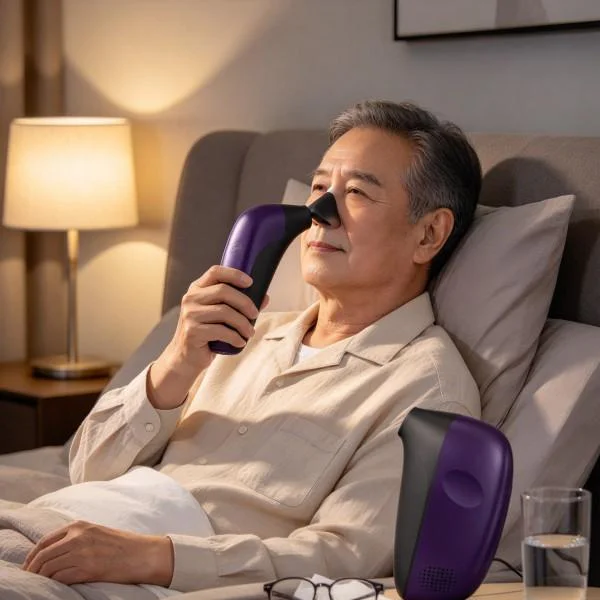
Stubborn sinus congestion persists when narrow ostiomeatal drainage channels swell shut, trapping deoxygenated stagnant fluid within thick mucosal tissues behind facial bones. While standard remedies wash the surface, clinical photobiomodulation (PBM) at targeted 960nm bypasses outer dermal barriers to energize microvascular beds and trigger autonomous mucosal drainage. Unlike oral medications that tax hepatic and renal clearance pathways, non-invasive 960nm light stimulates regional lymph clearance without chemical side effects or drug interactions.
The Daily Toll of Sinus Pressure and the Limits of Quick Fixes
Waking up with persistent sinus congestion means starting the day with an invisible clamp tightening across your forehead and cheekbones. Every time you tilt your head down to tie your shoes or look at a laptop, a heavy wave of pressure surges through your eyes and upper teeth.
Nights are just as exhausting. Airway obstruction forces mouth breathing, leaving you with dry throat irritation, fractured sleep cycles, and brain fog that drains mental clarity by midday. Simple daily activities turn frustrating when your head feels stuffed with wet cotton and breathing freely feels impossible.
Most people trapped in this cycle reach for conventional sinus infection remedies only to hit predictable roadblocks:
OTC Nasal Decongestant Sprays: Fast-acting sprays constrict blood vessels to open airways, but using them longer than three to five days frequently triggers severe rebound swelling (rhinitis medicamentosa), worsening the original blockage.
Oral Pain Relievers: Ibuprofen and acetaminophen temporarily quiet throbbing nerves, but they do nothing to clear mucosal traps or drain trapped fluid while posing long-term stomach and kidney risks.
Warm Washcloth Compresses: While moist heat soothes surface skin, conductive thermal energy dissipates in the top few millimeters of tissue, completely failing to reach deep sinus pockets encased in dense bone.
Saline Flushes and Corticosteroid Mists: Nasal rinses help clear free surface mucus, but they cannot penetrate closed ostea or resolve underlying deep-tissue vascular stasis.
Microscopic Stagnation: The Root of Chronic Facial Blockage
Chronic sinus discomfort rarely stems from a lack of surface cleanliness. Instead, it is a microvascular and metabolic bottleneck locked deep inside the facial skull.
When mucosal lining swells, the micro-openings that drain the maxillary and frontal cavities close. Trapped air is absorbed by surrounding tissue, creating negative pressure followed by secondary fluid exudation.
As tissue oxygen drops, microcapillaries constrict, and regional blood flow slows down. Stagnant fluid accumulates cellular waste products, including bradykinin and substance P, irritating sensitive trigeminal nerve endings. Surface interventions fail because they treat outward symptoms without breaking this deep tissue hypoxia loop.
960nm Photobiomodulation: Physics That Penetrates Bone
Breaking a deep metabolic logjam requires an energy source capable of penetrating dense facial bone without burning overlying skin. This is where precision light physics matters.
Skin Layer        ───────────────────────────────
                  │  650nm (Absorbed by skin melanin)
Subcutaneous      │  850nm (Soft tissue absorption)
                  ▼
Cortical Bone     ════════════════════════════════
Maxillary Sinus   │
Mucosa & Cavity   │  960nm (Minimal water scattering;
                  │        passes through bone to reach mucosa)
                  ▼
Typical red light devices (650nm) and standard near-infrared units (850nm) scatter quickly in human dermis and hemoglobin. By contrast, a calibrated 960nm emission falls within an optical window that minimizes light scattering through bone and dense cartilage. This allows targeted photonic energy to reach the inflamed sinus mucosa.
Once photons reach congested mucosal cells, they drive a clear biological cascade:
Cytochrome c Oxidase Reception: 960nm photons are absorbed by Cytochrome c Oxidase inside mitochondrial membranes, displacing nitric oxide that inhibits respiration.
ATP Energy Restoration: The respiratory chain speeds up, generating cellular ATP needed by ciliated epithelial cells to resume coordinated wave-like clearance of thick secretions.
Microvascular Dilation: Released nitric oxide diffuses into local vessel walls, restoring microcapillary flow and flushing inflammatory byproducts into active lymphatic channels.
Clinical Presentation: Recurrent maxillary and frontal congestion persisting over 2 years; high sensitivity to seasonal allergens; sleep interrupted by unilateral nasal collapse
Initial Assessment: SNOT-22 (Sino-Nasal Outcome Test) score of 62/110; persistent cheekbone tenderness rated 7/10; marked restriction of bilateral nasal airflow
Complete left-nostril blockage at night; heavy pressure when bending
Day 7 (Week 1)
48
5 / 10
Thinning of retained secretions; first unprompted drainage post-session
Day 14 (Week 2)
31
3 / 10
Unbroken sleep without mouth dryness; reduced morning eye-socket ache
Day 21 (Week 3)
18
2 / 10
Normal airflow throughout daytime desk work; smell perception improved
Day 28 (Week 4)
9
1 / 10
Normal mucosal tone; clear bilateral nasal airflow on wake-up
“For two years, every cold turned into weeks of pressure under my eyes that made focusing at my drafting table miserable. The hot compress routine never lasted more than ten minutes. Within two weeks of using the 960nm wand around my cheeks each evening, the heavy, packed-in feeling behind my nose broke up. I can finally sleep through the night without waking up gasping for water.”
— Documented home protocol participant feedback
Treatment Sensation, Practical Guidelines, and Boundaries
Using a handheld 960nm device feels like a gentle, penetrating warmth relaxing tight facial structures. Because this is true photobiomodulation rather than an ablative thermal laser, there is no stinging, electrical vibration, or dermal burning.
Individuals seeking to reduce dependence on drying decongestants or daily pain pills.
Anyone looking for an ongoing sinus infection home remedy to maintain clear airways during seasonal shifts.
Medical Boundaries and Clear Precautions
Active Cancerous Sites: Do not direct light energy over suspected malignant lesions or open skin ulcers.
Acute High Fevers: If facial swelling is accompanied by high fever, severe dental pain, or visual changes, seek immediate emergency medical care.
Implanted Electrical Devices: Avoid operating the light beam directly over pacemakers or neurological implants.
Eye Safety: Always keep eyes closed or wear protective safety goggles when treating paranasal and frontal areas.
Expected Healing Timeline and Real-World Economics
Tissue recovery follows a steady biological path. Consistency yields the best long-term outcomes:
Weeks 1 to 2: Microvascular Restart
├── Easing of sharp orbital and cheekbone tightness
├── Activation of sluggish nasal cilia
└── Initial clearing of trapped, stagnant fluids

Weeks 3 to 4: Mucosal Recovery & Airway Opening
├── Noticeable decrease in submucosal tissue swelling
├── Re-established quiet breathing through both nostrils during sleep
└── Substantial reduction in flare-up frequency

Long-Term Maintenance: Environmental Resilience
└── Brief 5-minute sessions two or three times weekly to support open pathways
Time and Cost Comparison
Routine visits to specialized clinics for sinus irrigation or physical light sessions run between $120 and $250 per visit, not counting travel time and work disruption. A dedicated handheld device provides the same underlying physical therapy parameters in your living room, delivering reliable daily care for multiple family members without ongoing prescription bills.
Practical Questions Answered
Can this light therapy be used right after a saline rinse?
Yes. Using a saline rinse first removes crusts and surface mucus. Following it 5 to 10 minutes later with a 960nm session helps dilate deeper vessels and encourages natural drainage from previously blocked ostia.
What should I do if my nose starts running during a session?
That is a positive sign of mucociliary reactivation. Keep clean tissues nearby, keep your head upright, and allow fluids to clear naturally without forceful nose-blowing, which can push pressure back into inner ear canals.
How often should I use the light once my sinuses feel clear?
Once breathing is open and facial tightness is resolved, drop back to two or three short maintenance sessions per week. This keeps local microcirculation healthy and prevents seasonal triggers from causing fluid build-up again.
Chronic sinus pain persists when constricted microvessels and trapped fluids lock the mucosal lining into a low-oxygen state behind facial bones. Targeted 960nm photobiomodulation (PBM) delivers coherent optical energy through cortical bone struct...
Idiopathic peripheral facial paralysis lingers because inflammatory swelling traps the seventh cranial nerve inside the rigid, narrow Fallopian canal, creating a severe microvascular and metabolic bottleneck. When navigating supportive bell palsy ...
Peripheral facial nerve palsy persists because the swollen seventh cranial nerve remains physically compressed within the narrow Fallopian canal of the temporal bone, choking its microvascular supply and trapping motor axons in an ischemic state. ...
Benign prostatic hyperplasia and chronic pelvic congestion linger because the transition zone of the prostate sits deep within a rigid pelvic floor, where microvascular compression causes localized ischemia and fluid entrapment. Targeted 960nm pho...
 Handheld Home-Use Therapy Device